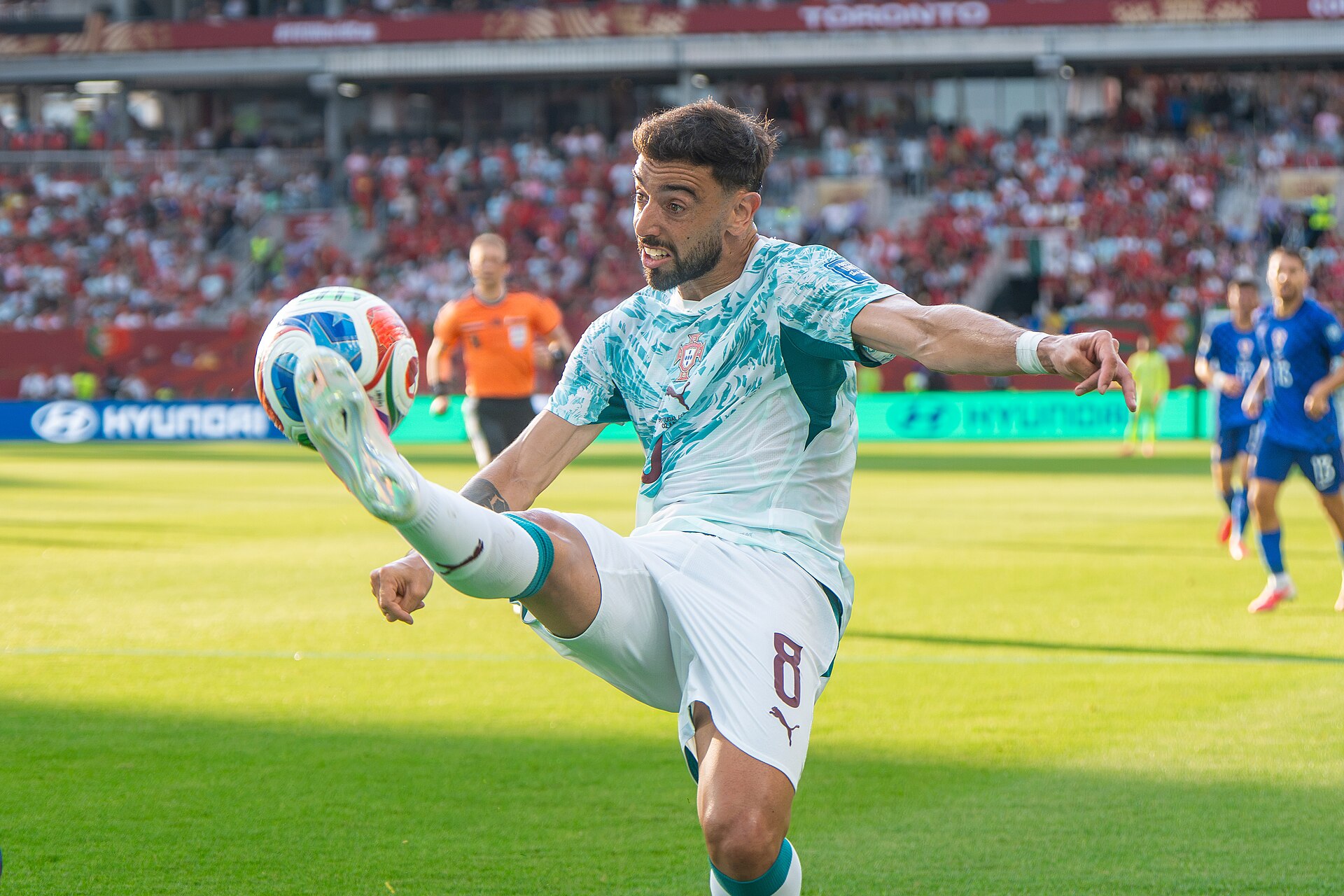
Bruno Fernandes in action against Croatia in July 2026; this archive image does not show the November match in Cardiff. Archive photo by Bryan Berlin (CC BY-SA 4.0).
Portugal closed its Nations League group campaign with a 3–2 victory over Wales in Cardiff on November 17, surviving Pedro Neto’s dismissal after Carlos Forbs supplied the winning goal. The result secured first place in Group A4 and gave Portugal a response to its heavy defeat by Denmark, while Wales was left with another evening of promising attacking moments and costly defensive consequences.
Bruno Fernandes opened the scoring, David Brooks equalized and Sorba Thomas put Wales ahead before Neto made it 2–2. Forbs then decided the contest in the second half. The sequence gave the match two changes of leader and left the home team chasing a final equalizer against ten men. The Football Association of Wales match report.
The result matters beyond the five-goal scoreline. Portugal entered needing a point to guarantee top spot and took all three. Wales had already secured a relegation play-off place, so the match also offered Craig Bellamy another test of how his side could compete with a technically strong opponent. The answer contained both encouragement and a familiar limit: creating chances and controlling decisive moments are different tasks.
For Portugal, the victory was its first since Cristiano Ronaldo’s international retirement. FIFA’s report places Forbs’s winning contribution in that transition, noting that he wore the number seven shirt. The symbolism is striking, but the more immediate value was practical: a substitute produced the goal that settled a difficult away match. FIFA’s report on Portugal and Forbs.
A first half in which neither lead lasted
Fernandes’s opening goal followed João Neves winning possession near the Wales penalty area. Portugal converted that turnover quickly, a reminder of the damage a high-quality opponent can do before a defending team has time to reorganize. Wales’s response came through Brooks after Harry Wilson’s effort was stopped and Rubin Colwill helped keep the attack alive.
Those two moments established the contrast that would run through the evening. Portugal could punish an error with little preparation. Wales could still find routes forward when it connected its attacking players and followed an initial chance. The home side’s difficulty was not an absence of ambition or an inability to reach dangerous positions. It was the challenge of making its good periods survive the next decisive exchange.
Thomas’s goal gave that ambition its clearest reward. Wales combined through Brooks and Wilson before Thomas finished a forward run to put the hosts in front. Neto’s reply at the far post restored parity before halftime. Sky Sports’ account records the same basic first-half pattern: the teams repeatedly answered one another, leaving an entertaining contest unresolved at the interval. Sky Sports’ match account.
For a side trying to establish itself against stronger opposition, the ability to recover from an early setback is important evidence. Wales did more than absorb pressure and hope for a single break. Its attacking contributors gave Portugal problems. But a lead that disappears quickly provides little opportunity to change the shape or emotional direction of a match.
That is the frustration of the first half from a Welsh perspective. Two goals against Portugal should be a substantial return. When the interval arrives at 2–2, the same attacking achievement becomes a question about what was conceded around it. The score does not erase the quality of the forward play; it makes defensive concentration inseparable from any assessment of that quality.
Forbs provided the decisive contribution from the bench
The winning goal came after Forbs collected an unsuccessful defensive header and finished past Danny Ward. The FAW places it in the seventieth minute. Forbs entered a match already full of attacking incidents and supplied the one that ultimately separated the teams. It was an effective use of a substitute in a game that had offered no comfortable margin to either side.
His contribution also changes the emphasis of Portugal’s response to the Denmark defeat. A team recovering from a 4–1 loss needs more than a declaration that it has moved on. It needs actions inside the next match: a way to regain the lead, enough depth to change the game and enough composure to finish the job. The Forbs goal provided the first part of that answer.
Neto’s subsequent dismissal made the remaining task more difficult. Two yellow cards in quick succession left Portugal short of a player for the closing period. The public match accounts differ in some descriptions of the second challenge, so the important established points are the second booking, the red card and the numerical disadvantage. The dismissal did not change the score, but it changed the conditions under which Portugal had to protect it.
A narrow lead with ten men asks different questions from an open eleven-a-side contest. Space and possession become less valuable if using them exposes the team to a transition it cannot cover. The immediate priority becomes controlling the routes by which an opponent can reach the goal. Portugal’s result shows that it completed the task on this occasion, without making the unnecessary dismissal any less costly as a decision.
For Wales, the extra player created an opportunity rather than an entitlement. It still needed a clear final action against an opponent protecting a small advantage. The late pressure did not produce the third goal. That is a useful reminder that numerical superiority changes the problem to solve; it does not solve it automatically.
What the result says about Portugal’s transition
Ronaldo’s absence inevitably gives Portugal’s next phase a powerful narrative. Yet the team’s immediate success cannot be assessed only through the shirt number left behind. Fernandes scored, Neto scored before being sent off, and Forbs supplied the winner. The result came through several contributors, which is the more useful sporting fact beneath the symbolism.
Forbs wearing number seven makes the winning goal memorable, but it should not place an entire national transition on one player. A decisive substitute appearance is an important contribution in its own right. It does not require a premature judgment that he must reproduce another footballer’s role, style or career. Portugal’s task is to build a functioning team from its current players.
The group finish gives Jorge Jesus a positive outcome to take into the next stage. Portugal won five of its six league-phase matches. That record can coexist with concern about the defeat to Denmark and the avoidable red card in Cardiff. A strong points total describes a successful campaign; the weaknesses visible within it still matter against the opponents waiting in the knockout phase.
The value of the Wales match is therefore mixed in a productive way. Portugal demonstrated that it could respond after losing a lead, draw on its bench and protect a narrow advantage under pressure. It also created a closing problem that better discipline could have avoided. A professional assessment should preserve both parts rather than turn the win into a claim that the transition is complete.
UEFA’s official results provide the wider group context, including Norway’s victory over Denmark on the same evening. The next phase will bring a different competitive setting from six league matches. First place is a meaningful achievement, but it is a starting position for the next test rather than an answer to it. UEFA’s league-phase results.
Wales has attacking evidence—and a play-off to prepare for
Wales finishes the group with one win and five defeats. The record is difficult, but the Cardiff performance shows why Bellamy can still point to parts of the team’s play worth developing. Brooks and Thomas scored, Wilson remained involved in threatening moments and Colwill’s contribution was recognized by the FAW as the home side’s player-of-the-match performance.
The challenge is turning those episodes into a result that holds together. Against a strong opponent, a small error can outweigh a long period of competent work. The team does not need to abandon the combinations that created its goals. It needs the defensive decisions around those combinations to make the attacking work count for more.
The broader calendar-year record adds urgency. Sky’s account gives Wales one victory, three draws and six defeats across ten matches in 2026. That is a different measure from the six-game Nations League table, but it reinforces the pressure to turn a competitive performance into a dependable result. The next window will offer a practical test of whether the lessons from these close passages of play have become habits.
Its next Nations League route is a play-off. The FAW says the draw takes place November 20 and the matches are scheduled for March 2027. UEFA’s regulations make the play-offs a two-leg contest, with the higher-league side seeded. Those rules are important context for a fourth-place finish: this is a route through a further competitive tie, rather than a reason to assume an automatic outcome from the group position alone. UEFA’s play-off regulations.
Bellamy also has individual experience to take from the evening. Ward made his fiftieth senior appearance, and Aaron Collins made his debut. Milestones do not change the score, but they contribute to the team’s development and the range of players available for the next window. The practical work now is to decide which relationships and roles can be made more reliable before the March tie.
The conclusion is that Portugal earned the result through a decisive substitute and a successful defense of a narrow lead, while Wales produced enough going forward to make the defeat frustrating rather than empty. Forbs supplied the winning moment; Neto’s red card supplied an avoidable complication. Portugal advances as group winner, and Wales moves toward a play-off with a clear priority: make its encouraging attacking football survive the mistakes that have repeatedly undone it.