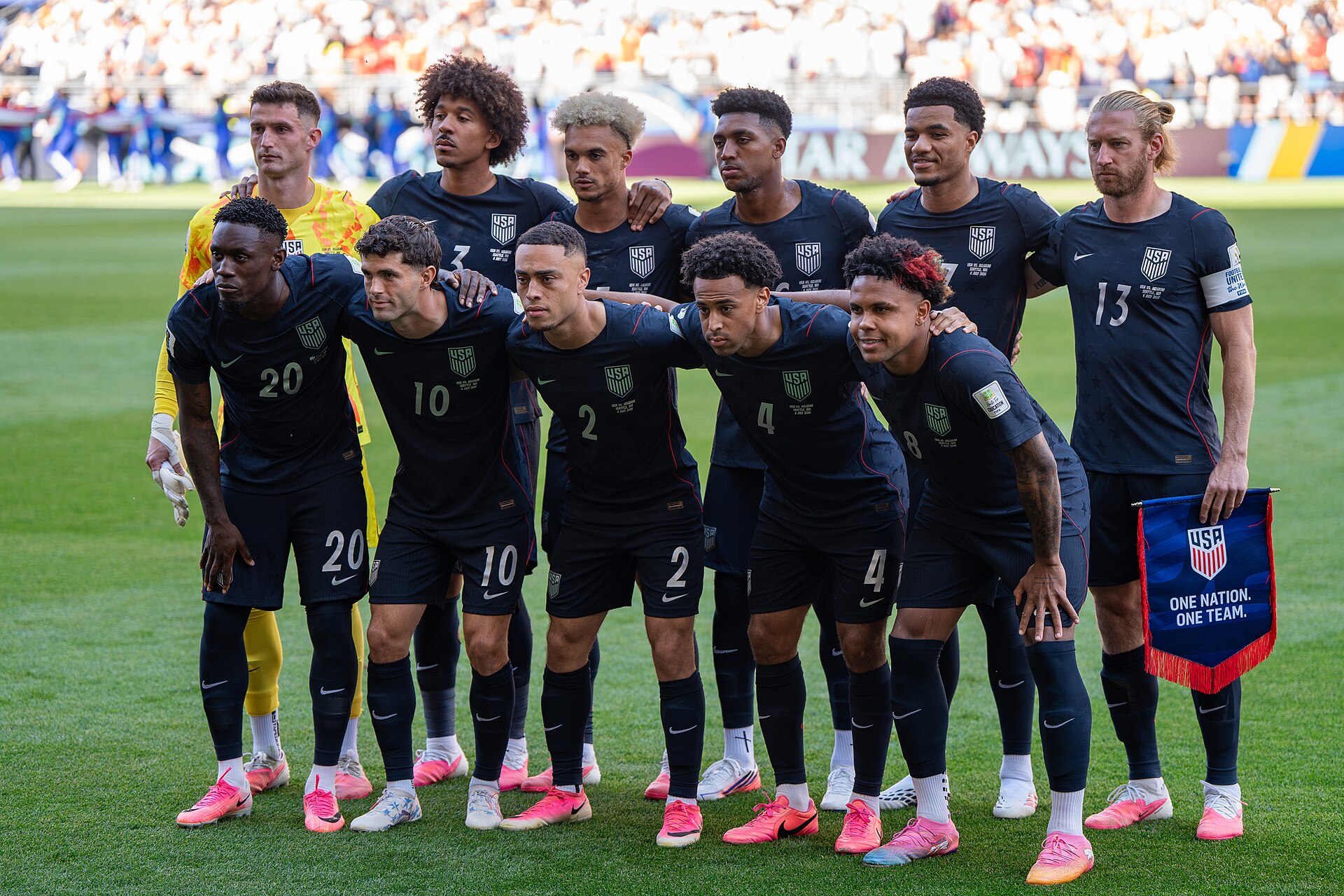
Erling Haaland before Norway’s match against Morocco in June 2026; this archive photograph does not show the Copenhagen game. Archive photo by Bryan Berlin (CC BY-SA 4.0).
Norway turned a two-goal deficit into a Nations League quarterfinal place on November 17, beating Denmark 3–2 in Copenhagen through a late Erling Haaland penalty. Haaland scored twice and Martin Ødegaard supplied the equalizer, reversing a match that had begun with Denmark apparently in control of both the score and its route through Group A4.
Rasmus Højlund and Pierre-Emile Højbjerg gave the hosts a 2–0 lead early in the first half. Haaland reduced the deficit before the interval, Ødegaard made it 2–2 late in the second half and the stoppage-time penalty completed the turnaround. The final result is recorded in UEFA’s league-phase results. UEFA’s official results.
The importance of the final goal was larger than the difference between a draw and a win on one evening. Norway needed to turn a difficult group position into qualification, and it did so in the home of the team directly in its way. Denmark had a substantial advantage inside the match and could not preserve it. That is why the result will be remembered as a major recovery for one side and a severe missed opportunity for the other.
AS’s match account records a handball decision against Joachim Andersen before Haaland converted the penalty. The live providers reviewed differ on exact minute labels, so this report describes the winner as a stoppage-time penalty rather than presenting inconsistent timestamps as a settled fact. The sequence and the final 3–2 score are consistent across the accounts. AS’s final match account; TNT Sports’ score and scorers.
Denmark’s early lead made Norway’s task much harder
The opening goals came from two different Danish threats. Højlund supplied the first, and Højbjerg added the second. For Denmark, that created the opportunity to manage the contest from a strong position. For Norway, it changed the immediate problem from finding a winning goal to preventing the match from moving beyond recovery while still generating enough attacking pressure to respond.
A two-goal lead early in a decisive match can change the balance of risk. The leading side has less need to force every attack and more reason to choose when to advance. The trailing side has to pursue the game while remaining vulnerable to a third goal. The score therefore gives Denmark’s eventual defeat a particular weight: it lost an advantage that should have provided options.
Norway’s first reply mattered because it arrived before halftime. At 2–1, the interval could become an opportunity to reorganize around a reachable target. A two-goal deficit would have required a much larger second-half swing. Haaland’s goal did not erase the opening problems, but it prevented those problems from defining the only possible story of the evening.
The accounts also record a Norwegian goal being disallowed earlier in the half. That interruption to the comeback is significant because the team still found a legitimate response afterward. The useful conclusion is about persistence inside the contest, rather than an unsupported claim about what players were feeling. The recorded sequence shows Norway continuing to produce incidents near Denmark’s goal despite the setback.
For Denmark, halftime at 2–1 was still a position from which to qualify. Its first-half attacking work had created something valuable. The question was whether it could combine that advantage with enough control after the break. As the second half developed, Norway kept the result within one goal, preserving the possibility that a single successful attack could change the group picture.
Ødegaard changed the match before Haaland settled it
Haaland’s two goals naturally dominate the headline, but Ødegaard’s equalizer was the hinge of the second half. Before it, Denmark still had a lead to protect. After it, the closing minutes carried a different pressure for both teams. Norway had a route to the victory it needed; Denmark had to respond to a game that had moved away from its early shape.
The equalizer came during a phase in which the match accounts also record Norwegian attempts striking the post. Those incidents show why the final penalty should not be treated as an isolated event that emerged from an otherwise quiet second half. Norway continued to create danger, even while the score remained against it. The late goals were the decisive return from that pursuit.
There is an important difference between saying Norway kept threatening and claiming it controlled every part of the match. Denmark had built the lead and retained attacking possibilities of its own. A comeback can be deserved through the chances it creates without requiring a simplified account in which the eventual winner was always the better side in every period.
Once the penalty was awarded, the match narrowed to a familiar but demanding situation: a striker, a goalkeeper and a single attempt carrying consequences for an entire campaign. Haaland converted. The fact that he is an established scorer does not make that outcome automatic. The value of the action is that he completed the specific task when qualification depended on it.
The winner also changed how every earlier event would be remembered. At 2–2, Norway’s recovery might have been discussed as an admirable effort that still fell short. At 3–2, the same recovery became the route into the quarterfinals. Small differences in the final score can produce large differences in the meaning attached to a performance.
That is particularly true for Denmark. An early two-goal advantage, a halftime lead and a late penalty concession now form the outline of a result it will want to examine closely. The analysis should concern how that advantage was lost and how the opponent kept reaching dangerous positions, rather than reduce the entire evening to the last decision.
The group context makes the comeback more significant
Norway had already beaten Denmark 3–2 in the opening group meeting in September. The November result therefore completed two wins against the same opponent, producing six points from those encounters. In a close group, those direct meetings can carry exceptional weight. A team can have a mixed overall campaign yet gain a decisive advantage against its nearest competitor.
The Norwegian federation’s team pages provide the official context for the campaign and the Copenhagen fixture. The sequence also included a 3–1 victory over Wales in the previous match. That gave Norway a platform for the final night, but it still required a result away to Denmark to turn the opportunity into progress. The Norwegian federation’s senior-team information.
Portugal’s victory in Cardiff confirmed its own position as group winner. Norway’s task was separate and more immediate: finish the Danish match in a position that secured the remaining quarterfinal place. The result shows the value of concentrating on the direct contest even while another match determines the wider table.
For readers, the table should be understood through the competition’s rules rather than through goal difference alone. Close standings can depend on the prescribed tie-break order, including direct results. Norway’s two victories over Denmark are therefore central to the story of progress, not incidental details beneath an overall scoring comparison.
The outcome is also a reminder that qualification narratives can change very late. A team’s position early in the evening is provisional while matches are still being played. Denmark’s 2–0 lead was a substantial sporting advantage, but it was not a completed qualification result. Norway’s final goals turned that distinction into the defining fact of the night.
What each team should take from the result
Norway can take evidence of recovery under severe competitive pressure. Its leading scorer delivered twice, its captain supplied the equalizer and the team continued to find a route forward after falling behind. Those contributions offer a stronger basis for confidence than a general claim that belief alone decided the match. The goals are identifiable actions inside a demanding situation.
There are also questions the winner should keep. Conceding twice early made qualification much harder than it needed to be. A dramatic recovery does not make that opening harmless. Against a different opponent, the same start might leave too little time or too few chances to repair the damage. Progress gives Norway another stage on which to improve that part of its performance.
Denmark’s review has a different starting point. The team demonstrated the ability to hurt Norway early, so the lesson is not simply that it lacked attacking quality. The more difficult issue is sustaining a favorable position as the opponent changes the game. That involves decisions about pressure, territory, substitutions and how to defend the most dangerous areas as the match tightens.
The final penalty will receive particular scrutiny because it settled the result. It should be assessed as part of the whole defensive sequence rather than treated as a complete explanation for a three-goal reversal. A team that has led 2–0 needs to examine the route by which the match reached that final crisis as well as the crisis itself.
The quarterfinal place now gives Norway a concrete next objective. A knockout tie will bring its own circumstances, and the Copenhagen comeback does not forecast an automatic result there. It does provide a demanding competitive experience on which the team can draw: a match in which the first plan went badly, but the final outcome still changed.
The conclusion is that Norway earned a memorable 3–2 victory by continuing to create a route back after Denmark’s early two-goal lead. Ødegaard restored parity, Haaland completed the turnaround from the penalty spot and the result delivered the quarterfinal place. Denmark’s failure to protect its advantage is the other half of the story. For Norway, the celebration is justified—and the clearest next lesson is to make the next decisive match require less rescue work.