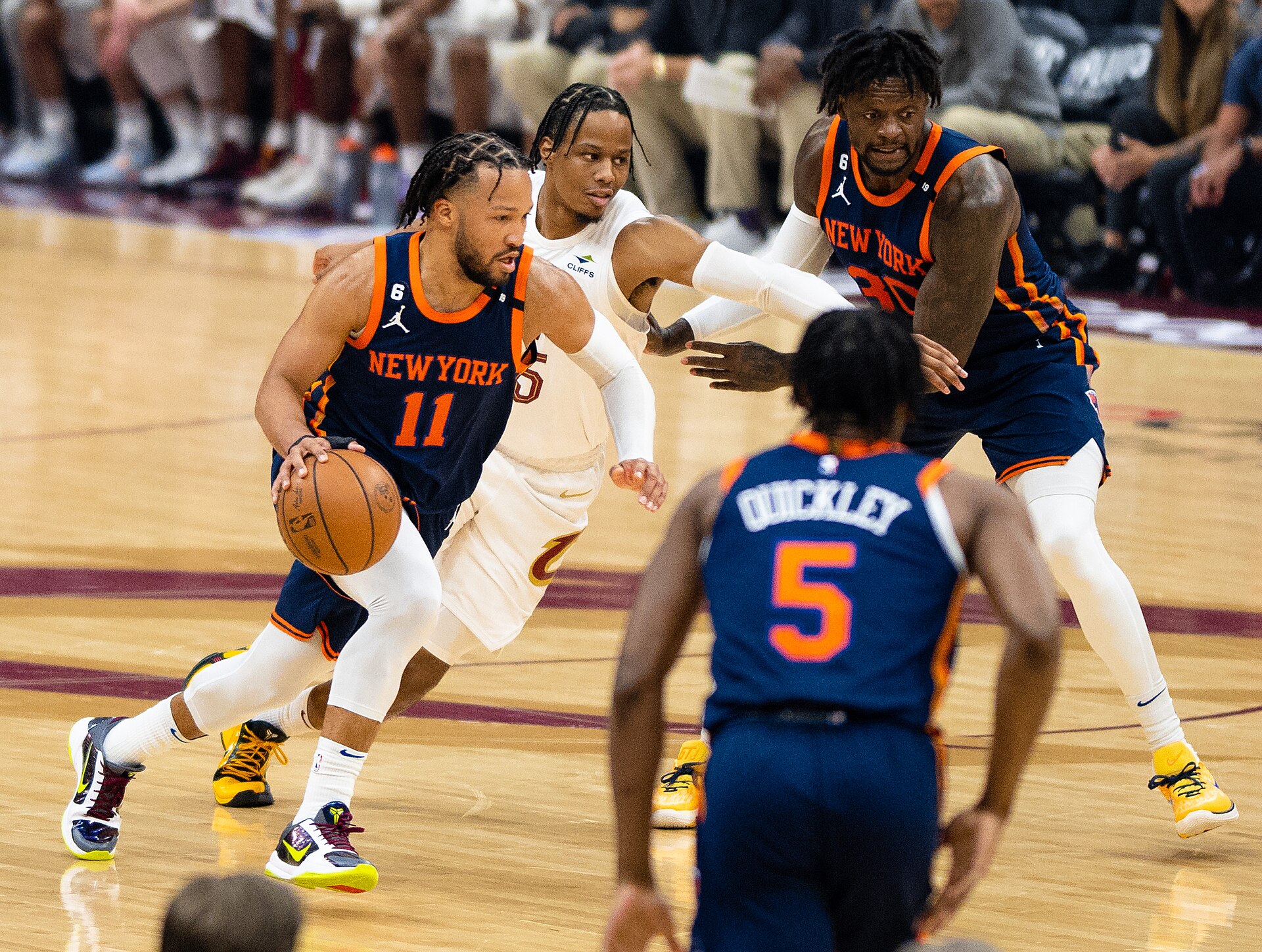
Jalen Brunson attacks the basket against Cleveland on April 26, 2023. This archive photograph is not from the November 17, 2026, game in Toronto. Archive photo by Erik Drost (CC BY 2.0).
TORONTO — Jalen Brunson scored 31 points, Karl-Anthony Towns supplied the possessions that kept New York alive, and the Knicks finished with nine unanswered points to beat the Toronto Raptors 111–102 on Tuesday night. A game Toronto led after three quarters became New York's 15th consecutive victory in the matchup, decided by a late combination of offensive rebounding, a difficult Brunson three-pointer and free throws the visitors converted when the home team could not.
The final margin obscured how close the contest remained. Toronto and New York were tied at 102 with 1:39 left. Brunson then hit a three-pointer, drew a flagrant foul on Ja'Kobe Walter and made the accompanying free throw. Landry Shamet added two free throws, and Mikal Bridges delivered the three-pointer that completed the scoring with 36 seconds remaining. The NBA's official play-by-play records a finish that turned an even game into a nine-point New York win without another Toronto basket.
Brunson's scoring led the result, but Towns' 16 points, 16 rebounds and eight assists gave it its structure. Six of his rebounds came on the offensive glass. Bridges scored 17, OG Anunoby had 16 and Shamet contributed 12 from a bench that doubled Toronto's reserve scoring. New York improved to 8–6; Toronto fell to 5–9 with its fifth consecutive defeat.
Walter scored 25 points and made seven three-pointers for the Raptors. RJ Barrett added 22, Scottie Barnes 20 and Immanuel Quickley 14. Toronto shot 50 percent from the floor and 40 percent from three-point range, figures that ordinarily provide a strong foundation. Its problems lay elsewhere: too many New York second chances, too little reserve scoring and a 10-for-18 night at the free-throw line. The official box score shows a defeat that cannot reasonably be explained as poor shooting alone.
How the Knicks changed the game in the fourth quarter
Toronto won the opening quarter 29–23 before New York responded with a 31–21 second period, taking a 54–50 lead into halftime. The Raptors reversed the direction again in the third, scoring 33 points and carrying an 83–80 advantage into the final quarter. Neither side had established control that was durable enough to survive the other's next sustained response.
The fourth quarter supplied the separation. New York outscored Toronto 31–19, a 12-point swing that more than erased its three-point deficit. That is the essential period in the NBA's game record: a visiting team that had surrendered 33 points in the third limited the same opponent to 19 in the fourth, while keeping its own offense productive. The Raptors' opportunities did not disappear, but their scoring stopped at precisely the moment New York found a reliable closing sequence.
With just over four minutes remaining, Anunoby made a three-pointer from a Towns assist to tie the score at 98. Toronto moved back in front on a Collin Murray-Boyles driving layup. Towns then recovered a missed Brunson shot and finished the putback that made it 100–100 with 2:56 left. That possession captured his importance more effectively than his point total: a New York miss became another opportunity, then a tie, rather than a Toronto chance to extend its lead.
Brunson subsequently hit a step-back jumper for a 102–100 advantage. Barrett answered with a driving layup, setting up the final tie. At that stage the outcome was still entirely open. New York's eventual nine-point margin should not be read backward as evidence that Toronto was already beaten. The final 85 seconds produced the result, rather than merely confirming something that had been inevitable all evening.
The most consequential possession came at 1:25. Brunson's three-pointer put New York ahead 105–102, and Walter was assessed a flagrant-one foul on the play. Brunson's free throw made it 106–102. Shamet's subsequent trip to the line added two more points before Bridges supplied the last three. New York's closing production thus came from three players and several different actions, even though Brunson made the shot that broke the tie.
Brunson's scoring and Towns' work between the highlights
Brunson finished 10 for 22 from the field, four for 11 from three-point range and seven for seven at the foul line. He also recorded five rebounds and five assists. His perfect free-throw shooting mattered in a contest ultimately separated by nine points, particularly because Toronto left eight of its 18 free throws unconverted. New York did not need every possession to end with a spectacular shot; it needed its scoring chances to remain dependable as the margin narrowed.
Towns took only nine shots and made seven. He was one for two from three-point range and converted his lone free throw. Those numbers describe efficiency, but his larger contribution was the combination of scoring, recovery and distribution. An eight-assist night from a player who also collected six offensive rebounds means New York was receiving value both when its initial offense worked and when it broke down.
His late assist to Anunoby and his putback at 2:56 were different solutions to the same problem. One generated a clean scoring opportunity for a teammate; the other rescued a possession after a miss. Towns also assisted Brunson's decisive three-pointer. It would be misleading to reduce his evening to a supporting role simply because Brunson scored almost twice as many points. The two players influenced different stages of New York's possessions.
Bridges' 17 points came on seven-for-11 shooting, while Anunoby made five of 11 attempts and added two blocks. Their contributions prevented Toronto from treating the game exclusively as a Brunson scoring problem. The closing three-pointer from Bridges was especially useful because it extended the margin from six to nine, leaving the Raptors with little time and a much more demanding comeback requirement.
Shamet supplied the most productive reserve scoring, making four of seven shots, including two of four from deep, and both of his free throws. Andre Drummond scored only two points but collected eight rebounds, three on offense, in fewer than 11 minutes. Towns and Drummond together accounted for nine of New York's 12 offensive rebounds. That is an important distinction between scoring the basket and helping make the basket possible.
Why Toronto's shooting was not enough
Walter's seven three-pointers produced 21 of his 25 points. He finished nine for 15 from the field and seven for 12 from beyond the arc, providing Toronto with its most potent perimeter performance. Barrett added two threes, Quickley two and Barnes one. The Raptors made 14 of 35 three-point attempts, compared with New York's 12 of 35, earning a six-point advantage from that part of the floor.
But New York made 29 two-point baskets to Toronto's 25, an eight-point advantage inside the three-point line. Put those two components together and the Knicks' field goals produced 94 points to the Raptors' 92. Add New York's 17 free throws against Toronto's 10 and the final nine-point difference becomes clear. This arithmetic does not explain every tactical decision, but it identifies why Toronto's superior three-point total did not translate into a win.
The free-throw disparity concerned conversion as much as opportunity. New York attempted 19 and Toronto 18, nearly the same number. The Knicks made 89.5 percent; the Raptors made 55.6 percent. Barrett was two for six, while Barnes converted five of six. Changing any one outcome would also change what followed, so missed free throws cannot be treated as a simple alternate score. They were nevertheless a substantial lost opportunity in a game tied in its final two minutes.
Toronto also received 13 points from its bench against New York's 26. The Raptors' starters actually outscored the Knicks' starters 89–85. Those totals should not be mistaken for a direct comparison of separate units, because starters and reserves share the floor in changing combinations. They do show that Toronto's four double-figure starting scorers were not enough to offset the contribution New York received elsewhere.
The Raptors committed only five individual turnovers in the box score, compared with New York's 12, and recorded 27 assists against the Knicks' 25. Those are meaningful positives for Toronto. They also make the result more revealing: the Raptors were not simply careless throughout the night. They protected the ball and created shots, but failed to finish enough possessions with a defensive rebound or a made free throw to protect their late position.
What the result means for both teams
The 15-game winning streak over Toronto gives New York a striking historical marker, but Tuesday's win was earned through a much narrower present-tense contest. A long series streak does not score points on the next possession. The useful takeaway for the Knicks is that they recovered from a difficult third quarter, received production beyond their leading scorer and executed the final stretch after Toronto had repeatedly drawn level or moved ahead.
For the Raptors, a fifth straight loss raises the cost of mistakes that might otherwise be absorbed across a healthier run of results. Walter's outside shooting, Barrett's 22 points and Barnes' 20 were real production. So were the advantages in three-pointers and individual turnovers. Toronto's task is to preserve those strengths while addressing the possessions it conceded on the glass and the points it left at the line. The game was competitive enough to make those details decisive.
The conclusion is straightforward: New York won because its final-quarter response was broader than a single hot shooting stretch. Brunson delivered the decisive shot, Towns extended and connected possessions, and the supporting cast supplied points that Toronto's bench could not match. At 102–102 the game still belonged to either team. The Knicks then scored the last nine points, turning a contested road night into a 111–102 victory and extending a matchup streak that Toronto remains unable to break.