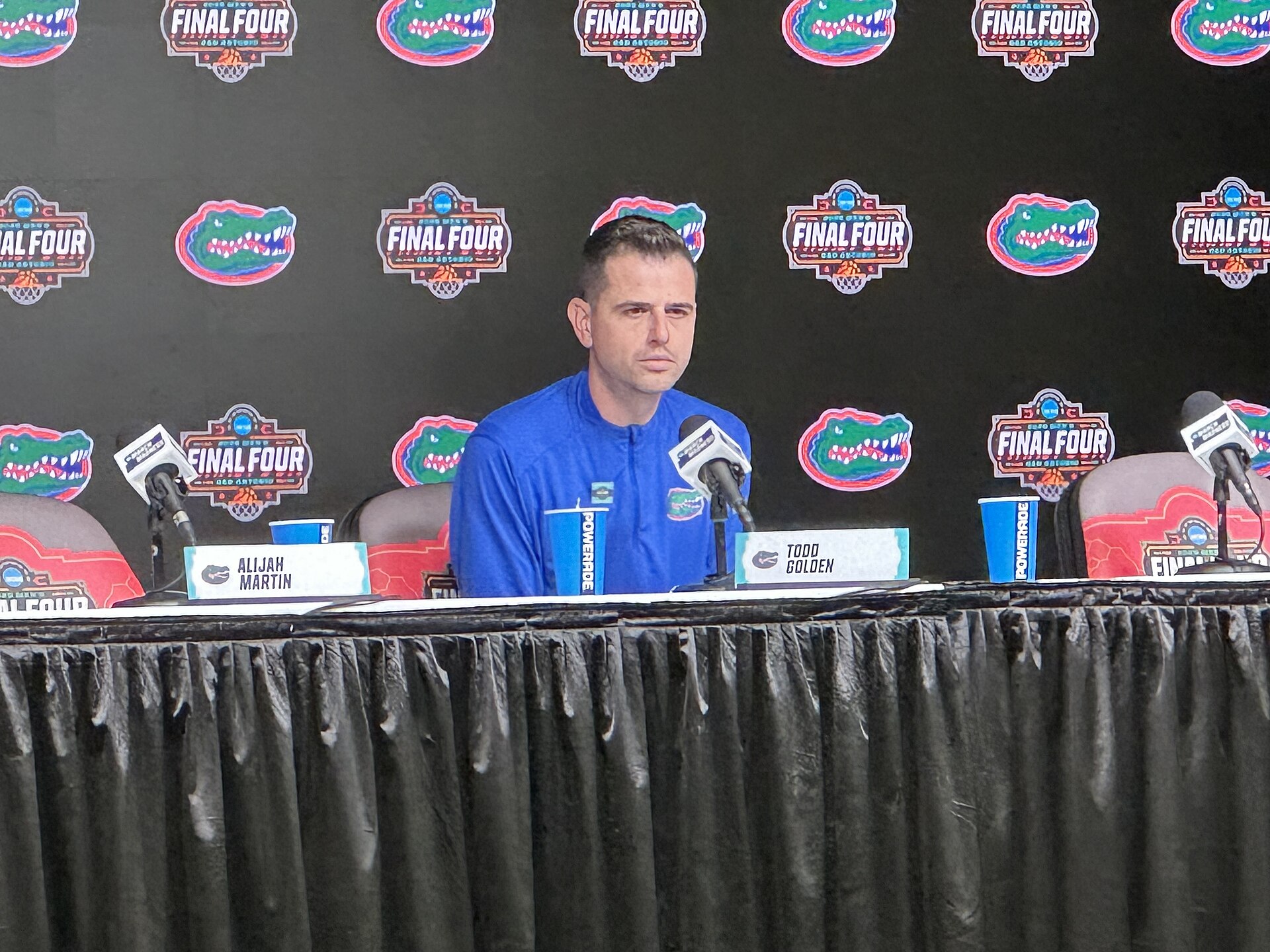
Florida coach Todd Golden at the 2025 Final Four in San Antonio; this archive image does not show the November 2026 game in Las Vegas. Archive photo by Gatorfan252525 (CC BY-SA 4.0).
No. 1 Florida beat Notre Dame 86–78 in Las Vegas on November 17 behind a career-high 24 points from Urban Klavzar, whose contribution became more important after point guard Boogie Fland left with a shoulder problem. The Gators improved to 5–0 in the opening round of the Players Era 8, while Notre Dame fell to 4–1 after making a serious second-half challenge.
The score was closer than Florida’s first-half control suggested. The Gators led 47–32 at halftime and never trailed, but Notre Dame cut the deficit to two in the second half before Florida responded. The decisive foundation was on the glass: a 38–22 rebounding advantage helped produce a 26–6 edge in second-chance points. Florida’s official match report.
Alex Condon added 19 points, ten rebounds and five assists. Thomas Haugh finished with 14 points, nine rebounds and four assists, while Denzel Aberdeen supplied 13 points. Notre Dame’s Braeden Shrewsberry led the Irish with 20, including five three-pointers, and Brady Koehler added 17. The official box score records the game at Michelob ULTRA Arena. The official final box score.
For Florida, the evening demonstrated the value of depth while creating an immediate question about Fland’s availability. For Notre Dame, it showed enough shooting and resilience to threaten the top-ranked team, alongside a rebounding deficit that repeatedly undermined the comeback. Those are distinct lessons within the same eight-point result.
Klavzar supplied scoring when Florida needed a replacement
Klavzar’s 24 points came from five made field goals, including three three-pointers, and an 11-for-11 performance at the foul line. That combination is important to the shape of his night. He did not rely only on making a high volume of shots from the floor; he also converted every free throw he received.
Eleven of the 24 points came at the line, nearly half of his total. In a game Florida won by eight, that reliable conversion had obvious value. The point is not that any individual free throw can be isolated as the reason for the result. It is that a substitute’s ability to turn opportunities into certain points helped preserve the advantage through a competitive second half.
The team total reveals another useful distinction. Florida finished 20-for-29 at the line. Subtracting Klavzar’s perfect eleven leaves his teammates a combined nine makes in eighteen attempts, or 50 percent. That calculation shows both the value of his individual accuracy and an area the Gators can improve. The overall win does not make those missed points disappear, particularly with another demanding opponent arriving the following day.
His role expanded after Fland’s problem. Florida’s report says Fland aggravated a sore right shoulder that had already kept him out of the previous game against Merrimack. That describes the reported concern, without establishing a new medical timetable. Klavzar then played almost 31 minutes and supplied the scoring that kept the offense productive.
The performance also placed a familiar strength in a new situation. Florida identifies Klavzar as the previous season’s Southeastern Conference Sixth Man of the Year. A player accustomed to contributing from the bench can still face a different challenge when a teammate’s absence changes the scale of the assignment. Tuesday required him to sustain his contribution rather than provide only a short burst.
Aberdeen’s 13 points added another important guard contribution, including a three-pointer during Florida’s response to Notre Dame’s second-half run. The backcourt answer was therefore broader than Klavzar’s scoring total alone. Several players had to take responsibility as the original plan changed, and the final result reflects that shared work.
Rebounding gave the Gators the possessions to protect their lead
The raw shooting percentages do not fully explain the game. Florida made 52.7 percent of its field-goal attempts and half of its three-pointers, while Notre Dame made 49.1 percent from the floor. Both teams were capable of scoring efficiently. The larger separation came when Florida created additional opportunities through offensive rebounds.
The Gators collected 15 offensive rebounds to Notre Dame’s four. That eleven-rebound difference helped produce the twenty-point gap in second-chance scoring. A successful defensive possession usually needs to end with control of the ball. When an opponent retrieves its miss, the defense has to do the work again, often from a less organized position.
Florida also led 42–22 in paint points. That figure and the second-chance total describe related parts of the game, so they should not be added together as if they were separate scoring advantages. A basket after an offensive rebound can belong to both categories. Read correctly, the numbers reinforce the same point: Florida’s size and work around the basket repeatedly created value.
Condon and Haugh were central to that broader frontcourt contribution. Their combined 33 points and 19 rebounds gave Florida more than finishing at the rim. The nine assists between them also show how much of the team’s production involved the forwards making decisions for others. A rebounding advantage becomes more useful when the players winning the ball can help turn the next possession into a good shot.
The official box score also shows an area where Notre Dame did better: Florida committed 14 turnovers to the Irish’s ten. That is an important counterweight to a story of complete Gator control. Florida won despite giving away more possessions in that category, making the offensive-rebound edge particularly important to the final balance.
That combination gives the coaching staff a practical review. Keep the work that generated extra chances, while reducing the turnovers that made those extra chances necessary. A win can contain a clear strength and a clear inefficiency at the same time. The most useful analysis identifies both rather than allowing the final score to hide either one.
Notre Dame’s shooting turned a comfortable lead into a contest
At halftime, Notre Dame faced a fifteen-point deficit. Its 46-point second half changed the complexion of the game, even though it did not complete the comeback. The Irish made seven three-pointers after the interval, giving their offense a route to reduce the gap more quickly than a sequence of two-point exchanges would have allowed.
Shrewsberry’s five made threes were the clearest individual expression of that threat. Fifteen of his twenty points came from beyond the arc. Koehler also contributed three three-pointers within his seventeen-point total. The perimeter production meant Florida could not simply treat its early advantage as a settled result.
The comeback reached a point where Notre Dame had a chance to take the lead. Florida’s account describes an attempted three-pointer that missed with the margin down to two. The Gators then scored nine straight points to rebuild the advantage. That sequence is the central competitive turn of the second half: the Irish reached the threshold of a lead change, and Florida prevented it.
For Notre Dame, that is both encouraging and frustrating. The team produced enough offense to challenge the top-ranked opponent after a difficult start. Yet the early deficit and the repeated failure to finish defensive possessions meant its good shooting had to repair a substantial amount of damage. The comeback did not occur on neutral terms.
A more complete performance would reduce the need for that recovery. The Irish can preserve the confidence earned from making shots under pressure while examining how Florida established its first-half margin and kept extending possessions. Those questions concern the structure of the game, not simply whether one potential go-ahead three fell.
The final eight-point margin therefore gives a more useful picture than either half alone. Florida’s early control was real, and Notre Dame’s response was real. The result was decided by the Gators’ ability to answer the strongest challenge and by the rebounding advantage that supported them before and after that moment.
Houston comes next, with Fland’s status an immediate concern
Florida’s published schedule has the Gators facing No. 8 Houston on November 18 with a place in the event’s championship game at stake. That gives the team a short turnaround after an evening in which a guard’s role expanded unexpectedly. The next matchup will test both the rotation and the ability to recover physically between demanding games.
The pairing also recalls Florida’s 65–63 victory over Houston in the 2025 NCAA championship game. The NCAA records that result as the Gators’ third national title. That history supplies a recognizable backdrop, but the current teams and the immediate tournament circumstances are what will determine the next meeting. The NCAA’s account of the 2025 championship.
Fland’s condition is the immediate information to watch. The report reviewed here describes the shoulder aggravation and his early departure, rather than a definitive return date. His importance is not limited to scoring: Florida’s account identifies his role in organizing the offense and defending the ball. Any absence changes responsibilities for the guards around him.
Klavzar’s performance offers evidence that Florida can respond when the intended rotation is disrupted. It should not be interpreted as a reason to overlook the value of a healthy starting point guard. Depth is most useful when it provides choices and resilience, not when it becomes the only available answer to a recurring problem.
The conclusion is that Florida earned its 86–78 win through Klavzar’s efficient scoring, productive frontcourt play and a decisive rebounding advantage. Notre Dame’s second-half shooting made the game competitive, but the Gators answered the closest challenge and never surrendered the lead. The next task is more immediate than a ranking debate: manage Fland’s situation, carry the rebounding work forward and prepare for Houston on a short turnaround.