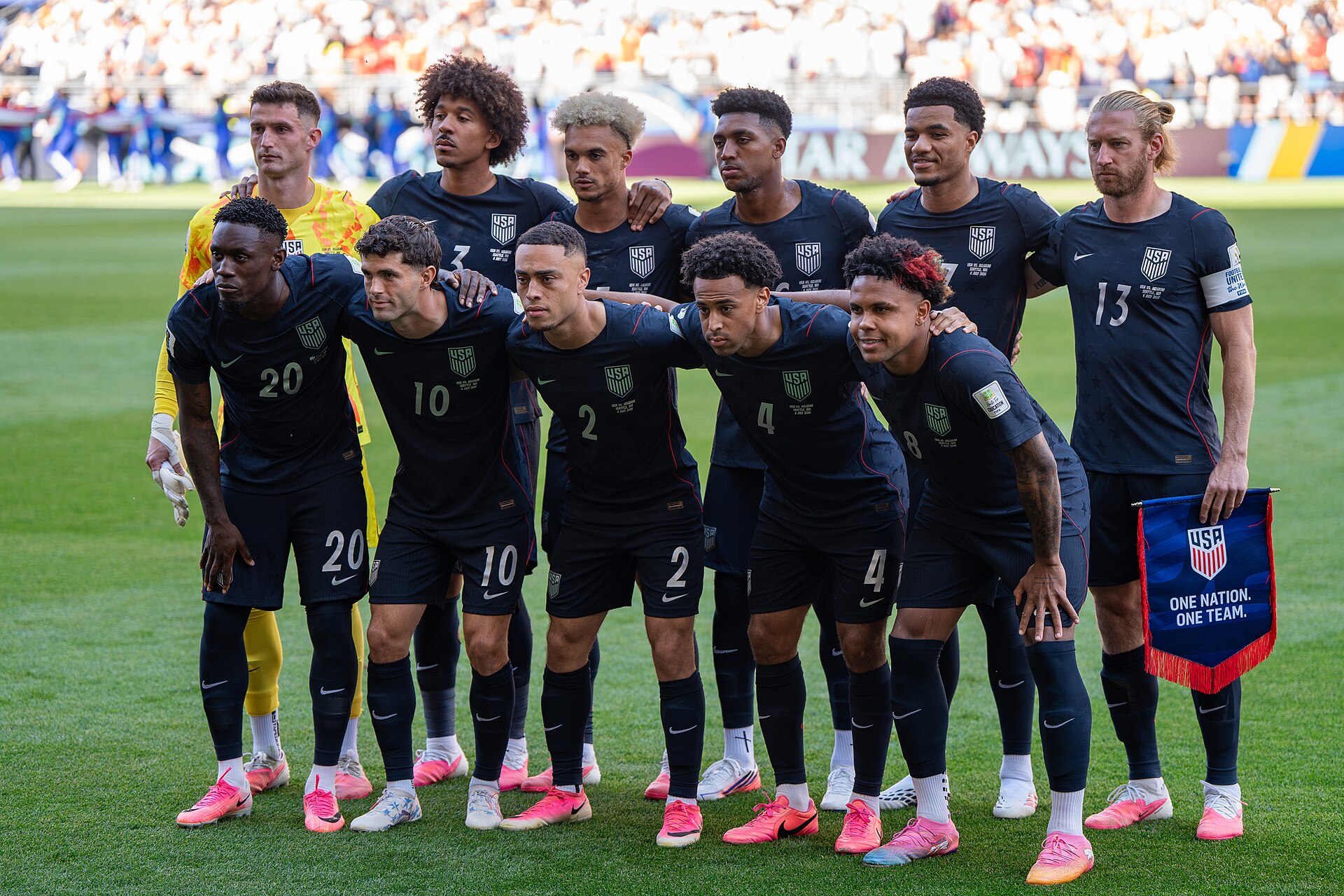
The United States starting team before its July 2026 World Cup match against Belgium; this archive image does not show the Cincinnati second leg. Archive photo by Bryan Berlin (CC BY-SA 4.0).
The United States completed an 8–0 aggregate victory over Haiti with a 2–0 win in Cincinnati on November 17, securing a place in the Concacaf Nations League Finals. Christian Pulisic and Julian Hall scored before halftime at TQL Stadium, and Weston McKennie assisted both goals as the USMNT finished the quarterfinal tie without conceding.
The federation’s official match hub records Pulisic’s goal in the twenty-fifth minute and Hall’s in the forty-third. Combined with Saturday’s 6–0 first-leg win in Miami, the result turned a commanding position into completed qualification. This was the second leg of the tie, a separate match from the November 14 report that some search results still foreground. U.S. Soccer’s final match record.
The evening also closed Mauricio Pochettino’s time in charge of the U.S. team. The outgoing coach retained the starting lineup from the first leg, then used the match to introduce substitutes while protecting the result. The final impression was one of continuity and shared contribution: established internationals produced the goals and assists, while a young forward again made a direct scoring contribution.
The next competitive stage is the Nations League Finals in March at SoFi Stadium in Inglewood, California. Qualification was the practical objective of the window, and the U.S. achieved it emphatically across the two matches. The larger question now is how the team carries that work into a new coaching phase and a more demanding knockout setting. The federation’s explanation of the quarterfinal route.
Two McKennie assists and two first-half goals
Pulisic’s opener gave the home leg its first decisive moment. With a six-goal aggregate advantage already in place, the United States did not need to chase the match recklessly. Scoring first nevertheless mattered because it moved the tie further away from any possibility of an uncomfortable sequence and gave the home crowd a clear attacking return.
Hall’s goal before the interval added a different kind of significance. The eighteen-year-old had scored in the first leg and did so again in the return. That continuity makes his window more informative than one isolated appearance: he contributed in consecutive competitive matches while playing alongside senior figures with much longer international histories.
McKennie’s two assists connected the established and emerging parts of the attack. The match record gives him the final pass for both Pulisic and Hall. An assessment focused only on the scoring list would miss that shared creative contribution. The same midfielder helped produce the return from two different finishers.
Pulisic entered the match with 35 international goals, according to the federation’s pregame account. Tuesday’s goal takes that total to 36 by addition to the published figure. The milestone context reinforces his place among the program’s leading scorers, but the immediate sporting value was the same as Hall’s later contribution: a goal that advanced the team’s task inside the match. U.S. Soccer’s pregame background and scoring records.
The halftime position also gave the coaching staff a clear platform for the remainder of the evening. At 2–0 on the night and 8–0 overall, the challenge became maintaining useful habits rather than manufacturing additional jeopardy. A team in that position can still lose concentration or become disconnected as changes arrive. The final clean sheet shows that the score remained intact.
Continuity in the starting team, opportunity from the bench
Pochettino selected the same eleven who began the first leg. U.S. Soccer’s lineup notes identify Diego Kochen in goal, a defensive group including Chris Richards, Auston Trusty, Antonee Robinson and Alex Freeman, and Tyler Adams as captain. Pulisic, McKennie, Hall, Malik Tillman and Sebastian Berhalter completed the starting team. The official starting lineup and notes.
The choice gave the group another match in which to develop the same relationships. International teams have limited time together, so continuity can be valuable even when an aggregate score offers room for extensive rotation. Players can work through familiar responsibilities under match conditions rather than begin every window by rebuilding the arrangement from the start.
The lineup also contained a substantial range of experience. Hall and Kochen were early in their senior international careers, while several teammates had long records in official competition. That mixture can make an opportunity more useful for a younger player: the player is being asked to contribute inside an established competitive structure, rather than carry a largely experimental team by himself.
For Hall, the clearest evidence was his goal. The important development is a repeatable contribution to the team’s work, not merely the attention attracted by his age. Young players benefit when discussion moves from abstract promise toward the actions they are already completing at senior level. Two scoring appearances in the same tie give that discussion a concrete basis.
The substitutions extended the evaluation. The match hub records appearances from players including Neil Pierre, Cavan Sullivan, Folarin Balogun, Santiago Castañeda and Reed Baker-Whiting. Their minutes took place within a tie the United States had already brought firmly under control. That setting offered opportunity while preserving the responsibility to keep the team organized.
It is useful to distinguish that opportunity from a final judgment about future selection. A player’s role in one settled second leg is part of a larger body of evidence. The coaching transition will bring further decisions, and the strongest case for any individual will rest on sustained performance across the circumstances the next staff needs to solve.
What the 8–0 aggregate victory establishes
The first leg did most of the work in establishing the size of the advantage. Saturday’s six goals left Haiti facing an exceptionally difficult return match. Tuesday’s result then completed the tie without giving the opponent an opening in the score. The aggregate total describes both the attacking margin and the absence of a conceded goal across the two games.
That is a meaningful competitive achievement, even if the second leg began with little uncertainty about the likely outcome. A team still has to complete the task. The U.S. did so with two further goals rather than a performance that relied only on protecting the earlier result. Qualification moved from an expectation into a recorded outcome.
The window also continued the team’s winning run after the World Cup. The first-leg account described the four-match sweep in the preceding camp; two wins over Haiti extend that sequence to six victories. That calculation provides a clear measure of the recent results without asking it to forecast every opponent the team will face next.
The margin should still be assessed in context. A quarterfinal tie against Haiti presents a particular set of problems, and the United States was strongly favored by the position established in Miami. The next stage may require the team to respond when a match remains level for longer or when the opponent can sustain more pressure. A large win is evidence of successful execution here, not a universal answer to those future situations.
For Haiti, the review concerns the whole tie rather than only the Cincinnati score. Conceding six in the first leg left little room to shape the second on favorable terms. The smaller return-leg deficit does not erase that first result, but it gives the staff a different match to examine when assessing how the team competed after the tie had moved so heavily against it.
Readers looking for the earlier match can find it in Taken Social’s first-leg report. Keeping the two fixtures distinct makes the chronology clear: six goals in Miami on November 14, two in Cincinnati on November 17, and an 8–0 aggregate outcome.
The Finals and a coaching handover come next
Pochettino leaves with the immediate competitive objective completed. The farewell aspect gives the night an obvious emotional frame, but the practical value for the program is the team’s position in the next competition. A coaching change is easier to organize around a secured Finals place than around an unfinished qualifying task.
The incoming phase will have useful material to assess. The same starting group completed consecutive matches, younger players contributed goals and minutes, and the attack produced through several established relationships. Those are tangible reference points. They do not oblige a future staff to preserve every selection, but they provide something more substantial than a general description of good momentum.
The challenge will be deciding what transfers to the next level of opposition. A productive relationship against one defensive setup may need adjustment against another. A team comfortable with a large aggregate lead will eventually need to manage a match in which the margin remains narrow. The Finals will test those abilities in a different competitive environment.
The location at SoFi gives American supporters a clear next destination in the competition’s calendar, while the exact sporting task will depend on the remaining field and draw. Qualification itself should not be confused with a title. The United States has earned the opportunity to compete for the next trophy, and the work now is to arrive with a team capable of handling the pressure that stage creates.
The conclusion is that the U.S. finished the Haiti tie professionally and emphatically. Pulisic and Hall scored, McKennie assisted both and the team advanced 8–0 on aggregate without conceding. The result supplies a positive ending to Pochettino’s tenure and a concrete starting point for the next staff. What matters next is carrying those reliable contributions into matches that demand more than the quarterfinal eventually required.