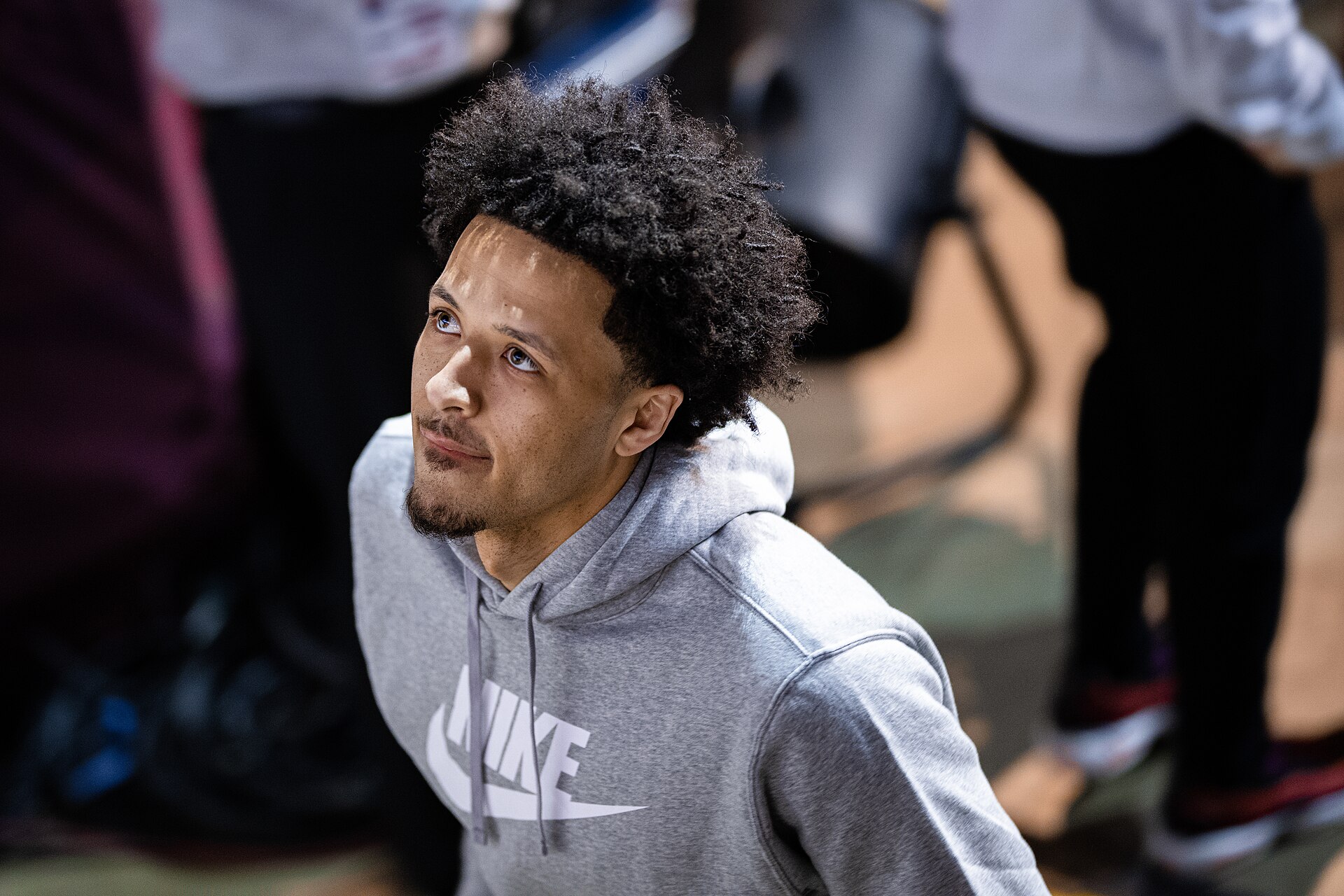
Cade Cunningham warms up at the 2022 NBA Rising Stars event in Cleveland. This archive photograph is not from the November 17, 2026, game in San Antonio. Archive photo by Erik Drost (CC BY 2.0).
SAN ANTONIO — The Detroit Pistons ended the NBA's longest winning streak Tuesday night, recovering from a 14-point deficit to beat the San Antonio Spurs 105–93 at Frost Bank Center. Cade Cunningham scored 27 points, Daniss Jenkins added 25 and Ausar Thompson delivered a performance that reached well beyond his 14 points: 12 assists, nine rebounds and five steals, including two late takeaways that helped close the game.
San Antonio had won 12 consecutive games and entered at 12–2. Detroit left with a 9–4 record after winning each of the final three quarters, while the Spurs fell to 12–3. Victor Wembanyama finished with 25 points and 18 rebounds, but his production could not overcome a difficult shooting night around him or the Pistons' ability to create points inside the three-point line.
The decisive late sequence belonged to Thompson and Jenkins. With Detroit ahead 97–90, Thompson stole the ball from Stephon Castle and set up Jenkins for a three-pointer with 1:45 remaining. Castle answered with a three, but Thompson took the ball from him again at 1:03. Jenkins later hit another three from a Thompson assist, and Thompson completed the scoring with a running dunk. The NBA's official play-by-play records the combination of disruption and execution that made Detroit's finish convincing.
The Pistons scored 60 points in the paint against San Antonio's 44 and recorded 31 assists on 45 made field goals. That was the foundation of a road win achieved despite six-for-25 three-point shooting. Detroit did not need an exceptional night from long range. It needed the ball to keep moving, enough pressure around the basket and a defense that improved substantially after conceding 33 points in the first quarter.
How Detroit erased San Antonio's early advantage
The opening period belonged to the Spurs, who took a 33–26 lead. Detroit's response came over a longer stretch than a single scoring burst. The Pistons won the second quarter 29–21, reaching halftime ahead 55–54, then took the third 23–18 to enter the final period with a 78–72 advantage. Across those two middle quarters, Detroit outscored San Antonio 52–39.
That 13-point difference changed the terms of the game. San Antonio had established the early cushion; Detroit had to solve the problem of scoring enough while slowing a team carrying a long winning streak. The Pistons' third quarter was particularly important because they limited the Spurs to 18 points after conceding 33 in the first. It gave Detroit room to build rather than requiring its offense to answer every San Antonio basket.
The Spurs' largest lead reached 14 points, according to the official game summary. Detroit therefore had to reverse a substantial deficit against an opponent that had spent much of the opening month finding ways to win. The visitors eventually finished 12 points ahead, a 26-point change from their deepest deficit to the final margin.
Detroit continued its work early in the fourth. Paul Reed's driving layup with 7:43 remaining made it 86–75 and drew a foul from Julian Champagnie. Reed missed the additional free throw, leaving the margin at 11. The possession was nevertheless part of a broader shift: a reserve big man was supplying interior scoring while the Pistons protected the position they had created through the middle quarters.
San Antonio still had a route back. Dylan Harper's basket and free throw cut the deficit to six at 3:27, and a Devin Vassell free throw later made it 93–88. Thompson answered with a reverse layup from a Cunningham assist. Harper scored again, but Cunningham's turnaround jumper at 2:07 restored a seven-point margin. Those exchanges mattered because Detroit kept producing a response before the Spurs could turn the pressure into a tie.
Cunningham, Jenkins and Thompson gave Detroit different ways to win
Cunningham finished 12 for 25 from the field with six assists and five rebounds. He carried the largest individual scoring load, but the Pistons did not ask him to supply every important late action. His turnaround jumper came between baskets involving other players, and his final assist sent Thompson toward the dunk that completed the scoring with 28 seconds remaining.
Jenkins made 11 of 21 shots and three of seven three-point attempts. His two late threes were particularly valuable on a night when Detroit struggled from outside overall. The first pushed the lead to double figures after Thompson's steal; the second made it 103–93 with 43 seconds left. Both were assisted by Thompson, giving the Pistons a closing partnership that did not depend exclusively on their leading scorer.
Thompson's 12 assists were the highest total for either team. He also collected five offensive rebounds and five steals. Those contributions affected different parts of a possession: creating another shot after a miss, finding a teammate for a basket and preventing San Antonio from completing its own attack. His 14 points were important, but they account for only one part of his influence on the result.
One late possession illustrated that breadth. After Cunningham missed with 3:43 remaining, Thompson recovered the ball, missed two tip attempts and remained involved as John Collins collected another offensive rebound. Collins was fouled and made both free throws. The sequence did not produce a Thompson basket, yet his work helped Detroit extend the possession until it produced points. The completed box score credits Thompson with nine rebounds, one short of a triple-double, alongside his scoring and assists.
Collins finished with 11 points and made all four of his free throws. Kevin Huerter added nine points and seven rebounds. Reed contributed 10 points, six rebounds, five assists and three steals off the bench, making five of eight shots. Detroit's reserve scoring was not enormous, but Reed gave the team productive minutes in several categories rather than simply filling time until the starters returned.
Why Wembanyama's 25 points and 18 rebounds were not enough
Wembanyama made 11 of 23 shots, including one of eight from three-point range, and converted both free throws. His 18 rebounds included five on offense. Harper scored 20 points on eight-for-14 shooting, Champagnie supplied 14 with four three-pointers, Vassell scored 12 and Castle had 10 with seven assists. The Spurs had several sources of production, but not enough efficient possessions across the full game.
San Antonio shot 41.6 percent overall and nine for 40 from three-point range. Detroit's 24 percent from deep was only slightly better than the Spurs' 22.5 percent, so the result should not be described as one team overcoming an opponent's hot perimeter shooting. Both struggled outside. The difference was how much Detroit accomplished elsewhere while those shots were failing to fall.
The field-goal totals make that distinction unusually clear. Detroit's 45 baskets included six threes, leaving 39 two-point makes. San Antonio's 37 included nine threes, leaving 28 two-point makes. The Pistons consequently earned a 22-point advantage from two-point baskets. The Spurs recovered nine points through their extra three-pointers and one through free throws, leaving the 12-point final difference. That is arithmetic from the box score, not a claim that every two-point basket was created in the same way.
The paint numbers reinforce the same theme: Detroit's 60–44 advantage there was substantial. Its 24–15 edge in fast-break points added another measure of pressure, although those categories overlap and should not be added together as separate scoring margins. The Pistons repeatedly found value closer to the basket and before San Antonio could settle into the kind of half-court possessions its size can complicate.
Fox, returning after missing Sunday's game at Utah with left hip tightness, scored six points on three-for-10 shooting and missed all five of his three-point attempts. That return restored another ball handler to coach Mitch Johnson's options, but it did not produce an efficient scoring night. San Antonio's five starters combined for 73 points; its reserves added 20, with 14 of those coming from Champagnie.
Wembanyama's individual plus-minus was positive-six despite the 12-point team defeat. That statistic describes the score difference during his minutes, rather than isolating his personal value from the other nine players on the court. It nevertheless helps explain why a strong individual line could coexist with a clear loss: San Antonio's results were different across its changing combinations, and the game had to be sustained through all of them.
A meaningful road win, and the end of a substantial run
The Spurs' 12-game streak was their first run of that length since the 2015–16 season. Ending it does not erase what San Antonio accomplished during the opening month. It does give Detroit a useful measure of its own start: the Pistons absorbed an early deficit on the road, improved defensively and maintained enough offensive organization to withstand the Spurs' fourth-quarter attempts to close the gap.
Detroit won the last three quarters by eight, five and six points, outscoring San Antonio 79–60 after the opening period. That sustained advantage is more informative than treating the result as the product of one spectacular closing shot. Jenkins' late threes mattered because earlier work had put the Pistons in position for those baskets to extend a lead rather than rescue a lost game.
The conclusion is that Detroit earned this victory through complementary contributions. Cunningham led the scoring, Jenkins supplied timely perimeter offense, Thompson connected the attack and disrupted the Spurs, and Reed helped the reserve minutes remain productive. San Antonio received a major rebounding performance from Wembanyama and 20 points from Harper, but could not match Detroit's efficiency inside the arc. A 105–93 result ended the Spurs' winning streak and gave the Pistons a road performance with substance behind the headline.