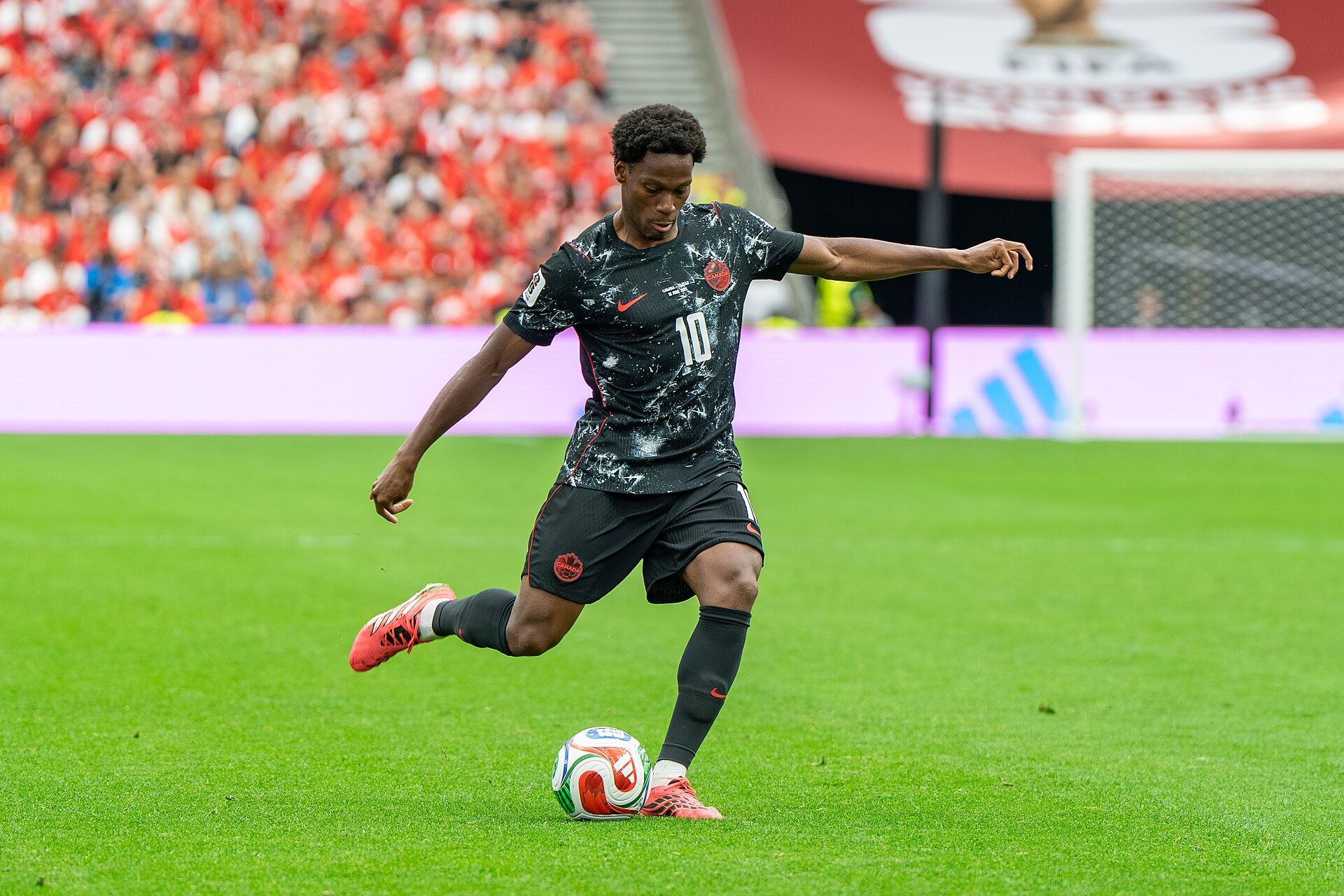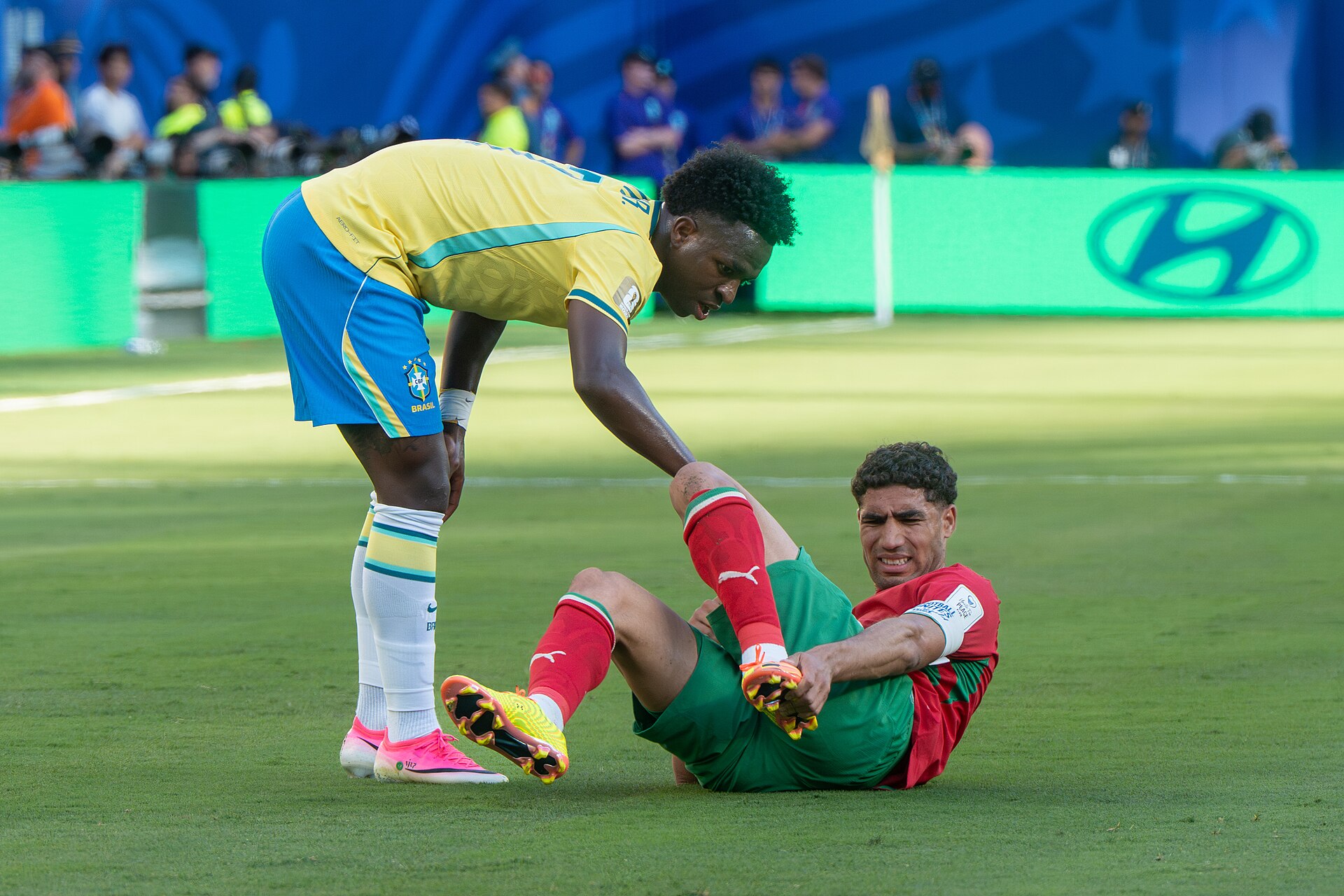
Vinícius Júnior with Morocco’s Achraf Hakimi during their June 13, 2026 World Cup match. Archive photograph. Archive photo by Bryan Berlin (CC BY-SA 4.0).
Vinícius Júnior scored a hat-trick as Brazil beat Singapore 7–0 on Tuesday, November 17, ending its 2026 international schedule with a commanding victory at Singapore’s National Stadium. Endrick, Estêvão and Rayan also scored, while the Brazilian Football Confederation credited substitute Allan with the seventh goal.
The CBF’s official match report describes Brazil’s largest winning margin since an 8–0 victory over China in Recife in September 2012. That historical comparison gives the score its scale, but the immediate football context is equally important. Brazil was responding to a 3–2 loss to Japan three days earlier in the same Singapore series. A comfortable win supplied a positive ending without making the questions raised by the earlier defeat disappear.
The score was already 4–0 by halftime. Vinícius’ three goals established control early, and Brazil continued adding to the result after the interval and through its substitutions. The completed match record from TNT Sports confirms the 7–0 final. This was a finished result, rather than a projection from an early live score.
Vinícius’ hat-trick gave Brazil control before halftime
The striking feature of the opening half was how quickly Brazil moved the match beyond an ordinary early lead. Vinícius scored three times during a short first-half span, with Endrick adding the fourth goal before the break. Singapore was left trying to limit further damage while Brazil could continue playing with the assurance of a large cushion.
The CBF account emphasizes combinations involving Bruno Guimarães, Endrick and Estêvão in the build-up to Vinícius’ goals. That is important to interpreting the hat-trick. The scorer supplied the final actions, but the opportunities were connected to the work around him. Brazil’s attacking quality appeared through partnerships as well as through the individual who finished the moves.
For a forward, repeated successful combinations can make a match more productive than a series of isolated attempts. A teammate’s run can change a defender’s position; an exchange can create a simpler finish than a difficult shot taken alone. The available account points to an attack benefiting from those connections, rather than only to a star imposing himself without support.
Endrick’s own goal widened the contribution beyond the hat-trick scorer. Estêvão then added another after the interval. The distribution matters because a large lead can become a passive exercise if the offense loses its connections. Brazil continued receiving productive actions from several attacking players instead of treating the remaining minutes only as time to be used up.
The result also extends a productive window for Vinícius. He had scored both Brazilian goals in the loss to Japan, giving him five across the two matches. That is useful individual evidence even though the team outcomes were very different. A player can perform productively in defeat, just as a team can win without every individual reaching the same level.
There is no need to turn the performance into a claim that Brazil has resolved every attacking question. Singapore presented a different level of challenge from Japan, and future opponents will defend differently. The firm conclusion is that Brazil made excellent use of the space and opportunities available on Tuesday, with Vinícius providing the outstanding individual return.
Allan and the substitutes kept the scoring going
With the lead already substantial, Brazil made several changes around the hour mark. The match records show opportunities for players including Allan, Vitor Reis, Marlon Gomes and Gabriel Bontempo. Substitutions in a game of this shape serve a different purpose from emergency changes made while trailing. The incoming players can be assessed within an established structure, although the reduced competitive tension is part of that assessment.
Allan contributed to the later scoring, with the federation describing his involvement in Rayan’s goal before crediting him with the seventh. The precise credit for the final goal differs across published records: TNT’s live record lists a Raoul Suhaimi own goal, while the CBF assigns it to Allan. This report follows the federation’s account. The discrepancy does not affect the confirmed 7–0 result.
That distinction is worth stating because scorers’ totals can matter long after a match ends. A live feed is useful for following events quickly, while an official post-match account can provide a different attribution. Readers comparing records should know why two otherwise matching reports may assign one goal differently, rather than assume that the final score itself is disputed.
Rayan’s goal also gave Brazil a contribution from another attacking option. A team beginning a new international cycle needs more than a single reliable scorer. It needs players who can combine with established starters, contribute after changes and carry out different roles. Tuesday supplied useful minutes and successful outcomes, even if a one-sided friendly cannot reproduce every demand of a competitive knockout match.
The same limitation applies to defensive conclusions. A clean sheet is a positive result, but the score alone cannot establish how Brazil would handle a stronger opponent’s pressure or transition attack. Singapore’s inability to score on this occasion is an observed outcome. It is not evidence that every vulnerability exposed in an earlier match has automatically been corrected.
The value of the substitutes’ work is therefore specific. They maintained enough attacking continuity for Brazil to keep adding goals after the main lead had been built. That is a useful sign within the context of the match, rather than a complete ranking of which players should start every future international.
For Singapore, the test was larger than the score
The match formed part of the Mizuho Blue Challenge The Kallang Football Series, an event involving Singapore, Brazil, Japan and Paraguay. Organizer Dentsu’s announcement identifies the National Stadium as the venue and links the series to the 60th anniversary of Japan–Singapore diplomatic relations. The event combined international football with a wider effort to stage high-profile sporting encounters in Singapore.
That commercial and diplomatic setting does not change what happened on the pitch. Singapore faced a team with much greater international pedigree and individual attacking resources, and the difference became emphatic. The result should be described honestly as a heavy defeat. Calling every difficult match a valuable lesson without identifying what must improve can become a substitute for analysis.
The practical value for Singapore depends on what follows. Facing players who move and combine at a high level can expose the cost of small gaps in positioning or decision-making. Turning that exposure into progress requires work after the event: reviewing the moments, improving the response and testing those changes in later matches. The opportunity to play an elite opponent is a beginning, not an achievement that automatically compensates for seven conceded goals.
A national-team program also operates within a wider system of player development, club competition and coaching. One friendly cannot measure every part of that system, and the result does not justify personal abuse of the players involved. It does provide a demanding reference point for the level at which Singapore wants to compete. A constructive assessment can acknowledge the gap without pretending that the scoreboard was flattering.
Singapore has previously hosted major Brazilian performances against other opponents. In October 2014, Neymar scored four times against Japan at the National Stadium, a match recalled by the CBF in its historical coverage. Tuesday’s hat-trick belongs to a different game and opponent, but the venue has again supplied an international stage for a prominent Brazilian attacker.
For spectators and organizers, the attraction is obvious: recognizable players and a result that draws global attention. For the football program, the more durable question is whether the experience improves later performance. Those are related benefits, but they are not identical. A successful event and a competitive national side are built through different kinds of work.
The Japan defeat remains part of Brazil’s assessment
The CBF’s report on the November 14 Japan match records a 3–2 defeat despite two goals from Vinícius. Brazil recovered from two goals down before conceding the late winner. That result offered a much less comfortable examination of the team’s ability to manage pressure and complete a match against strong opposition.
The two fixtures should therefore be read together. Tuesday showed Brazil’s ability to impose its attacking quality against a weaker opponent. Saturday showed that productive individual scoring did not guarantee collective control. Neither result should be used to erase the other. The useful assessment asks which strengths were repeated and which difficulties still need to be addressed.
There was also a historical note before Tuesday’s kickoff. Brazil observed a tribute to Dino Sani, a member of its 1958 World Cup-winning team who died on November 15 at 94. The federation says the players wore black armbands and a minute’s silence was held. The acknowledgment connected the current side’s final match of the year to an earlier generation of Brazilian football.
For the current players, the next task is to make productive attacking relationships reliable under more difficult conditions. Vinícius’ five goals across the window provide a strong individual foundation. The contributions from Endrick, Estêvão, Rayan and Allan broaden the positive evidence. The demanding part is preserving that quality when an opponent reduces the available space and threatens more consistently in return.
Brazil’s 7–0 victory is a clear and substantial result. Vinícius supplied the defining performance, his teammates and the substitutes sustained the attack, and the team ended the year with a clean sheet and a large margin. Its significance is strongest when kept in proportion: an emphatic response in Singapore, valuable attacking evidence, and further work ahead to turn those strengths into consistent performances against the best opposition.