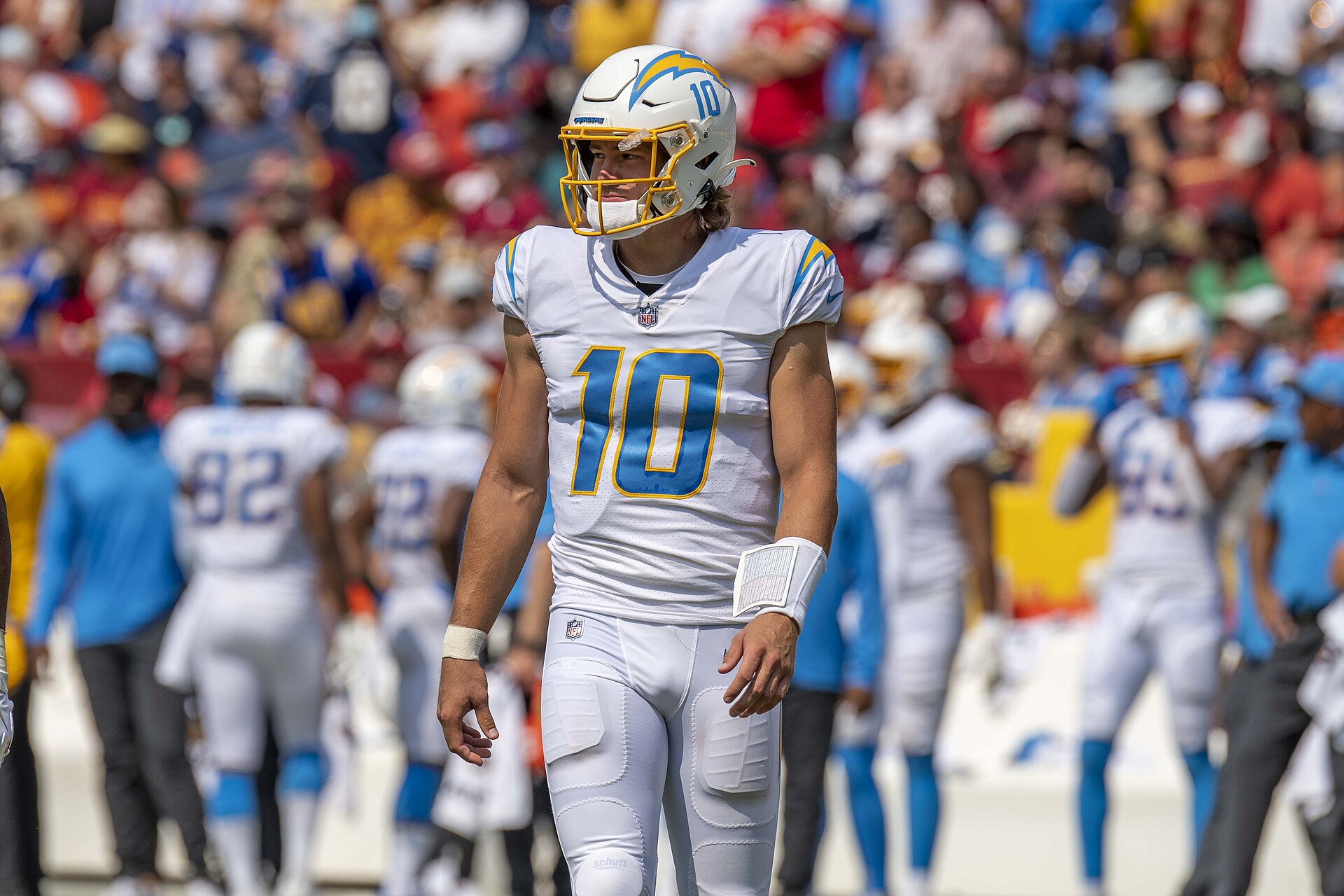
Justin Herbert playing for the Chargers in September 2021. Archive photograph. Archive photo by All-Pro Reels (CC BY-SA 2.0).
The Los Angeles Chargers finally have a win, and it came through the parts of the game that had to hold up when the margin became uncomfortable. Omarion Hampton ran for 105 yards, Justin Herbert scored on a 22-yard run, and a late defensive takeaway preserved a 23–20 victory over the Baltimore Ravens on Monday night, November 16, 2026, at M&T Bank Stadium in Baltimore.
Los Angeles improved to 1–8 after opening the season with eight defeats. Baltimore fell to 4–6. For the Chargers, the result did not erase the difficult first half of the season, but it replaced the pursuit of a first victory with something more tangible: a complete example of how this available team could win. Its running game produced 160 yards while its defense held the Ravens to 16 on the ground.
“Good to see the smiles back,” coach Jim Harbaugh said in the Chargers’ postgame account. The brief comment captured the immediate relief. The football explanation was more specific. Los Angeles won the turnover comparison, converted two important fourth downs and made all three field-goal attempts. When Baltimore had a chance to change the ending, Tarheeb Still forced the fumble that Elijah Molden recovered.
The late takeaway turned a narrow lead into a finished win
The team’s game recap identifies the decisive defensive play: after Zay Flowers made a catch with Baltimore threatening late, Still continued through the play and knocked the ball loose. Molden recovered, giving the Chargers possession with just over two minutes remaining. A three-point lead that still required another stop became an opportunity for the offense to close the game.
Herbert then completed an 11-yard pass to Charlie Kolar for a first down. The NFL’s official gamebook records the play in the final sequence. It was not the longest completion of the night, but its value depended on the situation. The Chargers needed to keep the ball and deny Baltimore another meaningful chance. A short completion that accomplished that task mattered more than an additional large passing total.
The finish illustrates why a takeaway is more than a defensive statistic. A normal stop can still leave an opponent another chance after a punt exchange. A recovery near the end of a close game changes both possession and the remaining time available to respond. Los Angeles had to execute after receiving the ball, but Still and Molden created the situation in which that execution could end the contest.
Baltimore’s fourth-quarter touchdown had cut a 23–13 deficit to 23–20. The Ravens therefore were not facing an impossible late margin. They needed a field goal to tie or a touchdown to take the lead, making the lost possession particularly costly. The Chargers’ defense had been under enough pressure that the closing play should be understood as a necessary finish, rather than a decorative turnover after the outcome was secure.
The earlier interception also mattered. Del’Shawn Phillips secured a ball deflected during coverage by Cam Hart, giving Los Angeles an advantageous starting position before its second touchdown drive. The Chargers finished without a lost turnover, while Baltimore had the interception and the late fumble. That two-takeaway advantage helped offset other areas in which the Ravens accumulated more offense.
Hampton and Herbert gave the Chargers a workable ground game
Hampton carried 22 times for 105 yards and a touchdown, averaging about 4.8 yards per attempt. Herbert added 51 yards on seven rushing attempts, including the opening touchdown. Together, their rushing production supplied almost all of Los Angeles’ 160-yard total. The result gave the offense a route to points that did not depend on a large passing workload.
Herbert completed 12 of 18 passes for 129 yards without a touchdown or interception. Those numbers are modest beside the volume Baltimore generated, but they fit the way Los Angeles won. The Chargers could use the ground game, preserve the ball and receive enough passing production in important situations. A quarterback’s role in a victory is not always measured by whether he approaches 300 yards through the air.
Tre’ Harris caught five passes for 86 yards, accounting for most of the Chargers’ receiving yardage. That concentrated production made him an important part of moving the offense when it did throw. Kolar’s late first down served a different purpose. One receiver helped supply the larger gains; the tight end delivered a completion whose significance came from the clock and possession situation.
Baltimore’s running game was almost absent by comparison. Derrick Henry finished with 10 yards on 10 carries, although he scored both Ravens touchdowns on short runs. His two scores should not be confused with an efficient rushing performance across the night. Baltimore could finish near the goal line, but it did not receive the sustained ground production that the touchdown count might suggest.
The team rushing comparison was 160–16, a 144-yard difference. That does not mean the Chargers won every measure of offensive control. It identifies the area in which they created a particularly strong advantage. The Ravens still moved the ball through the air, and Los Angeles still had difficult stretches on third down. The running game provided a foundation on which the other winning plays could matter.
Two fourth-down decisions helped create the cushion
The Chargers led 10–7 when their second-quarter touchdown drive reached a fourth-and-one. Harbaugh kept the offense on the field, and Hampton converted. Later in the drive, with the ball at the one-yard line on fourth down, Los Angeles again went for the touchdown. Hampton scored, extending the lead to 17–7 instead of settling for a shorter advantage through a field goal.
The decisions had a visible result: seven points from a drive that twice faced the possibility of ending without a touchdown. That does not establish that every fourth-down attempt would have been justified in every situation. Here, the offense converted both, and the additional scoring gave Los Angeles more room when Baltimore later rallied. The aggression was connected to actual execution.
The official statistics make that contrast unusually clear. Los Angeles converted only two of 13 third downs, a 15.4 percent rate, but was two-for-two on fourth down. It would be misleading to call the offense consistently dominant on possession downs. It was better in two critical extensions than it was across the broader third-down sample.
Cameron Dicker also made the available kicking opportunities, converting field goals from 38, 34 and 35 yards. His fourth-quarter kick pushed the lead to 23–13 before Baltimore’s final touchdown. In a three-point game, successful execution of ordinary-length kicks belongs in the explanation. Los Angeles did not need a record-distance highlight to receive decisive value from its kicker.
The scoring progression shows how those pieces accumulated. Herbert’s run and Dicker’s first field goal established a 10–0 first-quarter lead. Hampton’s touchdown restored a 10-point gap in the second. The teams exchanged field goals in the third, and Dicker’s last kick supplied another cushion early in the fourth. The Chargers built enough points over several phases to survive Baltimore’s response.
Baltimore gained more yards but lost the decisive opportunities
Jacoby Brissett completed 33 of 49 passes for 340 yards for the Ravens, with one interception and no passing touchdowns. Mark Andrews caught eight passes for 82 yards, and Flowers had six catches for 74. Baltimore’s passing production was substantial. The defeat should not be described as an offense unable to move the ball in any form.
The Ravens finished with 347 net yards to the Chargers’ 287 and 22 first downs to Los Angeles’ 15. Both teams averaged 5.3 yards per offensive play. Those figures complicate a simple domination narrative. Baltimore ran more plays and accumulated more total yardage, but Los Angeles received a better result from the combination of scoring, ball security and late execution.
The difference between yards and outcomes is central to the game. An offense can gain significant ground while a turnover ends a promising possession before points arrive. A defense can concede completions yet make a decisive play near the end. The Chargers did not have to win every statistical comparison to win the contest; they had to produce more valuable outcomes in the situations that remained.
Baltimore’s 16 rushing yards also left its offense heavily dependent on passing volume. Brissett’s 49 attempts were 31 more than Herbert’s 18. The comparison does not prove that every play choice was wrong, especially with the Ravens trailing, but it shows how differently the teams had to pursue their offense. Los Angeles had a productive ground option that Baltimore did not.
For the Chargers, the most useful next step is to preserve the strengths without overlooking the shortcomings. Two successful fourth downs do not make a two-for-13 third-down night a sustainable ideal. A late takeaway is valuable, but repeatedly depending on one would be precarious. The win offers concrete elements to build on—rushing efficiency, ball security and reliable kicking—alongside clear areas for improvement.
Los Angeles next returns home to face the New York Jets. One victory cannot repair an eight-loss start, but it changes what the team can point to when asked how it intends to compete. Monday’s answer was specific: Hampton and Herbert supplied the ground production, Harbaugh’s fourth-down decisions produced a touchdown, Dicker converted the kicks, and Still and Molden supplied the finish. The Chargers finally turned those parts into a result.