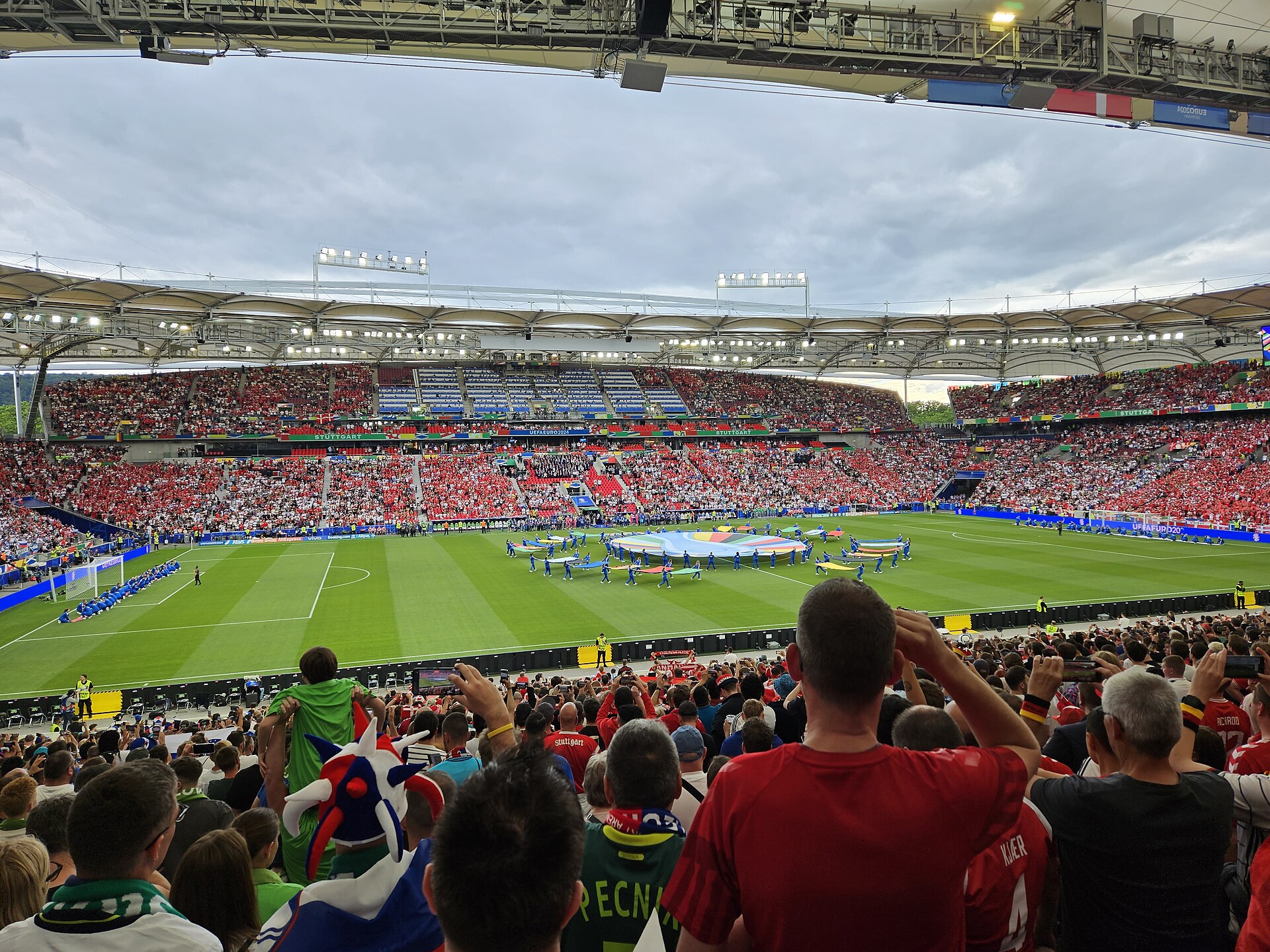
Denmark and Slovenia supporters at their Euro 2024 match in Stuttgart on June 16, 2024. Archive image of international football; not the November 2026 match in Braga. Archive photo by Mpel24 (CC BY-SA 4.0).
Denmark turned Portugal’s comfortable Nations League campaign into a warning on Saturday, winning 4–1 in Braga behind two goals from Rasmus Højlund and a performance that made the group’s final evening considerably more interesting. Portugal still has its quarterfinal place. What it no longer has is an unbeaten record, an unchallenged claim to first place or much room to dismiss the defensive problems exposed at home.
Pierre-Emile Højbjerg opened the scoring from the penalty spot in the 43rd minute. Højlund struck in the 50th and 57th, Joachim Andersen added Denmark’s fourth in the 75th, and Bernardo Silva supplied a stoppage-time consolation. Those are the decisive entries in UEFA’s official match record. The larger story was the visitors’ ability to turn a narrow halftime advantage into a commanding lead before Portugal could rebuild its footing.
For readers looking for the Portugal vs Denmark result, the answer is emphatic: Denmark won away from home by three goals. For the two managers, the implications are more demanding. Brian Riemer has evidence that his team can impose itself against the group leader. Jorge Jesus must show that Portugal can correct the spaces Denmark exploited before a knockout opponent makes those weaknesses even more expensive.
How Denmark took the game away from Portugal
The timing of the opening goal gave the contest its first sharp turn. A penalty shortly before the interval meant Portugal had to return from the dressing room chasing the game rather than managing a level score. That situation does not automatically explain a heavy defeat. It does, however, change the balance between taking attacking risks and keeping enough protection behind the ball.
Højlund then made the restart decisive. UEFA’s Matchday 5 report describes his first finish as a volley following Gustav Isaksen’s build-up work and his second as a low shot beyond Diogo Costa. Seven minutes separated the goals. In that short stretch, a one-goal problem became a three-goal deficit, leaving the hosts with an increasingly difficult choice between restraint and an ambitious attempt at recovery.
Andersen’s header later removed any realistic suspense about the winner. Silva’s reply in the third minute of added time altered the final score but could not alter the game’s meaning. There is a difference between a late goal that launches a comeback and one that arrives after the outcome has been settled. Portugal’s consolation belonged to the second category.
This was also a useful reminder that the identity of a scorer is only part of an attacking story. Højlund supplied the most damaging finishes, but Denmark’s goals came through a penalty, open-play finishing and an aerial contribution from a defender. A team creating several kinds of danger presents a broader problem than an isolated striker enjoying a fortunate evening.
Possession did not give Portugal control
The official match statistics complicate any easy account of Denmark simply retreating and waiting. Portugal had 54 percent possession, but Denmark led 17–15 in attempts and 7–6 in corners. The visitors also registered more attacks in UEFA’s count, 34 to 30. Portugal’s greater share of the ball therefore did not translate into a clear advantage in attacking volume.
Those figures support a limited but important conclusion: Denmark’s victory was accompanied by sustained attacking involvement. They do not establish the quality of every chance, and attempts alone cannot substitute for a detailed expected-goals model. They do make it difficult to explain the result as four isolated moments against an otherwise dominant home side.
Riemer’s explanation, carried in UEFA’s match coverage, emphasized pressing, improved defending closer to goal and the ability to keep possession long enough to frustrate Portugal. Jesus acknowledged that his team had struggled to stop Denmark’s attacking play, especially after halftime. Their assessments point toward the same central issue from opposite directions: Portugal could circulate the ball without consistently dictating where the next dangerous action would occur.
That distinction matters in international football, where teams have limited training time to refine collective responses. When a first line of pressure is beaten, the next defender must know whether to step forward or protect space. When possession is lost, midfielders must recognize whether the ball can be recovered immediately. Hesitation in either decision can make an apparently organized team vulnerable very quickly.
The score should still be read proportionately. One match does not erase Portugal’s previous four victories, just as one outstanding away performance does not guarantee Denmark’s success on Tuesday. The value of this result lies in the problems and possibilities it reveals. It gives both coaching staffs something concrete to address rather than a vague argument about momentum.
The Group A4 table and the path to first place
After five matches, UEFA’s Group A4 standings put Portugal on 12 points, Denmark on nine, Norway on six and Wales on three. Portugal has already secured a place in the quarterfinals. Denmark has strengthened its position substantially, but its progression still depends on finishing the job against Norway in the last round.
The final fixtures are Wales against Portugal and Denmark against Norway on Tuesday, November 17. That creates two connected contests: Portugal’s effort to retain first place and the Scandinavian rivals’ fight for the other quarterfinal berth. Denmark’s celebration in Braga was justified, but qualification itself remains a separate task. Norway still has a route into the top two.
There is a particularly interesting wrinkle at the summit. Portugal won the first meeting in Copenhagen 4–2. Denmark’s 4–1 victory in the return means the two teams have three points apiece from their direct meetings, with Denmark ahead 6–5 on aggregate. That head-to-head goal difference becomes relevant if they finish level on points.
Under Article 15 of the competition regulations, the initial criteria for tied teams prioritize their results against one another before overall group goal difference. Consequently, a Denmark victory over Norway combined with a Portugal defeat in Wales would put both leaders on 12 points and give Denmark the advantage in their direct comparison. This is a calculation from the published results and rules, rather than an additional result already decided on the field.
Portugal can avoid that possibility by taking at least a point in Wales. A draw would lift it to 13, beyond Denmark’s maximum of 12. Denmark, meanwhile, needs a draw or a victory against Norway to protect second place. A defeat would expose it to the head-to-head comparison with the Norwegians. The three-goal win in Braga has improved Denmark’s options; it has not made the last fixture ceremonial.
Why the Nations League stakes extend beyond this result
The 2026–27 Nations League format sends the first two teams in each League A group into the quarterfinals. Group position therefore decides access to the competition’s knockout phase, rather than merely supplying an attractive line on a winter results sheet. Teams outside the top two face a different set of league-status and playoff considerations.
For Portugal, qualification provides a measure of security while the defeat supplies a demanding diagnostic. A team preparing for knockout football needs more than the ability to overwhelm weaker stretches of a group schedule. It needs dependable responses when an opponent presses effectively, changes the tempo or scores first. Saturday tested those responses and found them inadequate.
Denmark’s challenge is different. Reproducing the same emotional intensity after a celebrated away win can be harder than finding it against a prestigious opponent. The Norway match requires discipline as well as confidence. Chasing another spectacular score would be less valuable than understanding the game state and ensuring that the result delivers a quarterfinal place.
That makes the contrast between performance and outcome especially useful. The performance in Portugal should encourage Riemer because it displayed more than defensive survival. The outcome gives him leverage in the table. Neither automatically carries forward. Denmark will have to earn the next result with the same attention to distances, pressure and decision-making that helped produce this one.
Supporters should also distinguish tournament implications from broader judgments about national teams. A group defeat can uncover a genuine weakness without proving that a squad has lost its quality. An emphatic win can demonstrate a convincing plan without establishing that every opponent will struggle against it. International football is full of changing personnel, tactical adjustments and short preparation windows; the best conclusions remain specific to what the evidence shows.
The goal totals underline how different the two campaigns now look. Portugal has scored ten and conceded eight; Denmark has scored eleven and conceded eight. Those cumulative figures do not overturn the points table, but they narrow the apparent distance between the teams. Portugal’s four earlier wins built a valuable cushion, while Denmark’s latest performance transformed its scoring record and its direct comparison with the leader. The remaining question is whether the visitors can turn that improved position into a second consecutive result when Norway arrives with its own qualification ambitions.
Conclusion: a statement win, with unfinished business
Denmark’s 4–1 victory deserves to be treated as a substantial achievement. It beat the group leader away, turned the early second half into the decisive period and created enough danger to make the score more than a curiosity. Højlund supplied the headline, but the collective pressure and range of attacking contributions gave that headline substance.
Portugal’s position remains strong enough to correct course. A point in Wales will secure first place, and the quarterfinal berth is already safe. The more urgent question concerns how it defends when possession alone cannot control the match. Saturday’s lesson is clear: Portugal can still finish first, but Denmark has shown exactly why finishing first will not be enough preparation for the challenges that follow.