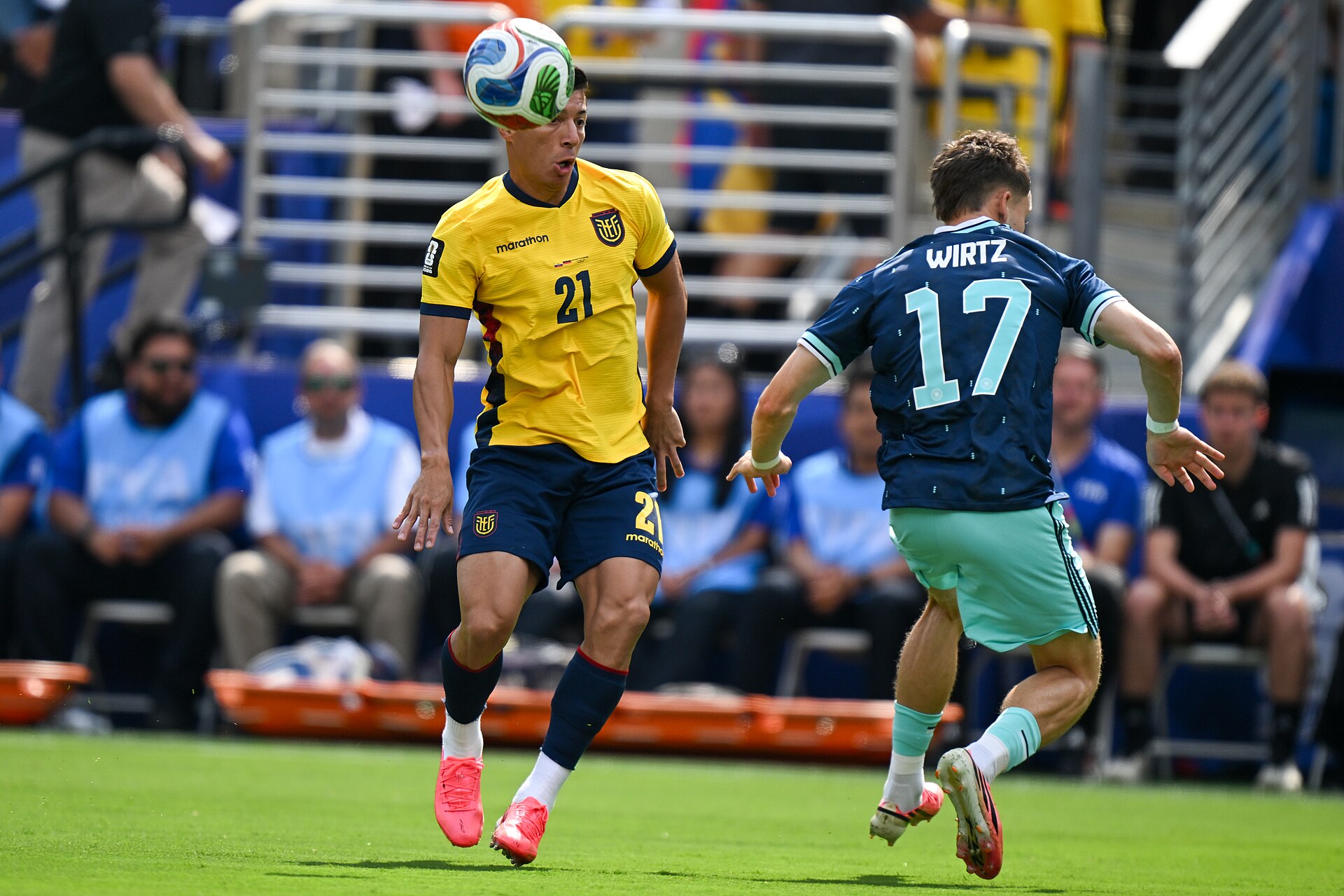
Germany’s Florian Wirtz, number 17, challenges Ecuador’s Alan Franco at the World Cup on June 25, 2026. This archive image does not show the November 13 match against Serbia. Archive photo by YantsImages (CC BY-SA 4.0).
Germany beat Serbia 3–1 in Belgrade on Friday, November 13, reviving its Nations League quarterfinal campaign and setting up a decisive final group game against the Netherlands. An early Srđan Babić own goal, followed by goals from Florian Wirtz and debutant Brajan Gruda, gave Jürgen Klopp’s team control before Serbia’s difficult evening ended with two dismissals.
The result moved Germany to eight points in League A Group A2, level with Greece and three behind the Netherlands. Serbia remained without a point after five matches. For Germany, the immediate reward was three points; the larger consequence was preserving a route to the last eight that can now be settled in Berlin on Monday.
UEFA’s official match center records Babić’s own goal in the third minute, Wirtz’s goal in the 14th and Gruda’s in the 50th. Babić scored at the other end in the 56th minute, but Serbia could not complete a recovery. Vanja Dragojević was dismissed in the 74th minute and Andrija Živković in the 89th.
Germany established the advantage before the red cards
The sequence is important to understanding the result. Germany was already three goals ahead before Serbia scored, and every goal had arrived before either dismissal. The cards made Serbia’s late task harder, but they did not create the lead that decided the match. An assessment centered only on Germany finishing against nine players would miss where the contest had been shaped.
UEFA’s account describes the opener as a Babić deflection from a Kai Havertz header. Wirtz added the second, and Gruda’s individual goal early in the second half extended the margin. That distribution of contributions matters: an own goal supplied the start, but Germany also produced goals through two of its attacking players rather than relying on the opening mistake alone.
A two-goal deficit so early changes the decisions available to the trailing team. Serbia had to find a way forward while protecting against further damage. Germany could approach subsequent phases with the scoreboard in its favor. That is tactical context arising from the timing of the goals, rather than a claim that a single formation or passing pattern explains every moment.
Babić’s reply briefly reduced the margin to two and gave the hosts something to build on. The dismissals subsequently narrowed the possibility of a comeback. The final score therefore contains both a German attacking improvement and a Serbian response that never became a sustained recovery. It was a clear away win, with the decisive work done well before the closing minutes.
The statistics show control beyond the scoreline
UEFA’s official statistics credited Germany with 73 percent possession and 23 attempts, compared with Serbia’s 27 percent and five. Germany completed 771 of 831 passes, with passing accuracy recorded at 93 percent; Serbia completed 161 of 229, or 70 percent. Germany also had six corners to Serbia’s none. Those figures describe a substantial difference in territory and circulation.
Possession alone does not establish attacking quality. A team can accumulate passes without creating meaningful danger, and match state affects how much each side has the ball. Here, however, the possession advantage sits alongside a much larger attempt count and three goals. The combined evidence supports a conclusion of German control more strongly than any one statistic would on its own.
The timing still limits what the aggregate numbers can tell us. Full-match totals include the periods after Serbia lost players. They cannot be used as if every minute had been played with equal numbers and the same score. A more complete future performance review would separate phases, but the headline evidence is already clear: Germany established its lead early and finished with a sizeable statistical advantage.
It would be excessive to turn that into a claim that all of Germany’s attacking problems are solved. Serbia entered the game at the bottom of the group, and a stronger opponent will pose different questions. The useful finding is narrower and more substantial: in a game Germany needed to win, its volume of possession and attempts translated into an actual advantage rather than another frustrating stalemate.
Gruda’s debut gives Klopp another attacking option
Gruda’s goal made his senior debut a particularly productive introduction. In comments carried by UEFA after the match, he called the occasion “a dream come true for me and my whole family.” The emotional significance is obvious, but there was a competitive contribution as well: his goal restored Germany’s momentum immediately after halftime and stretched the lead before Serbia replied.
Klopp’s choices came at the end of a selection process that mixed established players with new possibilities. The DFB’s November squad announcement named a 24-player group and highlighted Niclas Füllkrug’s return alongside a first senior call-up for Wael Mohya. The coach described reducing an earlier, larger pool as a difficult choice. Gruda’s appearance adds evidence to that broader process of assessing options.
That makes the performance useful beyond one player’s goal total. International coaches have limited preparation time, so the question is whether an individual can contribute within a functioning group. A successful debut can expand the choices available for the next match. It does not automatically establish a permanent starting role or settle the order among every attacking player competing for minutes.
Klopp’s post-match assessment, carried by UEFA, emphasized the performance and attitude, with praise for Havertz’s involvement. His comments support the interpretation of a collective improvement rather than an evening defined only by a debutant. The next step is to reproduce that cooperation against a Netherlands side arriving with the group lead and a very different competitive position.
Why Greece remains above Germany despite a worse goal difference
The official group table after five matches placed the Netherlands first on 11 points, Greece second on eight, Germany third on eight and Serbia fourth on zero. Germany’s overall goal difference was plus three, while Greece’s was minus five. That can look counterintuitive to readers accustomed to competitions that use overall goal difference as the first separator.
The explanation is in Article 15 of the Nations League regulations. When teams finish level, the initial criteria concern matches between the tied teams: points, then goal difference and goals scored in those meetings. Overall group goal difference comes later. Germany’s earlier defeat and draw against Greece therefore carry more weight in that comparison than the large difference in their overall goal balances.
This rule changes the meaning of Monday’s possibilities. Germany cannot assume that finishing level with Greece will be enough because its general statistics look better. A draw against the Netherlands would take Germany to nine points. If Greece also reached nine by drawing with Serbia, Greece would retain the advantage in their direct comparison. Germany needs to pay attention to points and the applicable tiebreak, rather than the visual comfort of a positive goal difference.
Germany’s clearest route is a win in Berlin. Taken Social’s calculation from the current table and Article 15 is that victory would secure a top-two finish. It would put Germany on 11 points; even if Greece also reached 11, the three-team comparison would favor Germany over at least one rival after the Netherlands’ 7–0 win against Greece. A German draw would require a Greek defeat. A German loss would leave it outside the top two.
A closed-door match with consequences beyond the pitch
The unusual setting in Belgrade had been established before kickoff. The DFB’s October 22 notice said the game would take place without spectators following a final UEFA disciplinary decision against the Serbian association for racist and discriminatory behavior at previous Nations League matches. The exclusion also affected Germany’s traveling supporters; the usual five-percent visiting allocation was unavailable.
The DFB said it had sought a solution with UEFA and the Serbian association but could not secure regular admission for away supporters. That context matters because the absence of a crowd was a disciplinary consequence, not an indication that the fixture had little interest. It also imposed a cost on fans who had already planned travel to support their team.
A quiet stadium can alter the atmosphere of an international match, but it does not supply a sufficient explanation for the result. Germany still had to score, Serbia still had opportunities to respond and the disciplinary events on the field remained the players’ responsibility. The crowd restriction belongs in the account as an important condition of the evening, without becoming a speculative substitute for football analysis.
The final group game now carries the real test
The DFB’s confirmed schedule places Germany against the Netherlands at Berlin’s Olympiastadion on Monday, November 16, at 8:45 p.m. Central European Time. Serbia visits Greece in the other group fixture. Those games will determine the final A2 order. For Germany, Friday supplied the opportunity; Monday will establish whether that opportunity becomes a quarterfinal place.
The wider competition rules also deserve attention. UEFA’s updated guide to the 2026/27 format says the first two teams in each League A group reach the quarterfinals. Because the next edition moves toward a three-league structure, the remaining positions have adjusted consequences: the highest-ranked third-place teams stay in League A, while other third- and fourth-place teams face different playoff or relegation outcomes. Fourth place should not automatically be described using an older edition’s rules.
The conclusion from Belgrade is clear. Germany earned a convincing 3–1 victory through an early advantage, productive attacking contributions and sustained control reflected in UEFA’s statistics. Gruda gained an impressive debut, Wirtz added a goal and the group race remained open. The result is a meaningful step forward, with a concrete qualification route. The Netherlands match will show whether Klopp’s team can take it against the strongest opposition in the group.