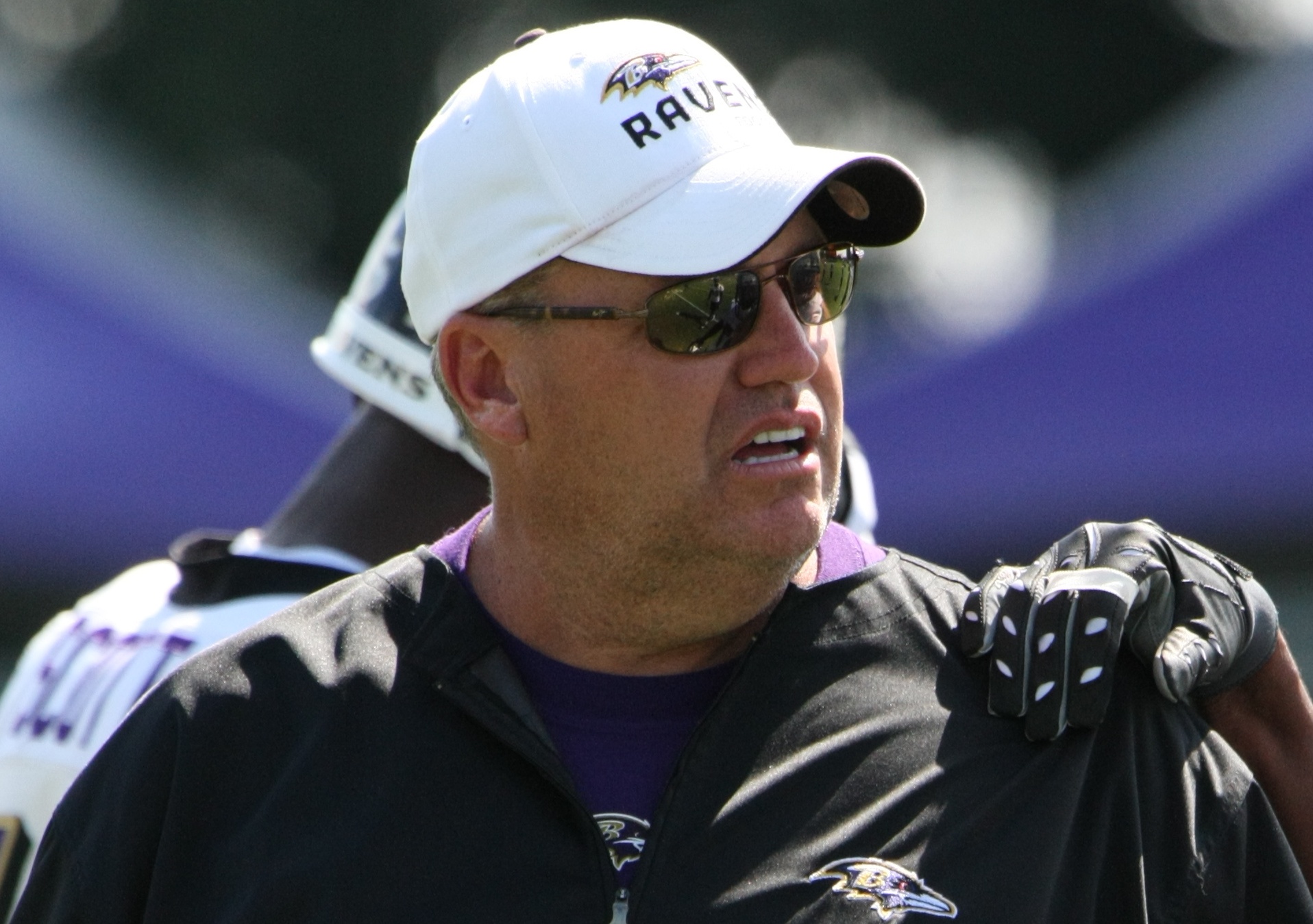
Rex Ryan during his time on the Baltimore Ravens coaching staff, photographed Aug. 3, 2008. Archive photo by Keith Allison (CC BY-SA 2.0).
Rex Ryan surrendered to Nashville authorities on Wednesday, Nov. 11, after police obtained six misdemeanor warrants stemming from an encounter between his pickup truck and two pedestrians downtown. The former New York Jets and Buffalo Bills coach, now an ESPN football analyst, is accused of striking the pedestrians near Fourth Avenue and Broadway late last week and leaving afterward. Police described their injuries as minor. The charges have brought a legal case involving an unusually recognizable driver into the middle of the NFL television season. Read the Metropolitan Nashville Police Department’s account.
The case concerns a reported street incident on Nov. 5, rather than anything that happened at an NFL game or television studio. According to police, the pedestrians were crossing with a walk signal when the truck turned right, ran over their feet and contacted one person’s leg. They subsequently waved down the driver at the next light, where they said he got out, argued and drove away. Police said photographs of the driver and license plate helped identify Ryan and a vehicle registered to him.
Ryan, 63, faces two counts each of leaving an accident scene, failing to provide information or render aid, and failing to obey a traffic control signal. Those are accusations awaiting adjudication. They establish the conduct authorities intend to prosecute; they do not establish that a court has accepted the police account as proven.
His lawyer, David Raybin, said Ryan surrendered after learning of the charges and was cooperating. Raybin also said the defense had only just received the warrant and had limited information about the allegations. The Associated Press reported that Ryan qualified for release on nonfinancial conditions after a commissioner set bond at $6,000, with a court appearance expected next month. Read the AP report on the surrender and defense response.
The reported encounter and the questions the case will have to answer
The police narrative describes two encounters: the initial contact in the crosswalk and the subsequent exchange at another intersection. That sequence matters because the alleged collision and the alleged conduct afterward are different parts of the case. Establishing who had the right of way addresses the first. Establishing what the driver knew, what information was exchanged and what happened before he left addresses the second. The fact that a driver stopped at a later light does not, on its own, answer all those questions.
The location also makes precision important. Police identified Fourth Avenue and Broadway as the initial intersection and Broadway and Representative John Lewis Way as the subsequent stop. Those details provide a route investigators can test against statements and any available records. They should not be expanded into claims that particular surveillance footage, independent witnesses or vehicle data have already substantiated every allegation. The public release identifies photographs; it does not present the entire evidentiary record.
Six counts can sound like six separate crashes when condensed into a short social-media post. Here, the police description concerns one reported encounter involving two pedestrians and three categories of alleged offense. The number reflects the charging structure, not six independently described collisions. Equally, describing the injuries as minor does not resolve whether traffic rules or duties after an accident were violated. Injury severity and the conduct charged are related questions, but they are not interchangeable.
Tennessee’s published accident law provides useful background: its injury-accident provision requires drivers to stop and remain to fulfill the associated information-and-assistance requirements. That explains why allegations about departure can be legally significant even when the injuries reported are not life-threatening. The relevant court filings and the law applicable to the particular charges will govern Ryan’s case; a general statutory provision cannot establish his liability. Read Tennessee’s published injury-accident provision.
The release decision answers a narrower question, concerning Ryan’s status while the case proceeds. A bond amount is not a fine or a damages award. Nor should the announcement of a $6,000 bond be rewritten as proof that he paid that sum in cash. The reported nonfinancial release arrangement means the next substantive developments are likely to come through the court process and any fuller response from the defense, rather than from the booking photograph itself.
A football résumé that reaches well beyond his television persona
Ryan is a familiar figure to viewers because his broadcasting career followed a long coaching apprenticeship. ESPN’s official biography dates his arrival at the network to April 2017 and lists work across Sunday NFL Countdown, Get Up, SportsCenter and radio. Before that transition, he spent eight seasons as an NFL head coach: six with the Jets, from 2009 through 2014, and two with Buffalo, in 2015 and 2016. His early Jets teams reached consecutive AFC championship games. Read ESPN’s career biography.
His reputation had been built earlier in Baltimore. The Ravens’ own history records his arrival as defensive-line coach in 1999 and promotion to defensive coordinator in 2005. He was on the staff of the team that won Super Bowl XXXV, then remained through the 2008 season before taking the Jets job. Baltimore’s account of his departure emphasized both the defense’s sustained production and the relationships he had developed with players. Read the Ravens’ account of Ryan’s departure for New York.
That background helps explain his appeal as a football analyst. A former coordinator can translate a disguised pressure, a protection adjustment or a defensive personnel decision into a discussion about what a coaching staff was trying to accomplish. Ryan’s public style has often been forceful, but the experience underneath it was accumulated through years of teaching players and preparing game plans. His credibility with an NFL audience has therefore rested on more than his ability to deliver an emphatic television opinion.
The distinction between his roles on Baltimore’s championship team and his later coordinator tenure is worth preserving. He contributed to the Super Bowl staff as an assistant; he became coordinator afterward. Compressing those periods into a claim that he coordinated the championship defense would misstate the chronology. His actual résumé is substantial enough without adding a title he did not hold at that time.
New York’s official coaching history lists Ryan’s regular-season record with the Jets at 46–50. The postseason record adds another part of the story: Pro Football Reference records four playoff victories against two losses during his tenure. Those figures describe why the period can be remembered both for two remarkable January runs and for a six-season regular-season record below .500. The early heights did not become a permanent level of performance. See the Jets’ coaching history; compare regular-season and playoff coaching records.
Buffalo offered a second head-coaching opportunity, but it ended before the completion of his second season. A Jets preview of the teams’ 2016 finale recorded a 15–16 mark over Ryan’s 31 games with the Bills and Anthony Lynn’s promotion to interim head coach. The contrast with his first two years in New York is central to a fair assessment: an accomplished defensive coach and two-time conference finalist also experienced the instability and uneven results that define many NFL coaching careers. Read the contemporary account of the Bills’ coaching change.
Why the case reaches the middle of ESPN’s NFL season
Ryan’s move to television gave him a continuing national platform after those coaching jobs ended. ESPN’s announced coverage for the 2026 season again places him on Sunday NFL Countdown alongside Mike Greenberg, Randy Moss, Tedy Bruschi and Alex Smith. He is consequently a current participant in a major weekly broadcast, rather than simply a retired coach whose name has returned to the news. That is the immediate professional context for the attention surrounding Wednesday’s surrender. See ESPN’s announced 2026 NFL coverage.
ESPN’s response was brief: “We are aware and are in touch with Rex.” The statement acknowledges contact with its analyst. It does not announce a suspension, a firing or a determination about the merits of the charges. Those additional conclusions should not be supplied on the network’s behalf. The broadcaster’s programming decisions and the court’s consideration of the case are separate processes, and a change in either would require its own reporting. Read reporting on ESPN’s statement.
The attention generated by a national television personality also creates a familiar problem for the people at the center of an alleged street collision. Discussion can quickly become a referendum on a public figure’s personality while the actual conduct and reported injuries receive less attention. Here, the relevant questions remain concrete: what happened in the crossing, what happened at the subsequent stop, and what the available evidence can establish about each allegation.
Nashville’s broader transportation planning offers context without providing an answer to the criminal case. The city’s Connect Downtown action plan includes pedestrian-safety work and evaluation of crossings, within a Vision Zero effort to eliminate roadway deaths. A downtown street can be a gathering place and a traffic corridor simultaneously. Turning movements, crossing intervals and driver awareness become especially consequential where those uses meet. Nothing in that planning document, however, determines fault in a particular encounter. Read Nashville’s Connect Downtown action plan.
What comes next
The meaningful next steps are a fuller defense response, the scheduled court proceedings and any evidence made public through them. Wednesday’s announcements establish that Ryan surrendered on misdemeanor warrants and that authorities have set out a specific version of events. They also establish that his attorney has promised cooperation while reviewing the allegations. The space between those positions is where the case will be tested.
For now, Ryan’s status is that of a defendant facing charges, with the reported injuries described as minor and the facts still subject to the legal process. His long football career explains the national interest; it cannot settle what happened on Broadway. A responsible conclusion rests on the actual record: a reported collision involving two pedestrians, six misdemeanor allegations, a voluntary surrender and a case that must now move from a police announcement into court.