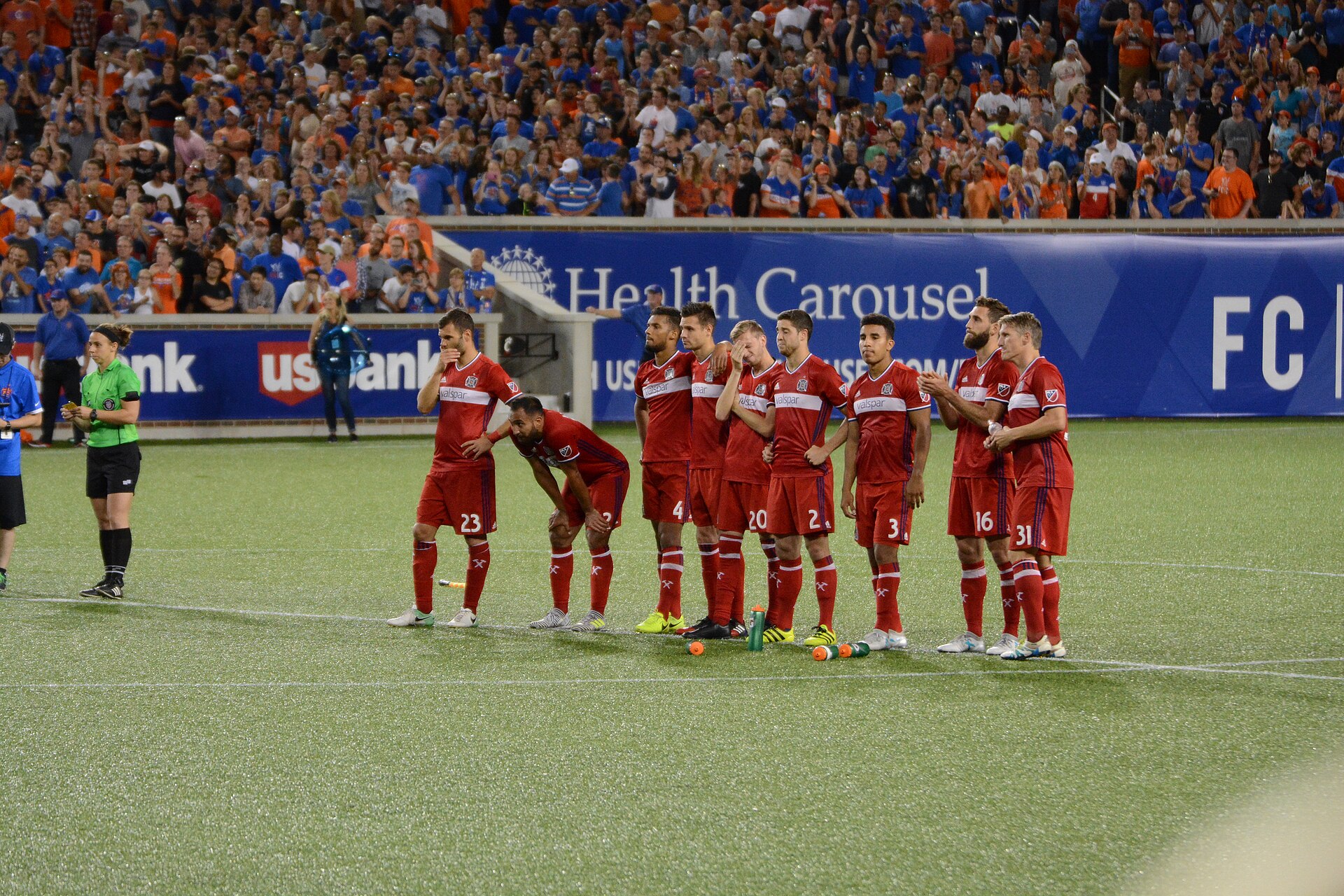
Chicago Fire players during a 2017 U.S. Open Cup match at Nippert Stadium in Cincinnati. Archive photo by Hayden Schiff (CC BY 2.0).
Chicago Fire FC lost a seven-goal game on Decision Day and still came away with the better seed. The Fire finished fourth in the Eastern Conference and will host fifth-seeded Charlotte FC at SeatGeek Stadium on Nov. 22 to open the 2026 MLS Cup Playoffs. A second match follows in Charlotte on Nov. 28. If the teams split the first two, they return to Bridgeview on Dec. 2. Sunday’s schedule announcement turned a chaotic final day of the regular season into a clear assignment for Chicago: win twice against a club it has already beaten twice this year. Chicago Fire’s playoff announcement Official MLS first-round schedule
For readers coming to the story through a search for “Chicago Fire,” this week’s matchup is the soccer club’s postseason draw. Robert Lewandowski scored two penalties on Saturday, but Columbus won 4–3 after twice erasing a first-half deficit and scoring the winner in stoppage time. Charlotte had a chance to take fourth on Decision Day. Chicago’s hold on that spot survived, and with it came the right to play as many as two of the three first-round games near home. This is the first postseason meeting between the clubs. Chicago’s Decision Day match report What MLS said was at stake on Decision Day Charlotte’s playoff announcement
Chicago Fire vs. Charlotte FC: Playoff schedule and how to watch
Game 1: Sunday, Nov. 22, at 6:30 p.m. ET (5:30 p.m. CT), SeatGeek Stadium in Bridgeview, Illinois. Game 2: Saturday, Nov. 28, at 12:30 p.m. ET (11:30 a.m. CT), Bank of America Stadium in Charlotte. Game 3, if necessary: Wednesday, Dec. 2, at SeatGeek Stadium, with kickoff time to be announced. Apple TV carries the series. In the United States, the opener is also scheduled for FS1 and Fox Deportes. The first two dates are firm; the third only comes into play if each team wins once. MLS dates, venues and broadcast listings
The venue matters for people planning to go. Chicago hosted regular-season games at Soldier Field, including the August meeting with Charlotte, but its home playoff games in this round are scheduled for SeatGeek Stadium. Charlotte’s lone guaranteed home game is the second match, a Saturday afternoon kickoff. That difference in the venues is easy to miss in the bracket, which labels home teams rather than grounds. For a trip built around Game 3, the conditional date and the outstanding kickoff time are two separate things to keep in mind. Chicago venue and local kickoff times Charlotte home match information
The format also makes the first match more consequential than a typical opening leg. MLS advances the first team to win two games. A tie at the end of regulation goes directly to a shootout, with no extra time. There is no combined score across the series. A club could win one match by three goals and lose the next two on penalties, and the team that won both shootouts would advance. For the first time in the matchup, both coaches have to weigh that possibility every time the score is level late in a game. MLS competition format
How Chicago held fourth after a 4–3 loss
Chicago entered Saturday with 55 points, two ahead of Charlotte. MLS had flagged the pairing before the final matches because the clubs were positioned to meet either way. Their order was the open question. The Fire ultimately finished with the same point total they had at kickoff, while Charlotte did not get the result it needed to go above them. That explains why there were two different stories at the final whistle in Bridgeview: Columbus had taken all three points, and Chicago still had the venue advantage it wanted for the first round. Decision Day standings and scenarios Final first-round seeds
Against Columbus, Lewandowski converted in the eighth and 22nd minutes. Gonzalo Tapia had answered the first penalty by the 16th minute, and Anass Zaroury answered the second within a minute. In first-half stoppage time, Anton Salétros sent in a ball that Lewandowski headed against the near post. Maren Haile-Selassie turned in the rebound for 3–2. That sequence showed the different routes Chicago had to goal. It also left the Fire a half of soccer to manage a lead that had already slipped away twice. Scoring sequence and lineups
Tapia leveled again in the 62nd minute. Brais Méndez scored in the third minute of added time to finish it. Chicago’s report credited both teams with six shots on target, a useful measure of how often the match turned into a direct test of the goalkeepers. It was a strong attacking performance by Chicago in several respects. In the playoffs, where a lead can decide an entire game of the series, the harder lesson is how quickly Chicago had to rebuild after it had done the work of getting ahead. Chicago–Columbus match statistics
The defeat did not erase a meaningful improvement in Chicago’s season. Fourth was the Fire’s best Eastern Conference finish since 2017, according to the club, and this is their second straight trip to the playoffs. Lewandowski closed the regular season with nine goals and five assists after making his league debut in July. Haile-Selassie scored in a sixth consecutive home match and finished the regular season with 13 goals. The postseason attack has several ways to create a difficult decision for a defender. The man drawing the closest attention in the area can also open up a chance for a runner arriving just behind him. Chicago’s end-of-season notes Lewandowski’s home debut against Charlotte
What the two regular-season meetings tell us
Charlotte already knows what happens if Chicago gives Lewandowski time in the box. In his Soldier Field debut on Aug. 1, he supplied both the equalizer and the winning goal. He was voted MLS Player of the Matchday after that performance. Charlotte can learn from that game without assuming every chance will end at his feet. On Decision Day, for instance, it was Philip Zinckernagel’s move that won the second penalty and Haile-Selassie’s positioning that made Chicago’s third goal possible. Defending the pass or run before the finish may be the more useful place to start. MLS player of the matchday report Chicago’s attacking sequences against Columbus
Chicago won the rematch 1–0 at Bank of America Stadium on Sept. 26, with Johan Gómez scoring his first MLS goal. It was a different kind of result from the home comeback. The Fire know they can win a tighter game in Charlotte, and the second leg will require going back to the same ground. Charlotte also has a result it can study closely. A one-goal match turns on fewer moments than a 4–3, and how the teams respond to the opening goal can have more influence than the most conspicuous individual matchup. Chicago’s 1–0 win at Charlotte
The regular-season sweep is useful evidence because it gives Gregg Berhalter and his staff two quite different performances to review. It does not confer a point or a goal in the playoff series. Charlotte can change its pressure, choose different spaces to close and force Chicago to play toward a side of the field where the first pass is less useful. Chicago can test whether it can still enter the box with more than one runner while keeping players behind the ball to respond if a move breaks down. Those are the decisions that can make the third meeting look different from the first two. September teams and match report August performance against Charlotte
Three details that could decide the series
The first is how Chicago protects the moments after it scores. Columbus’s second equalizer came so soon after Lewandowski’s second penalty that the Fire barely had time to settle. An attacking side has several options after the restart: pressure immediately, keep possession if the ball comes back or retreat into a compact shape. The concern is what happens when parts of the team do different things. Charlotte can test that coordination after a restart, a turnover or a failed Chicago set piece, especially if the outside players have pushed well upfield.
The second is how Charlotte handles Chicago’s movement around its center backs. Concentrating on Lewandowski helps take away one clear threat, but it can give a runner like Haile-Selassie a better angle if the defenders all turn to face the ball. Chicago has reason to send players in behind while Lewandowski occupies a defender. Charlotte has reason to focus just as much on the delivery and the second ball. Both of the Fire’s spot kicks against Columbus came after actions in the box that the defending team could have disrupted earlier in the move. How Chicago’s goals developed
The third is the scoreboard late in a tied game. A draw can feel like a reasonable outcome on the road during the regular season. Here it leads immediately to penalties. A coach can make a substitution to improve a team’s chance of winning before the whistle, preserve a player for the shootout or do both with the right change. Lewandowski went three for three on regular-season penalties for Chicago. That is relevant experience, but a shootout tests a full group of takers as well as each goalkeeper. Round One shootout rules Lewandowski’s regular-season penalty record
Chicago earned a favorable route through this round: a home opener, a possible home decider and two previous wins over the opponent. The way to turn that into a series win is to build on the smaller, more repeatable parts of those performances. The Fire have a striker who changes how a defense sets up, a winger who has been scoring at home and a recent example of a narrow win in Charlotte. The Columbus match showed how easily an advantage can disappear if the game stays open. Nov. 22 will be the first test of whether Chicago can keep the best parts of both approaches in the same game.