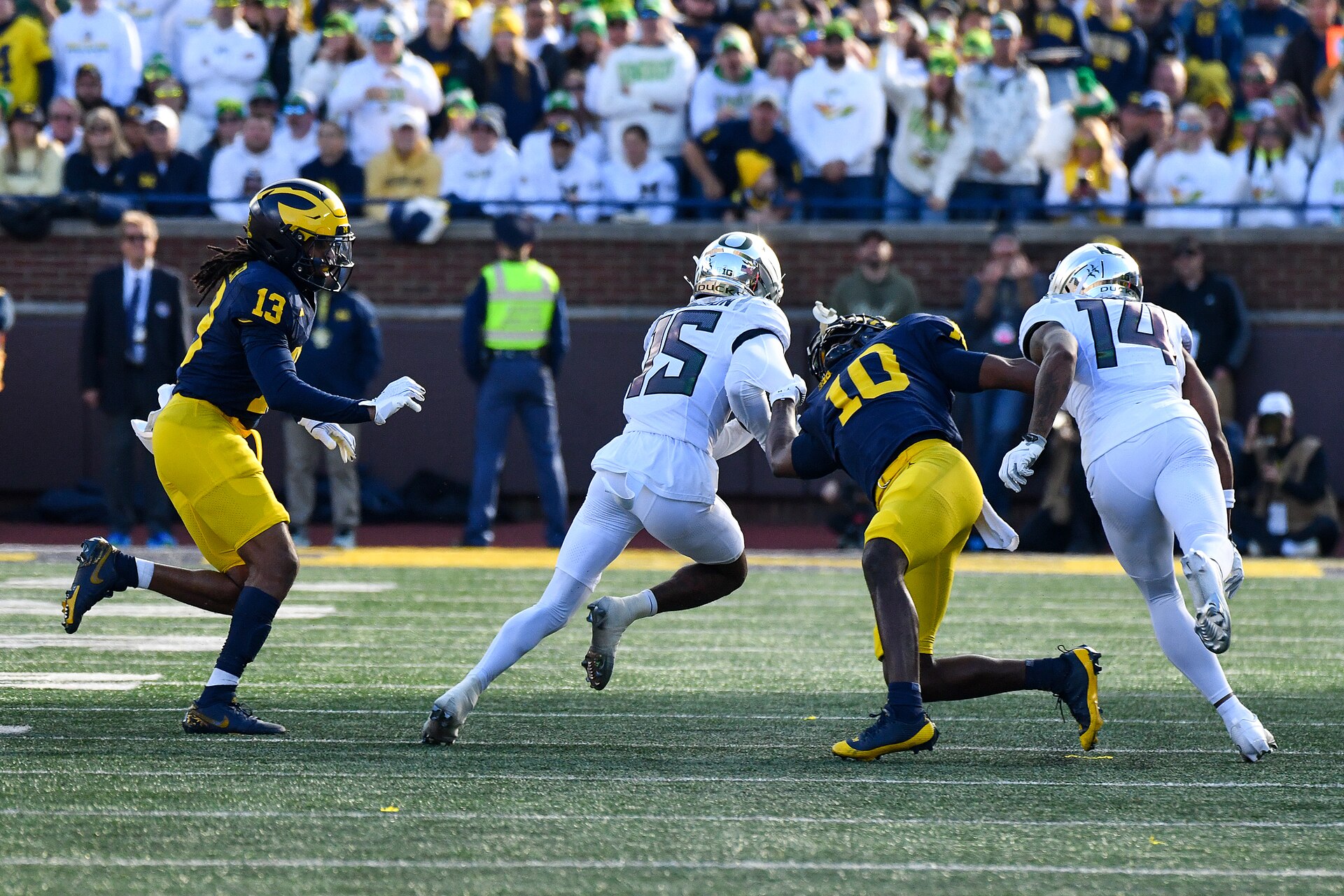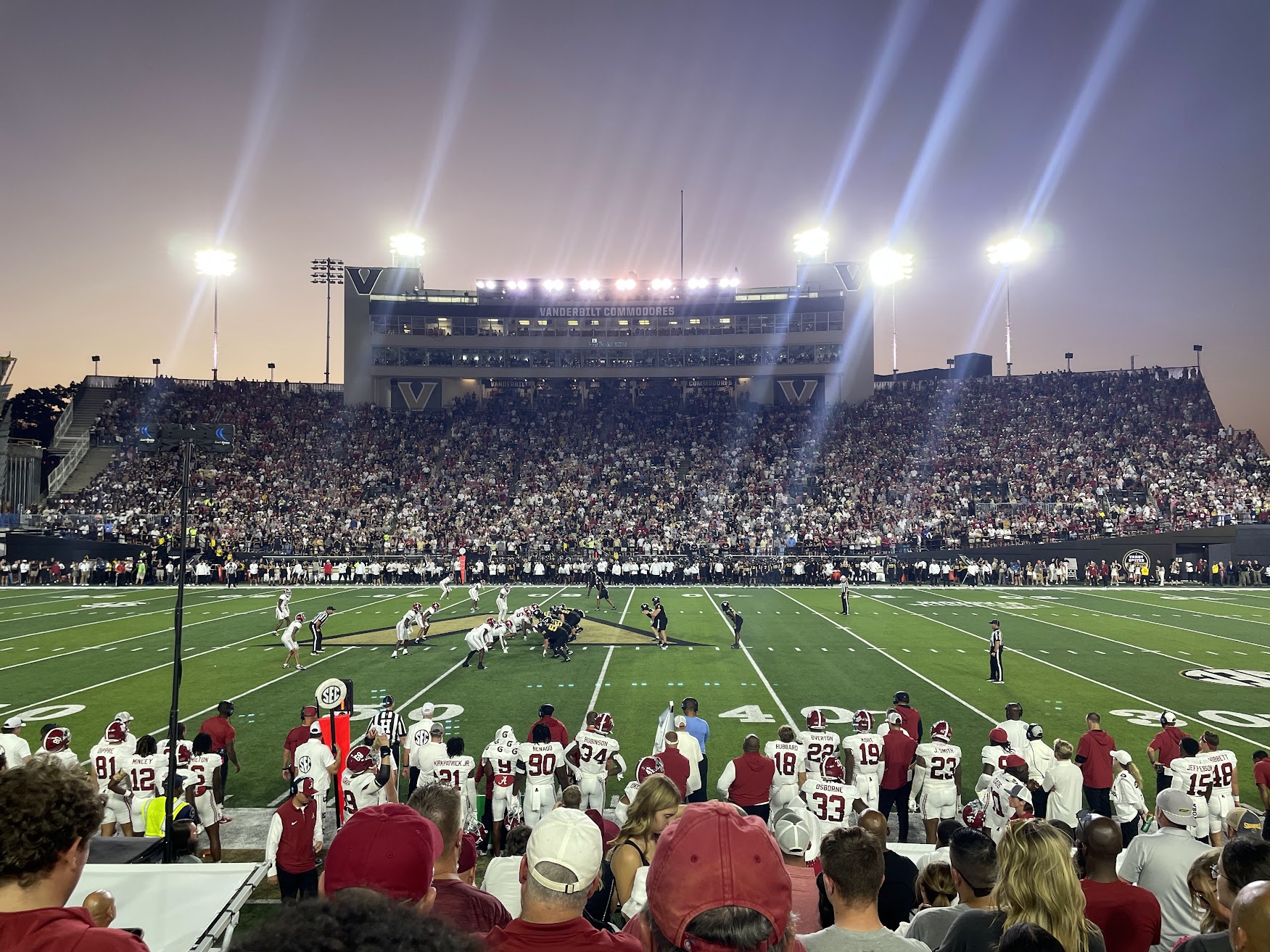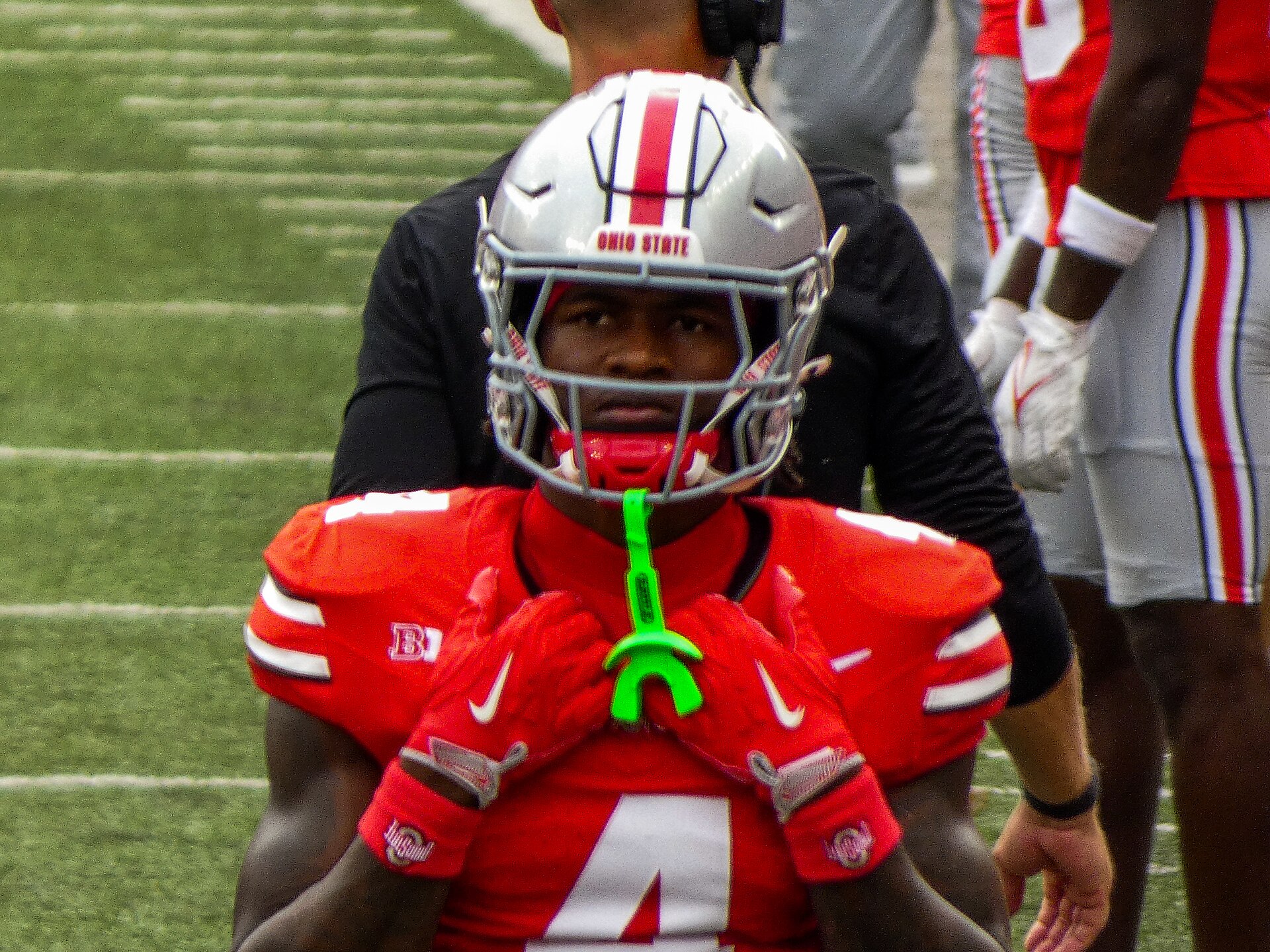
Ohio State receiver Jeremiah Smith in an August 31, 2024 archive photograph. This is not a photograph of the November 2026 Northwestern game. Archive photo by Ruralexpat (CC0).
Ohio State got the result it needed against Northwestern on Saturday, but the 28–19 victory was more an exercise in recovery than a declaration that every problem had disappeared. Luke Fahey threw three touchdown passes, Jeremiah Smith repeatedly supplied the dependable target, and Bo Jackson gave the Buckeyes a productive running game as they ended a two-game losing streak in Columbus.
The victory moved Ohio State to 7–3 overall and 5–2 in the Big Ten. Northwestern fell to 6–4 and 3–4. The official Ohio State game center confirms the final score and the central contrast: the Buckeyes generated more offense and controlled more of the afternoon, while mistakes kept the Wildcats involved longer than the home team would have preferred.
For a program coming off consecutive defeats, that combination produces a complicated verdict. Winning stopped the immediate slide. Turning the ball over three times made the performance less reassuring. The useful conclusion is neither that Ohio State has solved its season nor that an imperfect win counts for little. It found a workable route through a game in which its margin for comfort repeatedly narrowed.
The response that changed Northwestern vs Ohio State
Northwestern began with Jackson Kleather’s 44-yard field goal and later added another from 46 yards. Ohio State’s first touchdown came on Fahey’s short pass to Isaiah West, and Jackson’s two-yard run helped build a 14–6 halftime lead. The Wildcats were behind, but they had kept the game within reach without needing an unusually explosive offensive half.
The most important challenge arrived after the break. Nicco Marchiol completed an eight-play, 58-yard drive with a two-yard rushing touchdown, cutting the deficit to 14–13. That sequence, detailed in Northwestern’s official recap, created the point at which Ohio State had to demonstrate a response rather than merely protect an early advantage.
The Buckeyes supplied one. Fahey found Devin McCuin for an eight-yard touchdown late in the third quarter, restoring an eight-point cushion. In the fourth, a short touchdown pass to Smith extended the lead to 28–13. Northwestern’s final score came on a 17-yard Marchiol pass to Luke Dehnicke as time expired, changing the margin without creating another possession in which the Wildcats could threaten the outcome.
That chronology matters when interpreting a nine-point final. Northwestern genuinely challenged Ohio State by moving within one point in the third quarter. It did not spend the closing seconds with the ball and an opportunity to take the lead. The game had both a competitive middle and a more controlled finish for the home team, and a useful recap should preserve that distinction.
Luke Fahey found production without a huge passing total
Fahey finished 21 of 32 for 201 yards, three touchdowns and one interception. Those figures, available in the official box score, describe an afternoon in which the passing game’s value came from completing possessions rather than overwhelming Northwestern with sheer yardage. The three scoring passes went to three different receivers, even though Smith carried much of the receiving workload.
There is a practical reason that distribution matters. A defense can devote attention to the most dangerous receiver and still lose if complementary targets finish drives. West and McCuin did not need Smith’s reception total to make decisive contributions. Their touchdowns turned productive stretches into points, allowing the offense to extract more value from a passing total that would not look extraordinary on its own.
Fahey’s interception remains part of the evaluation. A quarterback can produce the winning throws and still leave room for improvement in ball security. Saturday offered evidence of progress in the offense’s ability to respond, rather than a reason to stop examining the possessions that ended prematurely. Those two judgments can coexist without diminishing the importance of the win.
The broader context was demanding. Ohio State entered after defeats against Southern California and Oregon, a sequence reflected in the school’s pregame notes and season record. After that kind of stretch, routine execution becomes consequential. A completed pass that sustains a drive, a correct protection or a reliable short-yardage option can matter more immediately than a spectacular highlight that does not resolve the next third down.
Jeremiah Smith and Bo Jackson gave the offense its structure
Smith caught 11 passes for 117 yards and a touchdown. Jackson ran 20 times for 114 yards and a score. Their production gave Ohio State two distinct ways to make progress: a receiver who could remain central to the passing plan and a runner who could carry a substantial share of the rushing work.
Calculated from the published totals, Smith accounted for about 58 percent of Ohio State’s passing yards. Jackson averaged 5.7 yards per carry. Those are measures of concentration and efficiency, respectively. They help explain how the Buckeyes could construct a winning offensive performance without needing the quarterback to post a much larger yardage number.
The benefit of a dependable primary receiver goes beyond a final reception count. He gives a quarterback a familiar answer when a play becomes urgent. The corresponding danger is that an offense can become predictable if every difficult situation points toward the same player. Ohio State’s touchdown distribution offered a partial counterbalance, even as Smith remained the obvious focal point.
Jackson’s role supplied a different kind of stability. A productive run does not simply add yards; it changes the menu available on the next snap. Manageable distances allow an offense to keep more options credible. Long-yardage situations let a defense narrow its expectations. Saturday’s ground production helped Ohio State avoid depending entirely on difficult passing answers.
Turnovers kept the victory from feeling comfortable
Northwestern’s defense created three takeaways. Braden Turner recorded an interception and a fumble recovery, while Braydon Brus recovered another fumble. Those plays helped the visitors remain relevant in a game where their offense did not consistently match Ohio State’s movement down the field. They also explain why the winning team still has specific work to do.
Turnovers are not interchangeable events. An interception on a developing drive, a loose ball in traffic and a special-teams mistake can produce different field positions and different consequences. What unites them is the removal of an expected possession or the creation of an unusually short one. A team can absorb that cost against one opponent and find it decisive against another.
Ohio State benefited from exactly that kind of swing before its final touchdown. The official play-by-play records a muffed Northwestern punt return recovered by Dalton Riggs at the Wildcats’ 10-yard line. Three plays later, Fahey found Smith for the score. The offense still had to finish, but special teams had sharply reduced the distance required.
That sequence deserves a place beside the passing and rushing numbers because it changed the task. A ten-yard touchdown drive asks different things from an offense than an eighty-yard march. Crediting the recovery does not diminish the score; it gives the full team credit and explains how field position helped Ohio State turn an eight-point lead into a fifteen-point advantage.
What Northwestern showed, and what it could not sustain
Marchiol threw for 225 yards, completing 18 of 31 passes, and scored once as a runner and once through the air. Dehnicke’s five catches for 88 yards provided a productive outlet. Caleb Komolafe led the running game with 54 yards on 11 carries. The Wildcats had individual contributions and stretches of effective play, but those stretches did not become a complete offensive performance.
The team totals show the limitation. Northwestern finished with 278 yards to Ohio State’s 369 and only 53 net rushing yards to the Buckeyes’ 168. Its six third-down conversions came on fifteen attempts, compared with six on twelve for Ohio State. The visitors created chances through their defense, but they did not consistently turn possession into enough sustained pressure.
For Northwestern, the lesson is therefore more specific than simply needing more effort or believing in an upset. The defense produced opportunities. The offense brought the game within one point. What was missing was the ability to keep generating answers after Ohio State responded. Against a talented opponent at home, intermittent success could make the game competitive without making it winnable at the end.
The Wildcats’ next scheduled game is at Minnesota on November 21. Ohio State goes to Nebraska before returning home for Michigan. Those fixtures give each team an immediate way to test whether Saturday’s lessons carry forward. For Northwestern, the priority is converting its disruptive defensive work into a more complete result. For Ohio State, it is preserving its productive balance while removing avoidable possessions lost.
The scoring pattern also gives the coaches a useful comparison between halves. Ohio State scored fourteen points in each, but the second-half points arrived after Northwestern had forced a fresh decision about the game. Maintaining production under that pressure was significant. It showed that the offense could return to its principal options instead of abandoning its structure when the score tightened.
Conclusion: a necessary win with a clear next assignment
Ohio State’s best achievement was its response when Northwestern reduced the lead to a single point. The Buckeyes produced the next two touchdowns and prevented the game from becoming a final-possession scramble. Fahey’s scoring throws, Smith’s reliability and Jackson’s rushing production supplied a credible foundation for that response.
The concerns are equally concrete. Three giveaways and an afternoon that required repeated repair are not the profile of a finished product. The 28–19 result stopped the losing streak, protected Ohio State’s remaining opportunities and gave Ryan Day’s team something firmer to build on. Its next step is to make that foundation less dependent on recovering from its own mistakes.