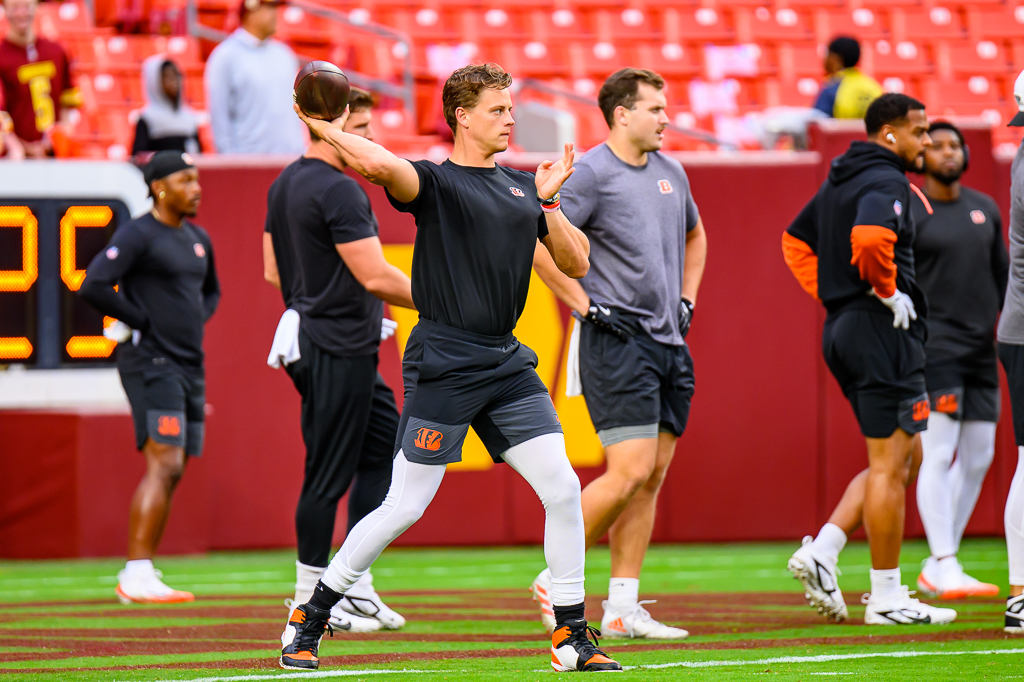
Joe Burrow warms up before Cincinnati’s preseason game at Washington on August 18, 2025. Archive photograph, not the November 2026 Steelers game. Archive photo by Joe Glorioso / All-Pro Reels (CC BY-SA 4.0).
The Pittsburgh Steelers arrived in Cincinnati with a share of the AFC North lead and left chasing a Bengals team that had controlled almost everything that mattered. Joe Burrow threw for 409 yards and four touchdowns, Ja'Marr Chase collected 231 receiving yards, and Cincinnati won 38-18 on Sunday night to take sole possession of first place.
The November 15 result at Paycor Stadium moved the Bengals to 7-2 and Pittsburgh to 6-3. It ended the Steelers' four-game winning streak and extended Cincinnati's to five. More revealing than the 20-point final margin was the position of the game before Pittsburgh's late touchdowns: Cincinnati led 24-3 at halftime and 31-3 entering the fourth quarter.
This was not a game turned upside down by a series of turnovers. Neither team lost the ball on an interception or fumble. Cincinnati instead established a sustained advantage through passing efficiency, long possessions and a Pittsburgh offence that spent much of the meaningful contest unable to respond.
“We did not execute at a good enough level to win,” defensive lineman Cam Heyward said in the Steelers' postgame account. The numbers make that assessment difficult to dispute. Pittsburgh's challenge now is to identify why a team coming off a bye could be so comprehensively outplayed, rather than allowing two fourth-quarter touchdown passes to soften the diagnosis.
Burrow and Chase made the field feel much larger for Pittsburgh
Burrow completed 35 of 44 passes with no interceptions. Calculated from those totals, that is a completion rate of about 80 percent and 9.3 yards per attempt. Those figures describe more than a quarterback repeatedly accepting short gains. They show an attack combining dependable completions with substantial movement downfield.
Chase caught 11 passes for 231 yards, averaging 21 yards per reception. His yardage accounted for about 56 percent of Burrow's passing total, a concentration that gave Pittsburgh an obvious problem without making that problem easy to solve. A defence can know where an opponent's most dangerous receiver is and still struggle to limit him.
The Bengals' official recap and notes credit Burrow with 302 passing yards and three touchdowns in the first half alone. Cincinnati reached halftime with a three-touchdown advantage while Pittsburgh was still trying to establish a functioning offensive rhythm. By then, the Steelers needed a substantial change in both their own production and the frequency with which they could get Burrow off the field.
Yet Chase did not catch any of the four touchdown passes. Two went to running back Chase Brown, with the others going to tight end Drew Sample and receiver Dohnte Meyers. That distribution is an important part of the performance. The receiver generating the largest gains and the players completing scoring possessions did not have to be the same people.
It also illustrates the difficulty of assessing coverage purely through touchdown totals. A player can place enormous pressure on a defence without appearing in the scoring summary. Conversely, a short touchdown catch may be the final consequence of problems created earlier in a drive. Cincinnati's production required Pittsburgh to defend several parts of the field, and the Steelers did not contain enough of them.
The Bengals say this was their fifth consecutive game with at least 30 points, the longest such streak in franchise history. The result therefore belongs to an extended period of offensive success, rather than standing as an isolated good night. Pittsburgh had encountered a team already playing with considerable confidence and did little to interrupt it.
The possession and yardage gap explains the scale of the defeat
The NFL's official gamebook records 484 net yards for Cincinnati and 222 for Pittsburgh. The Bengals averaged 7.4 yards per offensive play, compared with the Steelers' 3.8. Their time of possession was 35 minutes, nine seconds, leaving Pittsburgh with 24 minutes, 51 seconds.
The first-half comparison was harsher still: Cincinnati gained 337 net yards while Pittsburgh managed 40. A team can survive losing the overall yardage contest, particularly if it creates turnovers or wins field position decisively. The Steelers had no takeaways to provide that alternative route, and their early offensive possessions did not manufacture enough relief.
Time of possession alone is not an explanation of quality. A team can hold the ball for a long time without scoring efficiently, or score quickly and leave its defence on the field. Here it supports the other evidence: Cincinnati moved the ball, sustained drives and converted its superiority into a large lead. The metrics point in the same direction.
The Bengals' first possession produced a field goal, followed by a long touchdown drive that made it 10-0 early in the second quarter. Pittsburgh's difficulty answering those possessions meant the contest developed largely on Cincinnati's terms. The Steelers could not force enough exchanges in which their own offence placed comparable pressure on the opposing defence.
A third-down percentage by itself would give a misleadingly incomplete impression. Pittsburgh converted five of 13 attempts, while Cincinnati converted two of seven. Those totals do not show the Bengals losing control. They reflect how often Cincinnati was able to make progress without reaching third down, while Pittsburgh's final totals include work done after the deficit had become enormous.
That is why game state belongs beside a box score. A successful play at 31-3 may still demonstrate useful execution, but its influence on the outcome differs from a successful play in a one-score game. The fourth-quarter Steelers offence cannot be evaluated as if it had produced the same plays while the teams were level.
Pittsburgh's missed opening became a decisive second-quarter swing
The most damaging sequence came after Pittsburgh finally assembled a scoring opportunity late in the first half. Trailing 17-0, the Steelers reached Cincinnati territory but settled for Chris Boswell's 45-yard field goal with 1:25 remaining. The chance to enter halftime with some momentum lasted only until Burrow's next possession.
Cincinnati travelled 57 yards in eight plays and scored with nine seconds left. Meyers caught the 15-yard touchdown, turning what could have been a more manageable halftime deficit into 24-3. The Steelers were due to receive the second-half kickoff, so preventing that response would have preserved a clearer route back into the game.
Aaron Rodgers finished 15 of 29 for 143 yards, two touchdowns and no interceptions. The absence of a turnover was positive, but it did not compensate for the offence's limited movement during the period that established the result. A team needs more from its passing game than avoiding the single most conspicuous mistake.
Jaylen Warren carried seven times for 15 yards. Pittsburgh's eventual 102 rushing yards include later contributions from other players, and do not describe a ground attack that had controlled the opening stages. The relationship between the two phases became unfavourable: an ineffective start helped create a large deficit, and that deficit narrowed the range of sensible offensive choices.
The late touchdowns went to DK Metcalf and Pat Freiermuth. Metcalf also caught a two-point conversion, while Freiermuth's 27-yard score came with 7:19 remaining. Those were genuine scoring plays, but by then Cincinnati had already built and defended the lead that decided the contest.
There was also an injury concern. The Steelers reported that left guard Mason McCormick left on a cart with a right ankle injury. The initial account does not establish his availability for the next game. Any further conclusion should follow the team's medical updates rather than an assumption based on the appearance of the incident.
The division race has changed position, rather than reached a verdict
Cincinnati now has the lead, but the season series is split. Pittsburgh won the earlier meeting, which prevents Sunday night's result from becoming a complete description of the matchup across the year. It does, however, establish which team is ahead after Week 10 and which has the more immediate momentum.
For the Bengals, the strongest signal is the combination of offensive consistency and protection of the ball. Burrow's passing volume produced four touchdowns without an interception, while the team did not need a takeaway to create separation. That is a different kind of win from one built around short fields and defensive scores.
Burrow nevertheless kept the calendar in perspective in the team's account: “We've got a lot of football here to be played.” Cincinnati next travels to Washington for Monday Night Football in Week 11. Another prominent stage offers an opportunity to carry the form forward, but it does not automatically reproduce the advantages of a dominant home performance.
Pittsburgh remains on the road to face Philadelphia. Its response needs to begin earlier than the fourth quarter. The offence must sustain possessions before a deficit dictates its choices, while the defence needs to reduce the easy progression from one completed pass to the next. The burden cannot rest entirely on either Rodgers producing a rescue or the defence manufacturing turnovers.
The broadcast highlights from NBC Sports preserve the most visible plays, but the official records explain the broader result: Cincinnati was substantially more productive per play, owned much more of the first half and scored through several different receivers. Pittsburgh's late response altered the final margin without changing those fundamentals.
A 6-3 record leaves the Steelers firmly in a competitive season. Sunday night nevertheless supplied a demanding benchmark. The Bengals won the game through sustained execution and took the division lead in the process. Pittsburgh's answer will be measured by whether it can correct the early failures, not by how quickly it can dismiss the defeat as one bad evening.