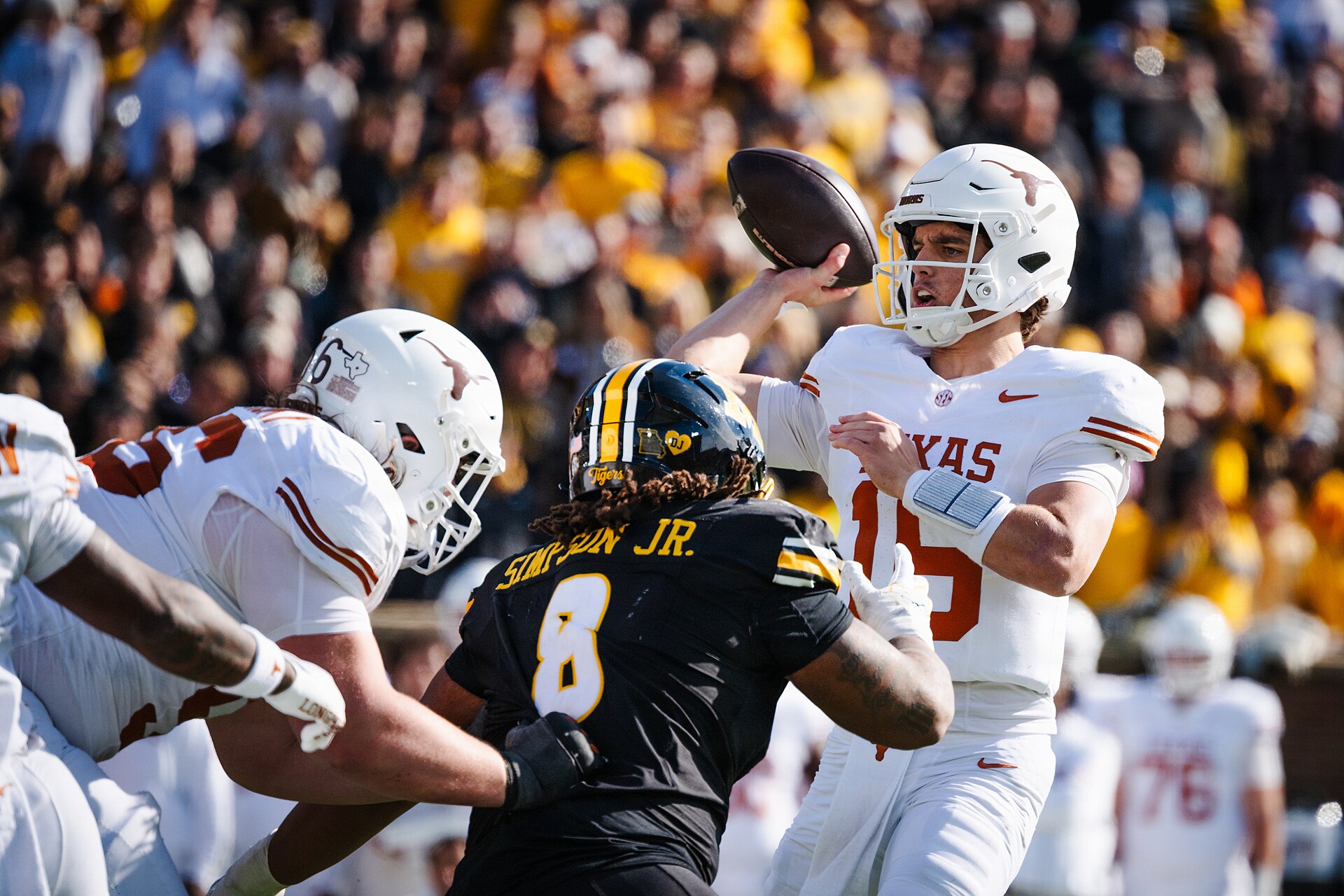
Arch Manning plays against Missouri in Columbia on November 7, 2026. This U.S. Air Force photograph is from the previous week, not the LSU game or its postgame celebration. Archive photo by U.S. Air Force / Staff Sgt. Joshua Hastings (Public domain).
Arch Manning's celebration after Texas beat LSU has become a second contest, played out through a short video and the conclusions attached to it. The clip shows the quarterback running toward his teammates after Saturday night's 22-21 victory. Some online interpretations treated their separation as evidence that the team was refusing to celebrate with him. The missing context is more ordinary: Manning had remained behind for a television interview while his teammates moved toward the end zone.
USA TODAY's John Leuzzi reports that Manning was speaking with ESPN's Holly Rowe near midfield after the postgame handshakes. The rest of the Longhorns had gone to the end zone for the traditional playing of “The Eyes of Texas.” When the interview ended, Manning ran to join them. The footage does not establish the locker-room rejection that some captions claimed.
There is, however, a serious football argument beneath the social-media noise. Manning threw three interceptions before delivering the late touchdown that rescued Texas. His performance created problems and eventually helped solve them. Understanding both parts is more useful than turning either a winning pass or a few seconds of celebration into a complete assessment of his night.
The official Texas recap records a four-yard touchdown pass to Raleek Brown with three seconds remaining at Tiger Stadium on November 14. It finished an 11-point second-half comeback in front of 102,321 spectators and moved the Longhorns to 8-2 overall and 5-2 in the Southeastern Conference. Those are the stakes behind the joy in the clip—and behind the frustration that preceded it.
The game was more complicated than its final throw
Manning completed 19 of 35 passes for 174 yards, with one passing touchdown and three interceptions. He also ran for a score. The official box score presents a much less comfortable evening than the final highlight suggests: Texas finished with 273 total yards to LSU's 366 and had to keep finding ways to survive after promising possessions ended without enough points.
Calculated from those passing totals, Manning completed about 54 percent of his attempts and averaged just under five yards per attempt. Neither figure describes an efficient, sustained passing attack. The last drive therefore should be understood as a decisive improvement at the necessary moment, rather than proof that the preceding difficulties were imaginary.
The opening possession had offered a different impression. Texas drove 75 yards in 11 plays, and Manning finished with a one-yard rushing touchdown. LSU responded with its own extended scoring drive. Quarterback Sam Leavitt found Jackson Harris for a 10-yard touchdown, then connected with Harris again for a nine-yard score in the second quarter, according to LSU's account of the game.
For LSU, safety Ty Benefield was central to the resistance. The Tigers credited him with eight tackles, two interceptions and a sack. Princewill Umanmielen also recorded eight tackles. Those contributions belong in the explanation of Manning's struggles: an interception total is a quarterback statistic, but a defence must recognise opportunities and finish plays to turn pressure into possession.
Dilin Jones' 44-yard touchdown run in the third quarter made it 21-10. At that point Texas needed more than a spectacular offensive moment. It needed enough defensive stops to prevent the required comeback from growing larger, and enough scoring along the way to make a final touchdown useful. The Longhorns eventually received both.
The final score also changes how the losing team will remember the night. LSU had created the advantage and the turnovers required to beat a highly ranked opponent, but it did not protect that position. A one-point loss does not mean the preceding work lacked value. It means the game remained open long enough for Texas to convert its last opportunity.
The comeback depended on defence and a kicker as much as Manning
Jelani McDonald's performance is the strongest corrective to a quarterback-only account. He intercepted three passes and finished with 11 tackles. Texas' postgame notes identify his interception total as tied for the second-most in a game in program history and the most by a Longhorn since Aaron Humphrey's three in 1997. It was an exceptional individual defensive contribution within a game decided by one point.
Rasheem Biles also had 11 tackles, adding a sack and two tackles for loss. Those plays do not produce the same easily circulated image as a last-second touchdown, but they help explain why the opportunity remained available. A comeback requires possession of the ball; defensive pressure and changes of possession supply it.
Gianni Spetic supplied the points that narrowed the problem. He made field goals from 42, 41 and 50 yards. The last of those brought Texas within five in the fourth quarter. The distance of the attempts matters: this was not merely a case of finishing drives that had reached easy kicking range. Spetic repeatedly converted possessions that stopped well short of the end zone.
The arithmetic makes his importance plain. Texas scored two touchdowns and three field goals. The final touchdown could become a winning score because the field goals had already reduced an 11-point deficit to five. Remove any one of those three kicks without changing the rest of the scoring, and the same final pass would not have produced the same result.
Texas held LSU scoreless in the fourth quarter and, according to its recap, forced four consecutive punts during the late stretch. That defensive sequence gave the offence repeated access to a game it had not yet earned control of. The winning drive was the last piece of the comeback, rather than the whole of it.
The Southeastern Conference's official game highlights provide a useful companion to the disputed celebration clip. Watching the football sequence places the final pass beside the plays that made it possible. A complete account has room for Manning's late execution, McDonald's takeaways, Spetic's range and an LSU team that had been close to closing the game out.
One successful drive can matter without erasing the mistakes
Texas' winning possession covered 58 yards in 12 plays and consumed two minutes, 16 seconds. Manning completed six of eight passes for 51 yards on that drive and added 10 rushing yards, the school reports. Compared with his full-game passing figures, the final series was a marked change in execution.
A short touchdown pass should not be confused with a trivial play. Near the goal line, the defence has less space to protect, but the offence also has less room in which to create a clean completion. Brown still had to finish the route and secure the ball, while Manning had to deliver the instruction the play required with almost no time remaining.
The ending demonstrates why quarterback assessment should preserve two time scales. Over the full evening, Manning's turnovers were a substantial liability. On the possession that decided the result, he completed the work needed to win. Calling the night flawless would ignore the first fact; insisting the winning series was meaningless would ignore the second.
Ryan Wingo led Texas with six catches for 68 yards, while Brown finished with four catches for eight yards and the winning score. That contrast is a reminder that a receiving total and the value of one particular catch can tell very different stories.
The same applies to criticism of team leadership. Teammates' feelings cannot be read reliably from a brief shot taken after the final whistle, particularly when television obligations explain why the quarterback is separated from the group. Performance criticism has a firmer foundation when it addresses decisions, execution and results that can actually be examined.
That does not make the celebration an irrelevant image. It captures the release after a difficult game and the peculiar visibility attached to a famous quarterback. What it cannot do is carry the evidentiary weight placed on it by a caption claiming to know why every other player is standing somewhere else.
Leuzzi's reporting supplies the sequence that the excerpt omits. The interview happened, the team moved toward its tradition, and Manning followed when his obligation ended. There is no need to invent a feud to explain that movement. The football itself supplies enough drama.
What Texas takes forward from the escape at LSU
The Longhorns' next game is against Arkansas in Austin on November 21, with kickoff scheduled for 2:30 p.m. Central, or 3:30 p.m. Eastern. Texas lists it as the final home game on its current schedule. After an emotionally expensive road victory, the immediate task is to carry the result forward without treating the comeback as a repeatable plan.
The strongest part of Texas' case is its ability to keep a difficult game within reach. Its defence produced takeaways, its kicker converted demanding attempts and its offence eventually completed the decisive possession. The more concerning part is how much rescue work was necessary. A team cannot reasonably expect three interceptions to be offset by an extraordinary defensive interception performance every week.
Manning's challenge is consequently more specific than proving he can celebrate with his teammates. He needs the accuracy and decision-making of the last drive to appear more consistently before the game becomes an emergency. The rest of the offence also has to turn field position and possessions into more dependable production.
The conclusion is clear enough without a social-media verdict. Texas earned a dramatic 22-21 victory, Manning delivered the winning pass after a difficult performance, and several teammates made indispensable contributions. The viral celebration clip left out a television interview, not a secret explanation of the team's relationships. The lasting story is the Longhorns' escape—and whether they can build something steadier from it.