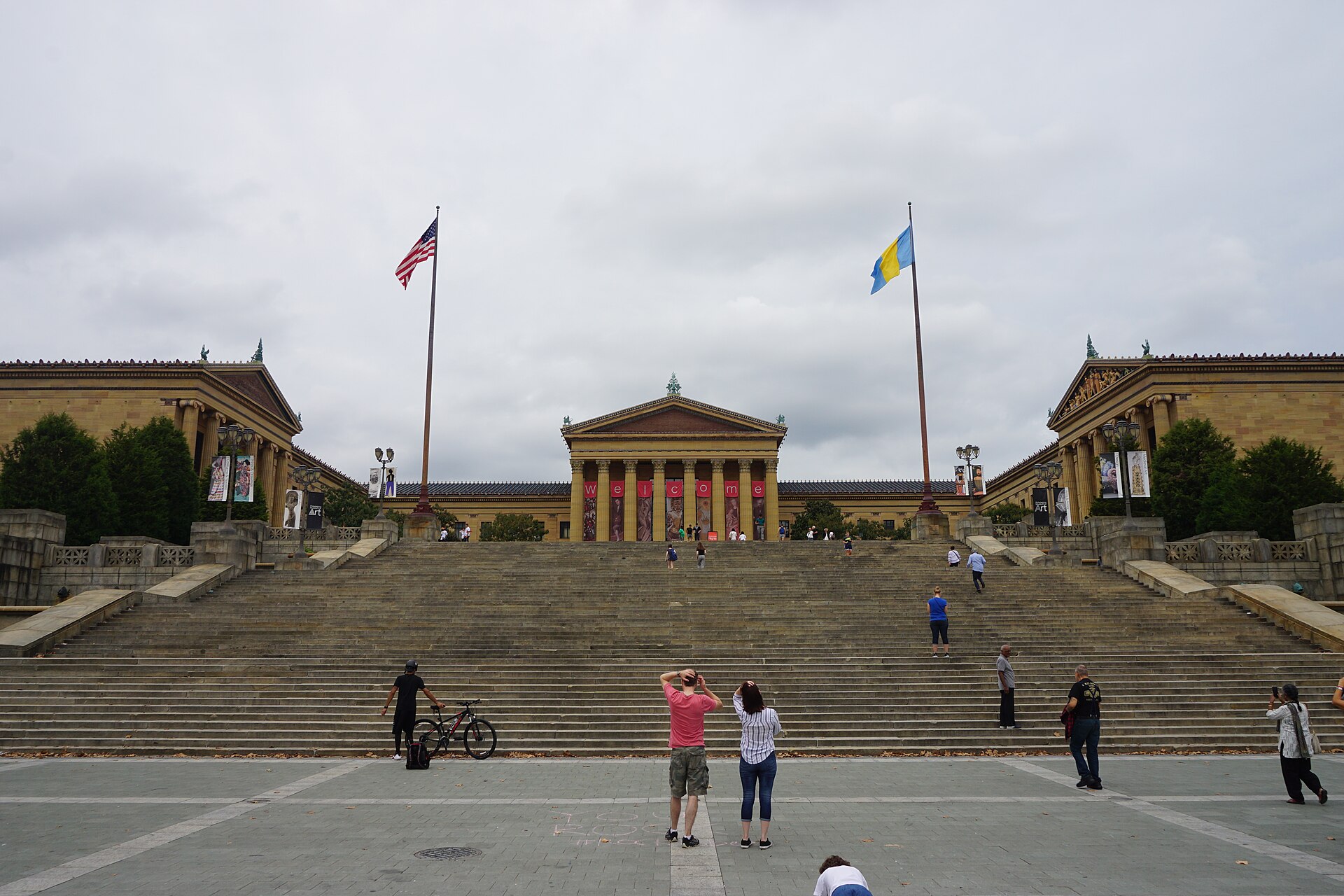
Visitors at the Philadelphia Museum of Art steps on October 11, 2017. Archive view of the landmark associated with Rocky; not a photograph of the 2026 race. Archive photo by Michael Barera (CC BY-SA 4.0).
Gobi Thurairajah led the men's standings in the 5K, 10-mile race and combined Italian Stallion Challenge at the 2026 Rocky Run, according to the event's published timing results. The November 14 races gave Philadelphia's celebration of the original film's 50th anniversary a competitive centerpiece, bringing a familiar movie ritual into the much more measurable world of bib numbers, timing chips and finish positions.
Thurairajah's listed times were 15 minutes, 43 seconds for the 5K and 52:30 for the 10-mile race, producing a combined 1:08:13. Arden Taylor led the women's 5K in 19:13, Roxanne Ramirez led the women's 10-mile standings in 1:01:04 and Angel Piccirillo topped the women's combined challenge in 1:26:15.
Those results come from the official Race Roster timing site checked Saturday evening. They provide a sharper account of the sporting event than the broad attendance estimates circulated before race day. They also highlight what makes this run distinctive: participants can tackle one distance or manage the demands of two separate starts on the same morning.
The results behind Thurairajah's three-race sweep
The 5K leaderboard placed Timothy Lanahan second in 16:05 and Luca Parente third in 16:12. In the 10-mile standings, Alessio Pignatelli followed Thurairajah in 55:37, with Lanahan third in 56:09. Lanahan was second in the combined challenge at 1:12:14, while Andrew Kasper was third in 1:15:33.
The margins help explain the sweep. Thurairajah's 22-second advantage in the shorter race was followed by a substantially larger gap over 10 miles. His combined lead over Lanahan was four minutes and one second. That arithmetic shows the importance of the longer leg without pretending to reconstruct tactical decisions that a timing table alone cannot reveal.
In the women's challenge, Piccirillo's listed components were 23:08 and 1:03:07. The result demonstrates why the combined competition should be read on its own terms: winning a single leg and recording the fastest total across both races are different achievements. The leading names need not be identical across every category.
For individual runners, the complete leaderboard offers far more detail than an overall podium. Age divisions, category positions and recorded times make it possible to place a personal effort in context. The official information page also lists nonbinary overall awards, extending the event’s published categories beyond the selected leaders highlighted here. A first attempt at the longer distance and a contest at the front of the field can both belong to the same event without representing the same sporting objective.
The Italian Stallion Challenge is two races
The organizer's challenge description is explicit: the Italian Stallion format combines a 5K with a 10-mile race, for a marketed total of 13.1 miles. The scheduled starts were 7 a.m. for the 5K and 8 a.m. for the 10-miler. It is not a single continuous half-marathon with one start.
That distinction changes the experience. Completing a short race and then lining up again requires a runner to think about the second effort while handling the first. The time available between starts depends on how quickly the initial distance is completed and on the event's starting arrangements. A single combined mileage figure does not describe those demands by itself.
It also changes how performances should be compared. A combined challenge time sums the racing components; it should not be casually compared with a personal best from an uninterrupted half-marathon. The distance label is familiar, but the structure is different. Good results reporting explains that difference rather than leaving readers to infer it.
The organizer awards challenge finishers an additional medal alongside the medals for the component races. That presentation helps make the event approachable for people whose goal is completing a demanding morning rather than pursuing an overall title. At the same time, the separate leaderboards preserve a competitive record for those racing the full challenge.
The race finishes by the museum, not at the top of the steps
The official race information places the start on Benjamin Franklin Parkway in front of the Philadelphia Museum of Art and says the finish is also in front of the museum. The course does not end by sending the field up the famous stairs. That is an important correction to the mental picture many people bring from the film.
The museum remains the event's defining setting, but a road race and a cinematic stair climb have different practical requirements. Thousands of people need room to move through a finish area, while timing, volunteers and supporting services have to work around them. The landmark supplies the identity without needing to become the final stretch of the official course.
There is a separate uphill contest within the longer race. The organizer calls it Mount Drago and records the climb with timing mats, with medals for the fastest 100 male and 100 female finishers on that segment. A runner's hill time is therefore another result, distinct from an overall 10-mile placing.
That creates several ways to engage with the event. A participant may focus on the shorter distance, the longer race, a combined total or the timed ascent. The variety makes it possible for the same route to support different personal ambitions, while requiring readers to check exactly which competition a result describes.
How large was the 2026 Rocky Run?
Before Saturday's races, the Associated Press reported tourism officials' expectation of 45,000 runners from all 50 states and 75 countries. Visit Philadelphia's anniversary guide used an estimate of about 40,000. Those were advance figures from different accounts, not interchangeable statements of verified finishers.
There is a further counting issue in a multi-race event. The same person can appear in the 5K, the 10-mile results and the challenge standings. Adding those lists does not produce a unique participant count. A responsible account should identify whether it is describing registrations, expected visitors, finish records or individual people.
For that reason, this report does not present an advance attendance estimate as the final race total. The meaningful verified point is that the timing site contains separate, substantial fields and category results. A final organizer accounting would be the appropriate basis for a definitive count of unique participants.
The distinction is more than a technicality. Attendance figures become part of how cities assess an event's reach, while finishers measure something else. Both can be useful, but neither should be inflated by counting one person's achievements several times or by converting a promotional expectation into a completed result.
Fifty years of Rocky gives the race a larger setting
The original Rocky arrived in 1976, and its connection to Philadelphia has outlasted the normal publicity cycle of a successful movie. The Academy of Motion Picture Arts and Sciences records its wins for best picture, John G. Avildsen's direction and the editing of Richard Halsey and Scott Conrad at the 1977 Oscars.
Those awards explain part of the film's historical standing, but the run draws on something more accessible than an awards list. Training, persistence and a recognizable place give people a physical way to connect with the story. A fan does not need to become a boxer to understand the appeal of completing an effort that once seemed beyond reach.
The Philadelphia Visitor Center says the 2026 Rocky Season runs from September 29 through December 3, Rocky Day and the anniversary of the film's national release. Its program extends beyond racing into tours and cultural events. Saturday's run is one part of that longer civic celebration.
The anniversary also links two versions of the city: a setting viewers have seen on screen and a place where residents continue their everyday lives. An organized race temporarily brings those versions together. Visitors arrive with an image of Philadelphia, then experience the distances, public spaces and practical movement of a real city.
The world-record gathering and what comes next
The running weekend followed a separate costume gathering at the museum on Friday. AP reported that an announcer confirmed a Guinness record with 570 people dressed as Rocky Balboa. That result belongs to the November 13 gathering, not to Saturday's racing field, and it should not be described as a new road-running record.
Visit Philadelphia's program continues after race weekend. The anniversary guide lists I Play Rocky, a film about the making of the original, for a nationwide release on November 20 after a limited opening. It also lists a Rocky-themed Philadelphia Flyers event on December 3. Visitors should check the linked organizers for current availability and event details.
For runners, the immediate next step is more personal: find the correct category, check the recorded result and use the timing site's correction process if a genuine discrepancy appears. The race FAQ directs participants to the official results and says its photography partner will email race-photo information in the following week.
Choosing the correct distance matters when sharing a result. A photograph at the museum may be a memorable part of the day, but the timing record establishes which race was completed and in what time. Keeping those details together lets participants celebrate an achievement accurately, whether it is a podium finish or a first successful attempt.
Conclusion: a film tradition with a real sporting record
The 2026 Rocky Run produced a clear competitive headline in Thurairajah's sweep, alongside separate women's victories for Taylor, Ramirez and Piccirillo. Its two-start challenge and timed hill segment gave the morning a structure more varied than the shorthand of “running the Rocky steps” suggests.
Fifty years after the film, the event's lasting strength is the opportunity to turn admiration for a fictional underdog into a measurable personal effort. The anniversary provides the occasion; the runners supply the work. The published results give that work its proper record, while Philadelphia's broader celebration continues into December.