Published November 6, 2026 · Taken Social Editorial
Antonio Sivera saved Rubén Vargas' first-half penalty as Deportivo Alavés held Sevilla to a 0–0 draw at the Ramón Sánchez-Pizjuán on Friday. The goalkeeper's intervention preserved a point for the visitors and left Sevilla short of the victory it wanted before the international break.
The opening game of LaLiga's twelfth round offered more opportunity than the score suggests, but neither side found a finish. Sevilla carried more possession and generated the stronger statistical chance total, while Alavés combined its goalkeeper's work with important defensive interventions.
The result left Sevilla on eighteen points and Alavés on thirteen, according to Europa Press' match report. For the visitors, the draw stopped short of ending a league winless run stretching back to September 6.
Sivera turns away the game's clearest opportunity
The defining first-half moment came when Félix Correia won a penalty under a challenge from Ángel Pérez. Vargas took the kick in the 32nd minute, but Sivera kept it out. With the match still goalless, a single intervention changed the value of everything that followed.
A converted penalty would have required Alavés to pursue an equalizer. Instead, the visitors could continue working from a level score, while Sevilla remained under pressure to create another opening. The save did more than protect the goal in one moment; it preserved the circumstances in which the rest of the game was played.
Correia remained a threat later in the match. Europa Press describes his 67th-minute run from the left, a cut inside and a right-footed effort that went wide. It was another indication that Sevilla could reach dangerous positions without supplying the final touch the evening required.
Those two episodes frame the home side's frustration. One was a high-value dead-ball chance, the other a move developed through individual running and technique. Neither produced a lead, leaving the scoreboard unchanged despite different routes toward goal.
The second half still required decisive defending
Cadena SER's account describes Sivera turning away a Juan Iglesias header after a Gabriel Suazo cross. It also records Pablo Ibáñez clearing an Iglesias effort from the line with the goalkeeper beaten.
Alavés had an opening of its own later, when Carlos Benavídez was unable to finish a chance following a corner. Odysseas Vlachodimos intervened at close range. The hosts therefore needed their goalkeeper as well, even if their overall attacking numbers were stronger.
These moments are why a goalless result cannot be understood simply as an absence of attacking activity. A penalty save, a line clearance and a close-range intervention can each be decisive without changing the score. The defensive actions are part of the explanation for the zeroes.
For Alavés, sharing that work mattered. A goalkeeper can rescue a team once, but the players in front of him must still complete defensive situations and manage the next phase. Ibáñez's clearance is a concrete example of an outfield intervention protecting the point after the initial line of defense had been passed.
What the possession and chance figures show
FotMob's final match data gives Sevilla 60% possession, thirteen shots and 34 touches in the opposing penalty area. Alavés had nine shots and fifteen touches in Sevilla's box. The listed expected-goals totals were 1.58 and 0.54 respectively.
Those figures support a reading of greater Sevilla pressure, but each measures a different part of an attack. Possession records control of the ball; touches in the box indicate access to a dangerous area; shots register attempts; expected goals assesses the quality of the resulting chances.
They should not be treated as four separate versions of the same verdict. A team can hold the ball without creating a clear sight of goal. It can also create one very valuable opportunity in a match where it spends less time in possession. The penalty is especially important when interpreting Sevilla's chance total.
Opta's event definitions describe expected goals as a measure based on characteristics such as shot distance, angle, assist type and whether a chance is a header. Adding the values provides an indication of the average scoring return associated with the shots taken.
The metric gives context to the draw; it does not replace the result with a hypothetical score. Sevilla's 1.58 does not mean it scored or was entitled to score two goals. The actual outcome depended on execution, goalkeeping and defending in the particular chances the teams produced.
A shot-based total also captures a different thing from every promising attack. A dangerous pass that never reaches its intended recipient may create concern without producing an attempt to score. Opta separately defines a missed chance for situations where a significant opportunity does not result in a shot. That is one reason to read the numerical summary alongside the reported incidents, rather than expecting any single measure to contain the whole match.
It is also useful to distinguish creating a chance from placing the resulting shot. Stats Perform's explanation of expected goals on target describes a separate model incorporating where an on-target effort travels. That distinction helps explain how a promising chance and a successful save can exist together.
The teams' shapes posed different questions
FotMob lists Sevilla in a 4–2–3–1 and Alavés in a 3–5–2. Those starting shapes provide a framework for reading the matchup, though players' positions necessarily change as a game moves between attacking and defending.
On paper, a back three supported by wing-backs can give a visiting side several bodies across its defensive line. The challenge for the opponent is to move that structure, find space between its members or create a moment before it can reset. A cross, a direct run and a second ball offer different ways of testing it.
Sevilla's reported chances reflect that variety. Suazo's delivery led to a header, Correia attacked from the left, and a loose-ball situation required a line clearance. The opportunities were present in different forms; the home side's problem was completing one of them.
The substitutions did not alter the score. Sevilla introduced Chidera Ejuke for Vargas before later adding Robbie Ure and Alfon González, while Alavés used options including Carlos Protesoni, Abderrahman Rebbach and Mariano Díaz.
A change of personnel can provide fresh running or a different point of attack, but its success still depends on the next possession. Friday's result leaves the effect of those changes within a game whose central defensive resistance held through the closing stages.
A reunion on the touchlines added historical interest
Sevilla's official pre-match history noted the crossed paths of the coaches. Luis García Plaza now leads Sevilla after his earlier Alavés tenure, while Quique Sánchez Flores is in charge of Alavés after previously coaching Sevilla.
The club also identified players with connections to both sides, including Jon Guridi, who joined Sevilla from Alavés in the summer, and Mariano, now with the visitors after his time in Seville. The fixture therefore carried familiar relationships beyond the immediate league-table stakes.
That familiarity is context rather than a complete tactical explanation. Coaches inherit changing squads, and a player's former employer is not the same side indefinitely. It nevertheless adds an extra dimension to the meetings, particularly when both clubs are trying to establish more consistent results.
The pre-match account recorded 46 previous competitive meetings across the top two divisions and the Copa del Rey, with 22 Sevilla wins, twelve draws and twelve Alavés victories. Friday adds another draw to that long history.
Recent visits had also given Alavés reasons for confidence. The two most recent meetings in Seville had finished 1–1, and the visitors won 3–2 there in the 2023–24 season. Friday's clean sheet continued their ability to leave this ground with something.
One point has different implications for each side
For Sevilla, the frustration lies in the combination of home advantage, a penalty and several subsequent chances. The club's preview had identified twenty points as the target before the break. The draw took it to eighteen, leaving that immediate objective unmet.
For Alavés, avoiding defeat at a difficult venue supplies something to build on, particularly after a long stretch without a league win. The clean sheet is a positive result in its own right, but one point at a time cannot entirely solve the problem of a winless sequence.
The sides also have different material to take into their reviews. Sevilla can point to access to the penalty area while asking how to turn that access into more decisive finishing. Alavés can review its defensive interventions while examining how to produce more sustained attacking relief.
The distinction matters because a shared score does not mean a shared performance or a shared emotional response. The hosts had reasons to feel an opportunity had escaped. The visitors had reasons to value Sivera's work and the defensive actions that followed it.
Friday ultimately belonged to the players who kept the ball out. Sivera's penalty save supplied the headline moment, but the draw also required a line clearance at one end and a close-range intervention at the other. Sevilla and Alavés each left with a point, and each with a clear question about how to turn the next opportunity into a winning goal.
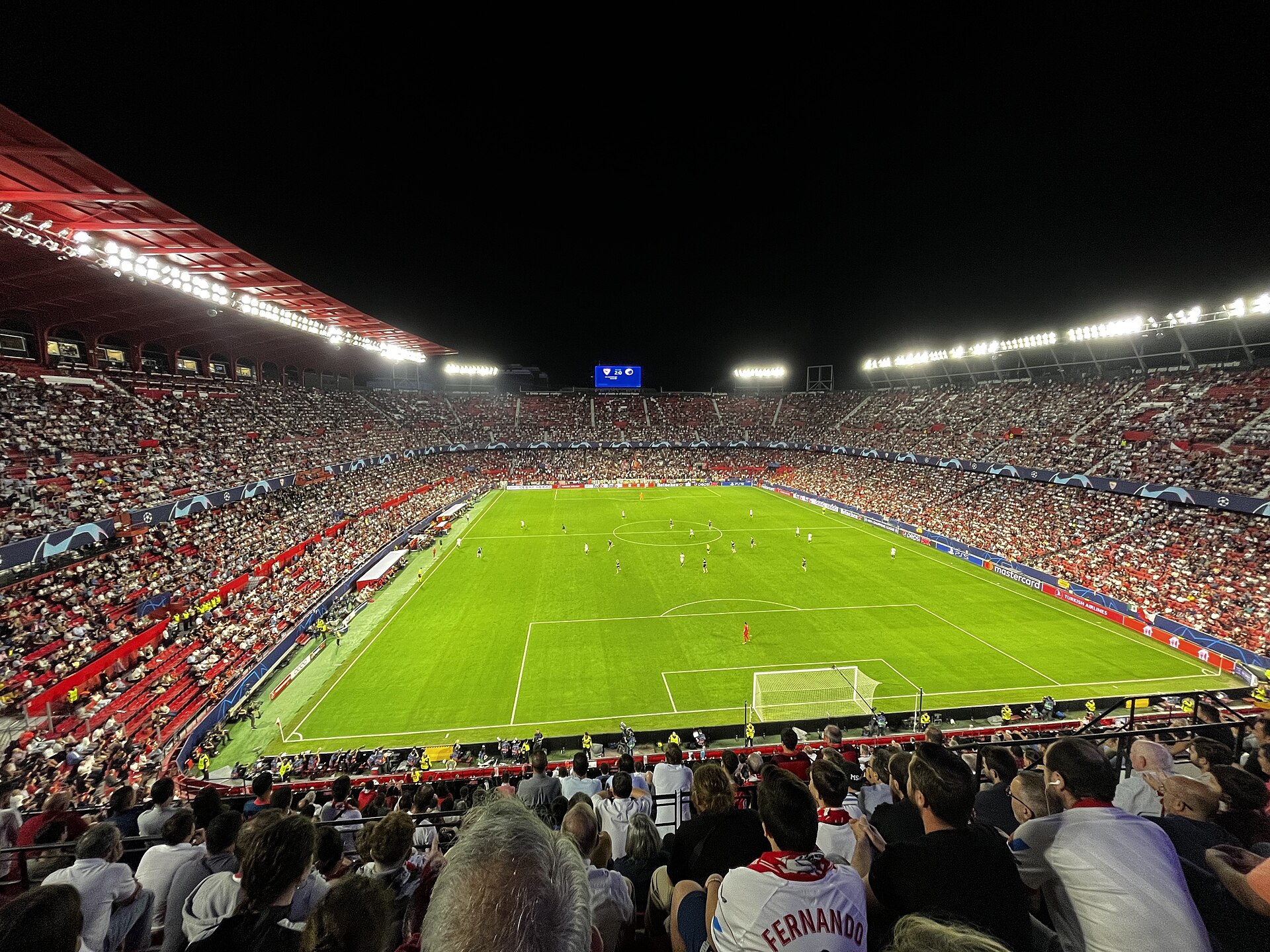
The Ramón Sánchez-Pizjuán during a match on October 25, 2022. Archival photograph by Niels98; CC BY-SA 4.0. This is not an image of the November 6, 2026 Alavés match. Source: Wikimedia Commons. Image license.