Published November 6, 2026 · Taken Social Editorial
Paige Bueckers and Azzi Fudd said Friday that their romantic relationship ended more than a year ago, before the Dallas Wings selected Fudd with the first pick in the 2026 WNBA draft. The teammates made the announcement on Fudd's podcast and asked supporters to stop directing hostility toward people around them.
The timing is the important new information. Friday was the public announcement, rather than the date of the breakup. Their account also places the end of the relationship before the draft decision that reunited the former University of Connecticut teammates in Dallas.
The news has drawn attention to two of the most recognizable young players in women's basketball. Their professional connection, however, has its own substantial history: a national championship together at UConn, consecutive first overall draft selections and individual achievements that explain their positions in the league.
A public statement sets out the timeline
On the November 6 episode of Fudd Around And Find Out, Fudd said they were no longer together. Bueckers clarified that it had been “over a year” and said they remained friends and professional teammates.
Bueckers rejected suggestions that their past relationship explained Fudd's draft selection. The pair also described receiving negative messages, including messages directed at family and friends, and asked people not to send updates about what the other was doing.
Those statements provide a clear account of what they chose to disclose. They do not provide an invitation to reconstruct private events from a missed social media post, a courtside gesture or a photograph with someone else. A public announcement can settle a factual question without making every detail of a person's life public property.
There is an important reporting distinction here. The fact that a relationship has ended can be confirmed by the people involved. A proposed explanation assembled from online observations is a different claim and requires its own evidence. No such explanation is necessary to understand Friday's news.
The basketball history began before Dallas
Bueckers and Fudd were teammates on UConn's 2025 national championship team. The Huskies beat South Carolina 82–59 in the title game, finishing 37–3. Fudd scored 24 points and was named the Final Four's Most Outstanding Player; Bueckers added seventeen.
The championship account published by UConn records the program's twelfth national title and its first since 2016. Sarah Strong also scored 24 points and collected fifteen rebounds in that final.
That shared achievement is the relevant starting point for their basketball partnership. A championship team depends on complementary contributions: handling the ball, creating an advantage, making a shot and completing a defensive possession. Two players can develop a strong understanding through those repeated responsibilities.
Their experience also illustrates why a professional reunion can have a clear sporting explanation. Familiarity with another player's timing can be useful, but it is only one part of roster construction. Teams must evaluate skill, development, positional needs and how the entire group fits together.
Bueckers established herself in her first WNBA season
The WNBA's official 2025 Rookie of the Year announcement records Bueckers receiving seventy of 72 votes. She started all 36 of her appearances and averaged 19.2 points, 5.4 assists, 3.9 rebounds and 1.6 steals.
She shot 47.4% from the field and 88.8% at the foul line. Her 692 points and 194 assists led the rookie class in both totals and per-game averages. She also earned an All-Star starting place during that first professional season.
One performance made a particularly clear statistical statement. Against Los Angeles on August 20, 2025, Bueckers scored 44 points while making seventeen of 21 shots. The league identified it as a rookie single-game scoring record.
Those numbers help explain the scale of attention surrounding her. They document production across scoring and creation, rather than a reputation built solely on college recognition or online popularity. Her professional record provides a concrete basis for assessing her role in Dallas.
The voting result is also unusually decisive: seventy of 72 votes is about 97% of the panel. That calculation does not measure every aspect of a player's game, but it shows how strongly the available voters agreed about her first season.
Fudd's draft credentials were substantial
UConn's April 13 draft announcement identifies Fudd as the seventh player from the program selected first overall. She joined a list including Sue Bird, Diana Taurasi, Tina Charles, Maya Moore, Breanna Stewart and Bueckers.
Her final college season included All-America recognition from the WBCA, Associated Press and USBWA. She averaged 17.7 points, shot 45.5% from three-point range and 95.5% on free throws, and finished her UConn career with 292 made three-pointers.
Those are specific basketball qualifications for a high draft position. Shooting efficiency influences how a defense can position itself, particularly when a perimeter player must be respected away from the ball. A defender who cannot comfortably leave a shooter has less freedom to crowd another player.
That is an analytical explanation of why shooting can complement a creator; it is not a claim to know every internal discussion Dallas held before making its selection. The publicly documented college record is strong enough to discuss the choice on basketball terms.
The university’s draft release also records achievements away from scoring. Fudd was the 2026 Big East Scholar-Athlete of the Year and had earned her bachelor’s degree in communication in May 2024. At the time of the announcement, she was due to receive her MBA that May. Her final college season included 117 assists and 97 steals, further evidence that the evaluation extended beyond making three-point shots. For a prospect, that broader record matters: a team is selecting someone to participate in every phase of a professional game, rather than to reproduce one highlight.
Fudd's draft place was also a continuation of a long UConn pathway into the league. Being part of that history adds visibility, but it does not erase the individual record that earned her consideration in the first place.
A rookie season supplied new evidence
Fudd's official WNBA biography records thirty regular-season appearances in 2026, including 24 starts. She averaged 13.1 points, 1.8 assists and 1.7 steals, while making 39.7% of her three-point attempts.
She earned All-Rookie recognition and became the first rookie to win the WNBA's three-point contest. Her 62 made threes established a Wings rookie season record. The profile also records time missed with a right knee injury, including the final thirteen regular-season games.
The combination gives a fuller account than a single headline statistic. The shooting translated into professional production, while the missed games limited the available sample. Both belong in an assessment of her first year.
Comparing her raw totals directly with a player who appeared in more games would miss that difference in opportunity. Per-game averages and percentages answer other questions, but they too need context about role, minutes and health. A credible evaluation keeps those measures together.
Nothing about Friday's personal announcement changes the recorded makes, misses, assists or defensive plays. Those remain the evidence on which a basketball assessment can be built. It is possible to acknowledge the news while continuing to treat the players as athletes with careers to evaluate.
Why the podcast setting matters
iHeartMedia's episode announcement identifies the show as a partnership involving iHeart Women's Sports and Stephen Curry's Unanimous Media. Fudd co-hosts with Ashanti Plummer, a former professional player and sports media entrepreneur.
The format allows an extended conversation rather than a brief answer in a postgame interview. Its published description places basketball, friendship and life in the public spotlight within the same episode. That is a broader setting than a short clip circulating on its own.
For a reader, the practical advantage is access to the original source. The episode is available through iHeart and other podcast platforms, allowing the statement to be understood within the conversation in which it was made.
For journalists, it also creates a responsibility to preserve the scope of the disclosure. An athlete-controlled interview is a source to report accurately, rather than permission to add a dramatic narrative the participants did not supply.
Support does not require intrusion
The league's fan code and digital community guidelines prohibit abusive and discriminatory content on WNBA and team pages. The digital rules specifically address harassment, threats and offensive material, with possible restrictions on accounts that violate them.
Those rules describe the league's own spaces, not every conversation across the internet. They nevertheless establish a clear expectation that following a team or player should not involve targeting other people. Enthusiasm and criticism can exist without turning relatives or friends into subjects of abuse.
Friday's announcement also demonstrates the limits of reading personal meaning into ordinary sporting interactions. A high five, a conversation during play or an image from an arena captures a moment. It does not contain a complete explanation of a relationship.
The useful public record is now clear: Bueckers and Fudd have explained their status and its timing. Their shared basketball story continues to be measured through the work they do as teammates, the skills they bring to Dallas and the performances they produce on the court.
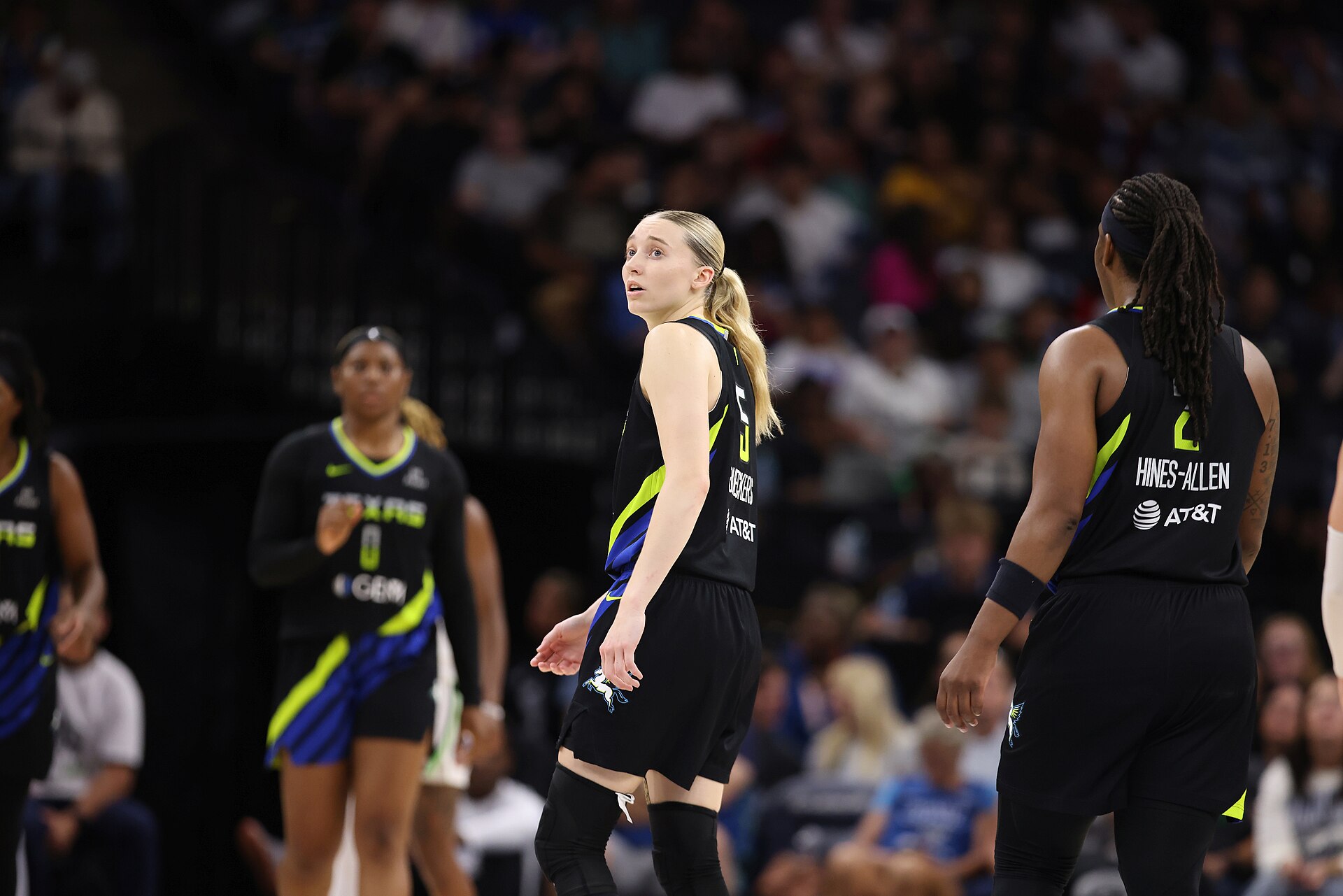
Paige Bueckers playing for the Dallas Wings on September 1, 2025. Archival photograph by John Mac; CC BY-SA 4.0. This is not a photograph from the November 2026 podcast. Source: Wikimedia Commons. Image license.