Published November 6, 2026 · Taken Social Editorial
Kike Pérez struck the winning goal as Venezia beat Udinese 2–1 on Friday, lifting the home side above its opponent and leaving Paolo Zanetti with an immediate reminder of the work facing him in his new job. Three goals in a short second-half spell transformed a tense contest at the Stadio Pier Luigi Penzo into an important victory for Davide Nicola's team.
Toma Bašić put Venezia ahead, a Matías Moreno own goal brought Udinese level and Pérez restored the home advantage in the 65th minute. Venezia then protected a result that carries particular weight because it came against a direct rival near the bottom of Serie A.
For readers searching for the Venezia–Udinese result, the central story is both straightforward and consequential: Venezia recovered from conceding an equalizer, while Udinese's change of coach did not immediately interrupt its losing pattern. The visitors finished the evening alone at the foot of the table, according to ANSA's match report.
A goalkeeper's intervention came before the decisive goals
The score remained level through the first half. Venezia threatened early through Antoine Hainaut, whose attempt required a response from Maduka Okoye, while Udinese found opportunities through Jurgen Ekkelenkamp and Keinan Davis. The match offered warnings at both ends before either side scored.
Filip Stanković's work became especially important around the interval. He denied Ekkelenkamp before producing a crucial stop against Davis early in the second half. The striker reached a one-on-one opportunity, but the Venezia goalkeeper kept the ball out with his foot.
That intervention deserves attention alongside the winning shot. Had Davis converted, Venezia would have been chasing the match. Instead, the home side retained a level platform and soon moved ahead itself. Goalkeeping can change the direction of a contest without appearing in its list of scorers.
Davis also struck the post during the first half, although an offside flag affected that move. The distinction matters when assessing the visitors' threat: a passage can demonstrate attacking movement without counting as a valid chance that would necessarily have produced a goal.
The visitors' problem was therefore more complicated than an inability to enter dangerous areas. They created moments that tested Venezia, but they did not take a lead from them. The eventual result turned on how each side handled the opportunities that followed.
Three goals turned a level match into a relegation battle
Fantacalcio's account of the game records Bašić's opening goal early in the second half. It changed a match that had reached the interval without a breakthrough and placed the immediate burden on Udinese to respond.
The response came quickly. Nicolò Zaniolo's delivery and Davis' involvement contributed to the move that ended with Moreno putting the ball into his own net. A video review examined the attacking sequence before the equalizer stood. Venezia's advantage had disappeared almost as soon as it had arrived.
Pérez then supplied the decisive answer. Receiving the ball after Pasquale Mazzocchi's involvement, he struck left-footed from distance and found the upper part of the goal. It was an individual finish with a collective consequence: Venezia had a second lead to defend and Udinese had another recovery to attempt.
An Akor Adams effort later failed to add to the score because the move was ruled out. The official result remained 2–1, rather than a more comfortable margin. Venezia still had to manage the closing stages with a single goal separating the teams.
Those details make Friday's victory more informative than a simple statement that the home side scored twice. Venezia had to respond to disappointment within the match, reassert itself and finish the job. That is a useful sequence for a team trying to turn encouraging passages into points.
Nicola values the way Venezia finished
Speaking after the game in comments carried by Fantacalcio, Nicola emphasized both the quality of the opposition and the importance of making previous performances count. He described a good opening half-hour before Udinese pushed forward and made it harder for Venezia to maintain its spacing.
His more encouraging assessment concerned the final twenty minutes. Venezia continued to work and did not simply retreat after regaining the lead. That distinction offers a specific way to understand what the coach liked: managing an advantage through active participation rather than relying exclusively on emergency defending.
Nicola also discussed a wider rotation, with seventeen or eighteen players being used more regularly, and the challenge of bringing injured players back into the group. He identified Gianluca Busio as an important returnee and stressed the contribution required from midfielders as well as forwards.
The schedule has limited preparation time. Nicola said the team had played five matches in a short period while trying to establish its technical and tactical approach. A coach can outline a plan quickly; giving players enough shared training time to make it automatic is a different task.
Friday offered an example of why contributions beyond the front line matter. Both Venezia scorers were midfielders. An opponent defending the central forward still has to account for runners and shooters arriving from deeper positions, which creates another set of decisions for its defensive structure.
Zanetti identifies a physical and psychological problem
Udinese's new coach did not present the defeat as a problem that could be solved by one selection change. In his post-match interview with DAZN, reported by Fantacalcio, Zanetti pointed to difficulties sustaining the pace and intensity required across the game.
He had taken only two training sessions before this fixture. That is an important limit on judging a new tactical approach, though it does not reduce the immediate cost of the defeat. A team near the bottom needs results while its coach is still learning how best to obtain them.
Zanetti referred to Udinese's fifty-point season a year earlier as evidence of quality in the group. His argument was that technical ability had to be matched by intensity, recovery running and a stronger collective response to difficult moments.
He also defended Davis' contribution and said the striker needed support. The forward created openings, including the chance Stanković saved, but a striker's work cannot compensate indefinitely if the team behind him becomes stretched. Zanetti described that loss of compactness as the game wore on.
These are related issues rather than separate complaints. When a team cannot maintain its running, the distances between players can increase. A lost ball then becomes harder to recover, and the next defensive action may require an even longer run. Breaking that cycle is part of the new coach's immediate assignment.
Why Pérez's winner matters beyond its technique
Pérez's reaction reflected the stakes. In his post-match comments, he credited the team's work during a difficult period and thanked the supporters who continued following it. He presented the victory as a reward for preparation rather than an isolated moment of inspiration.
He also dedicated his goal to people affected by a train accident in Spain and to Tenerife's Jesús de Miguel. That dedication was part of the player's public response to scoring; it should not be confused with an explanation of the match itself or expanded into claims beyond what he said.
The sporting value of the finish is clear. Venezia regained the lead only minutes after conceding, denying Udinese a long period in which to build confidence from its equalizer. The home side converted a threatening moment into a goal before the visitors could settle around a restored level score.
In a meeting between nearby rivals in the standings, the same goal changes two trajectories. It adds three points to one side and prevents the other from taking anything from the evening. That makes the result especially valuable even though the season still has many matches remaining.
It does not establish that Venezia's difficulties are over. Winning a direct meeting is evidence of progress, not a guarantee of safety. The next test is whether the team can reproduce the useful parts of this performance against opponents who pose different problems.
What the result means for the two clubs
ANSA reports that Udinese has now lost eight of its last nine league matches. Such a sequence makes each setback feel larger because it arrives on top of previous damage. Zanetti must work on confidence and organization while preventing the next fixture from becoming a referendum on every earlier defeat.
Venezia can take a more constructive lesson. Stanković provided a decisive save, the midfield supplied two goals and the team recovered after an equalizer. Those are concrete contributions to build into the next performance, rather than a general appeal to belief.
The two coaches therefore leave with different immediate tasks. Nicola needs to preserve the balance between bravery and control that he praised late in the match. Zanetti needs to help Udinese sustain its better moments for longer and ensure that Davis' opportunities are supported by a more durable team shape.
Friday's final score is Venezia 2, Udinese 1. Pérez's finish delivered the headline, but the victory also depended on a goalkeeper's intervention, a response to conceding and the work of protecting a narrow advantage. At the Penzo, Venezia turned those elements into three points when they mattered most.
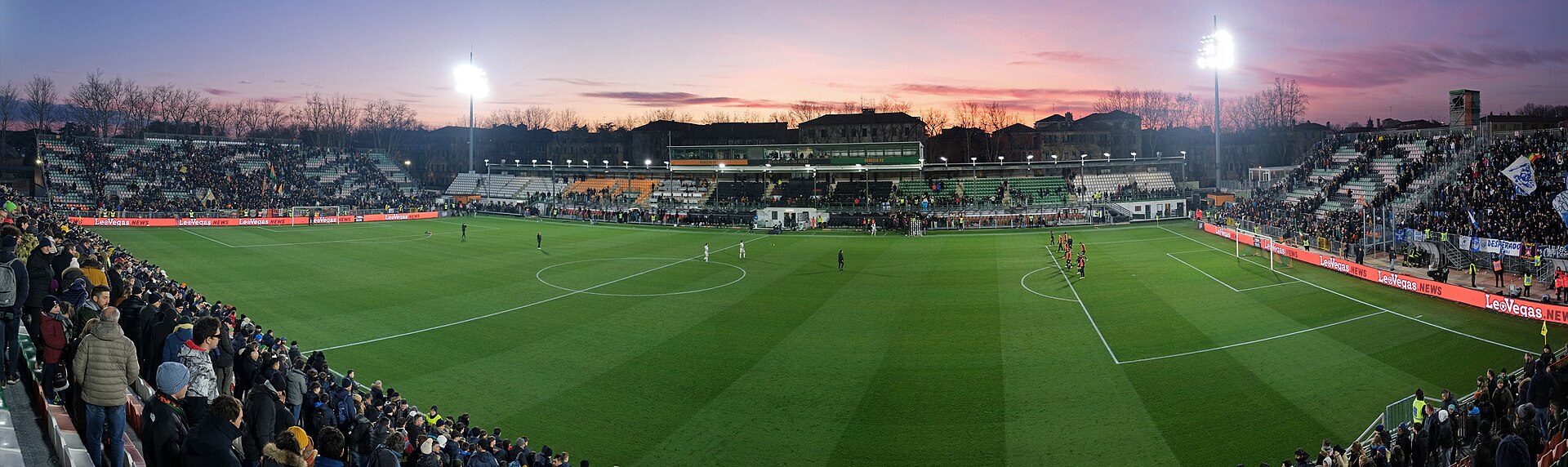
The Stadio Pier Luigi Penzo during Venezia’s match against Empoli on January 4, 2025. Archival photograph by kallerna; CC BY-SA 4.0. This photograph does not show the November 6, 2026 Udinese game. Source: Wikimedia Commons. Image license.