Published November 6, 2026 · Taken Social Editorial
Money Williams scored 35 points and made all thirteen of his free throws as Boston College beat Massachusetts 71–55 at TD Garden on Friday. The Eagles improved to 2–0 under new coach Luke Murray by taking care of the ball, capitalizing at the line and holding UMass to twenty points after halftime.
It was a victory built through more than outside shooting. Boston College made only three of 27 three-point attempts, yet found enough scoring elsewhere and prevented its own possessions from disappearing through turnovers. Williams supplied almost half the team's points while remaining on the court for all forty minutes.
The result gave Murray another early step in a first season shaped by a heavily reconstructed roster. It also ended UMass' four-game winning streak in the rivalry, returning a familiar Massachusetts matchup to Boston's largest basketball stage.
Williams supplies the finishing, control and free throws
The official final box score lists Williams with 35 points, nine rebounds and five assists against one turnover. He shot 10-for-22 from the field, including two three-pointers, and 13-for-13 at the line.
The free throws made his scoring particularly valuable on an evening when the team's perimeter attempts repeatedly failed to fall. Thirteen points at the line supplied a dependable return without requiring another made field goal.
His point total also represents a concentrated offensive responsibility. Thirty-five out of 71 is approximately 49.3% of Boston College's scoring. That share illustrates how central he was to the win, while the rebounds and assists show involvement beyond the shots he finished himself.
The single turnover is important beside that workload. A player handling the ball frequently can accumulate points while also giving away possessions. Williams' recorded line combined substantial production with control, helping the Eagles avoid an additional source of difficulty when shots were not falling.
It is the sort of performance that can establish an early reference point for a new roster. Teammates and coaches gain evidence of where offense can come from under pressure, while opponents gain a clearer picture of the player they will need to account for.
Boston College creates separation after a close first half
The Eagles led 37–35 at halftime before outscoring the Minutemen 34–20 over the final twenty minutes. UMass made seven of 28 field-goal attempts in the second half and one of ten from three-point range.
That change turned a two-point game into a sixteen-point result. Boston College did not need a dramatic improvement in its own shooting percentage to pull away. Its advantage came from sustaining enough scoring while reducing the opponent's return.
The final team totals underline the unusual shape of the victory. Boston College shot 22-for-59 overall and UMass 21-for-54, leaving the teams only one made field goal apart. The largest scoring difference came at the line, where the Eagles went 24-for-26 and the Minutemen 8-for-14.
Both teams scored 47 points from field goals once the different numbers of three-pointers are accounted for. The sixteen-point scoring gap therefore came entirely from made free throws. Possession management and defensive execution still shaped the opportunities that produced that arithmetic.
For UMass, the second-half decline is the immediate focus. A strong first twenty minutes kept the game close, but the visitors could not maintain enough offense to match Boston College's scoring from the line and inside the arc.
Four turnovers help the Eagles survive a poor perimeter night
Boston College committed four turnovers to UMass' fourteen. The Eagles finished with a 22–4 advantage in points off turnovers. They also scored 38 points in the paint, giving the offense another route when long-range attempts failed.
A low turnover total does not guarantee good offense, but it preserves the possibility of an attempt. That becomes especially useful in a game where the first shot may miss. Keeping the possession alive long enough to shoot or draw a foul is preferable to surrendering it without either opportunity.
Armoni Zeigler's five steals supplied another part of that advantage. Žak Smrekar scored twelve points, while Brandon Benjamin contributed ten points and eight rebounds. The supporting production helped turn Williams' individual performance into a team win.
The result still leaves an obvious area for improvement. Three makes from 27 attempts is 11.1% three-point shooting, far below a rate an offense would want to rely on over time. Friday demonstrates that Boston College found another way to win; it does not make that shooting outcome desirable.
A useful review will separate shot selection from conversion. The box score establishes which attempts went in, but evaluating whether the attempts were well created requires looking at the possessions themselves. The next task is to preserve ball security while improving the quality and finishing of the perimeter offense.
A proven scorer arrives from Montana
Williams' official Boston College biography supplies context for the scoring. The Oakland native arrived after three seasons at Montana, where he led the Big Sky Conference with 20.6 points per game in his junior year.
He scored 699 points that season and earned unanimous first-team all-conference honors. His Big Sky Tournament included a record 91 points over three games, highlighted by a career-high forty against Northern Colorado, and ended with tournament MVP recognition.
That history shows why Boston College could look to him for substantial offense immediately. Friday was not the first indication that he could carry a large scoring load, although doing it in a new program and a regional rivalry gives the performance its own significance.
The transition also changes what surrounds a player. New teammates, a new coaching staff and a different schedule require familiar skills to work in a different structure. The opening two games offer early evidence that Williams can supply an offensive focal point while that structure develops.
Boston College's pre-game report records his 22-point debut in Tuesday's 76–50 win over Wagner. Adding Friday's 35 gives 57 points through two games, an average of 28.5. The sample remains small, but the immediate contribution is clear.
Murray's first head-coaching season gains another result
According to his official biography, Murray became the fourteenth head coach in Boston College men's basketball history after serving as an assistant at Connecticut. His UConn tenure included two national championships.
His earlier assistant positions included Louisville, Xavier, Rhode Island, Towson and Wagner. The résumé emphasizes offense, recruiting and player development, but the move to Boston College gives him responsibility for the complete program rather than one part of a larger staff.
Friday provided a useful kind of early win for that transition. The Eagles could not depend on a smooth shooting performance and had to establish control through other aspects of the game. A new team learns something about itself when it can succeed despite an obvious weakness on the night.
At the same time, two wins are the beginning of an evaluation, not its completion. Building repeatable habits over a full schedule will require more than an exceptional individual scoring performance. The encouraging elements are the care with the ball and the ability to finish possessions at the line.
A rivalry result with meaning on both campuses
Both schools' pre-game material identified this as the 49th meeting, with Boston College leading the series 26–22 before tipoff. Friday extends that overall advantage to 27–22. The previous meeting at TD Garden had been in 2014.
UMass' official preview noted that the Minutemen were seeking a fifth consecutive win over the Eagles. It also described Boston College's rebuilt group as containing ten transfers and two freshmen.
The Minutemen arrived after winning 71–60 at Troy, where an extended 32–1 run had changed the game. Junjie Wang recorded eighteen points and thirteen rebounds in that opener, while Abdullah Ahmed blocked seven shots. Friday presented a different challenge against a team that protected its possessions.
Dwayne Wimbley Jr. led UMass with fifteen points against Boston College, with Ahmed adding twelve. The visitors had enough production to remain within two points at the break, but the final twenty minutes left them at 1–1.
A neutral-site rivalry game can create an early opportunity to learn more than a routine opener. The setting is different from a campus home game, the opponent is familiar to local supporters, and a new roster has to apply its habits away from its ordinary surroundings.
What comes next for the Eagles and Minutemen
Boston College's published schedule has Maryland Eastern Shore next at Conte Forum on November 10, with a 7 p.m. Eastern tip. UMass' official team calendar lists UMass Lowell on November 11 at 7 p.m.
For the Eagles, the immediate aim is to carry the control of Friday's performance into a more balanced shooting night. Williams has supplied the headline scoring, but a sustainable offense will benefit from more players and more areas of the floor producing consistently.
For UMass, the review starts with the contrast between the halves and the possessions lost through turnovers. The first half showed an ability to compete within the game; the second demonstrated how quickly that position can erode when scoring becomes difficult.
Boston College left TD Garden with an unbeaten start and a defining early performance from its new senior guard. Williams' 35 points made the difference visible. The four team turnovers and twenty-four made free throws explain how the Eagles supported that performance when the three-point shot offered very little.
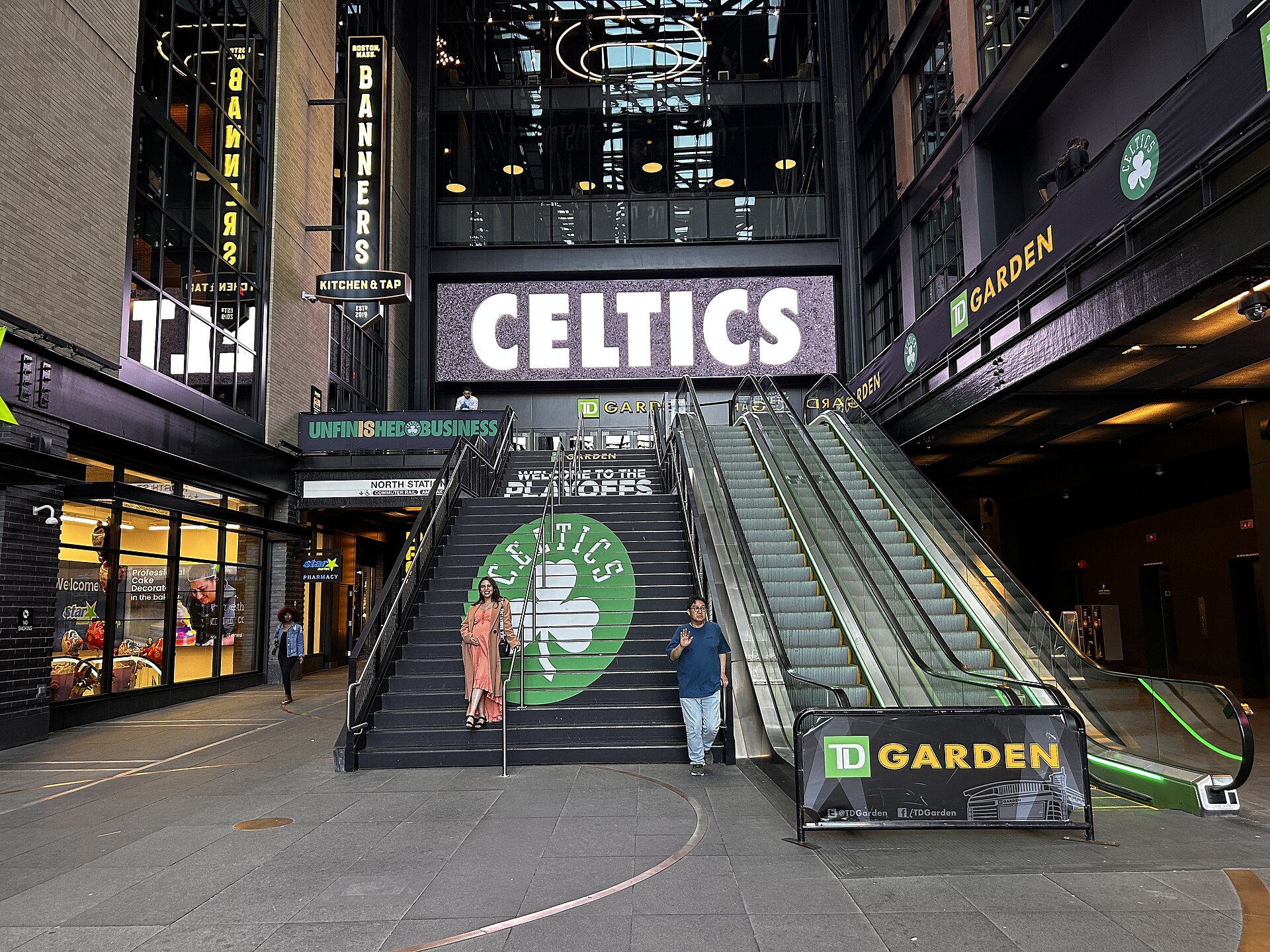
The entrance to TD Garden and North Station in Boston, photographed in May 2023. Archival photograph by Scott Edmunds; CC BY 2.0. The arena hosted the November 6, 2026 Boston College–UMass game; this photograph does not show that event. Source: Wikimedia Commons. Image license.