Published November 6, 2026 · Taken Social Editorial
Sammy Kershaw's account of being denied a place on the CMA Awards red carpet has prompted a public show of support from fellow country musicians, turning an invitation dispute into a wider argument about how the industry recognizes its veteran performers.
The Louisiana singer said Thursday that his request to walk the carpet at the November 18 ceremony had been refused after months of planning. By Friday, artists including Riley Green, Carly Pearce and Mark Chesnutt had responded in his support. The controversy arrives less than two weeks before the Country Music Association celebrates its sixtieth annual awards show in Nashville.
The immediate issue is access to the red carpet. It is not an announced ban on Kershaw's music, a canceled performance or a decision by the voting membership on an award nomination. That distinction is central to understanding both his complaint and the response it has generated.
What Kershaw says happened
In a social media statement reported by Country Rebel, Kershaw said he rearranged his schedule and booked travel and accommodation in anticipation of attending with his wife. He described the eventual refusal as “extremely hurtful, embarrassing and very disappointing.”
His manager told the outlet that the explanation given involved an overwhelming number of requests and updated criteria. According to that account, Kershaw could purchase tickets, but seating with other artists was not guaranteed. The manager said he was not planning to attend at that point.
That explanation comes through Kershaw's representative; it is not a public statement issued directly by the CMA. Country Rebel's Friday afternoon follow-up said the association had not yet addressed his account. The reviewed official CMA announcements do not explain the decision about his request.
The difference between being offered a seat and being welcomed onto the carpet helps explain why an ordinary ticket is not necessarily a remedy from the artist's perspective. One provides admission to the room. The other provides visibility within the event's official arrival coverage.
A refusal can therefore carry a symbolic meaning even when the artist remains able to attend as a paying guest. Kershaw's complaint is about recognition as much as proximity to the stage, which is why the issue has traveled beyond the practical question of where he would sit.
Fellow artists make the disagreement public
Country Rebel's separate report on the reaction identifies responses from Green, Pearce, Drew Baldridge, Jake Owen, Chesnutt and Doug Stone. Baldridge offered his own place, while Pearce credited the influence of artists from Kershaw's generation.
The responses matter because they come from musicians at different points in their careers. Support is not confined to peers who shared Kershaw's chart era. Younger performers are also describing his work as part of the foundation on which their own careers were built.
That does not establish how every invitation was allocated or whether another artist's request would have been treated differently. It does establish that the decision has become a matter of professional concern among people the ceremony itself exists to recognize.
Some reactions broadened into criticism of celebrity culture and the treatment of traditional country artists. Those are the speakers' assessments. They are not documentary evidence that a particular guest displaced Kershaw, and there is no basis here to identify an individual attendee as responsible for his exclusion.
The more concrete question is whether the association can explain how it balances current nominees, performers, presenters and veteran members when arranging a finite arrival event. A clear explanation would allow that balance to be discussed on its actual terms.
The career behind the complaint
Kershaw's official biography traces his musical beginnings to Kaplan, Louisiana, and to early influences including George Jones, Conway Twitty and Mel Street. The comparison with Jones became a recurring feature of his emergence as a traditional country singer.
His early recordings included “Cadillac Style,” followed by songs such as “Don't Go Near the Water” and “I Can't Reach Her Anymore.” In 1993, “She Don't Know She's Beautiful” reached the top of the singles chart. The albums Don't Go Near the Water and Haunted Heart became million-selling records.
Other familiar titles include “Queen of My Doublewide Trailer,” “Third Rate Romance” and “Love of My Life.” His continuing performance work has included the Roots & Boots tour alongside Collin Raye and Aaron Tippin.
Contemporary Cash Box coverage from August 1993 also lists Kershaw among that year’s CMA Horizon Award nominees, alongside Mark Chesnutt, Tracy Lawrence, John Michael Montgomery and Trisha Yearwood. His connection with the ceremony reaches back to his breakthrough period.
These details explain why the complaint found a receptive audience. For listeners who encountered country music through those records, Kershaw is part of a personal musical history. For working musicians, he is also an example of a career that continued beyond its initial period of heavy radio exposure.
Those forms of recognition do not always appear in a current nomination list. A song can retain meaning at a concert, in a family or among younger performers after the commercial cycle that first made it successful has ended. An anniversary ceremony has to decide how much of that longer life it wants to show.
An anniversary built around continuity
The CMA's November 5 performance announcement lists Cody Johnson, Miranda Lambert, Ella Langley, Tim McGraw, Kacey Musgraves, the Red Clay Strays, Zach Top and Tucker Wetmore. It also announces a special tribute to Dolly Parton, with additional performers and presenters to follow.
Lainey Wilson will host the show for a third consecutive year. The broadcast is scheduled for November 18 from Bridgestone Arena, beginning at 8 p.m. Eastern on ABC and Disney+, with next-day availability on Hulu.
The announced program is itself an attempt to connect generations and different stages of success. Established stars and newer nominees share a schedule, while a tribute looks beyond the current eligibility year. That mixture is part of what makes an awards broadcast more than a sequence of envelopes.
It also creates a difficult editorial task for the producers. A three-hour television event cannot offer equal time to every significant career. Choosing what to include is unavoidable. How those choices are communicated, particularly to artists who have made plans to participate, is a separate issue.
Kershaw's complaint falls into that second area. His public account concerns a request and the experience of waiting for a decision. It does not require the audience to conclude that every veteran must perform in order to ask whether the process was clear and considerate.
Awards voting and carpet access are different processes
The association's published 2026 balloting framework describes three voting rounds for the main awards. The eligibility period ran from July 1, 2025, through June 30, 2026, with professional members selecting nominees and eventual winners.
That system is designed to recognize work within a defined period. It is distinct from the broader decisions about honoring careers, presenting tributes or inviting guests. A musician's absence from this year's competitive categories does not, by itself, answer the question of whether that musician should appear during the arrivals.
The CMA also runs separate programs recognizing touring professionals, broadcasters, international contributions and wider industry achievements. Its own structure acknowledges that the work sustaining country music extends beyond the names competing for the principal televised prizes.
That provides useful context for the disagreement. The industry already has several ways to recognize contribution. The challenge raised by this episode is how those different forms of respect become visible at its most prominent annual gathering.
Membership, voting eligibility, a performance invitation, an audience ticket and red-carpet access should therefore be described precisely. They may overlap for an individual artist, but they are not interchangeable credentials. Confusing them can make a disagreement seem broader or simpler than the evidence supports.
What viewers and attendees can expect next
The official ticket and attendee page continues to direct buyers to Ticketmaster and advertises separate premium hospitality options. It lists doors opening by 5:30 p.m. Central and asks attendees to be seated by 6:45 p.m. ahead of the 7 p.m. Central live start.
Those public instructions describe entry to the ceremony, security and the broadcast schedule. They do not resolve Kershaw's account of the carpet decision. Anyone considering attending should use the official ticket information rather than assume that a purchased seat includes an appearance in arrival coverage.
The most meaningful next development would be a direct explanation from the CMA or an updated statement from Kershaw about whether an arrangement has changed. Further artist reactions show the breadth of concern, but they cannot independently establish the terms of an invitation discussion.
For now, the public dispute has put an unexpected question beside the sixtieth-anniversary celebration: how should an institution make its history visible to the people who helped create it? The answer will be judged through practical decisions as well as the tributes written into the show.
Kershaw's recordings give that question a recognizable voice. His complaint has resonated because fellow performers and longtime listeners connect those songs with an enduring place in country music. Whether he walks the carpet on November 18 remains the immediate issue; the larger discussion concerns how a genre welcomes its own history into the room.
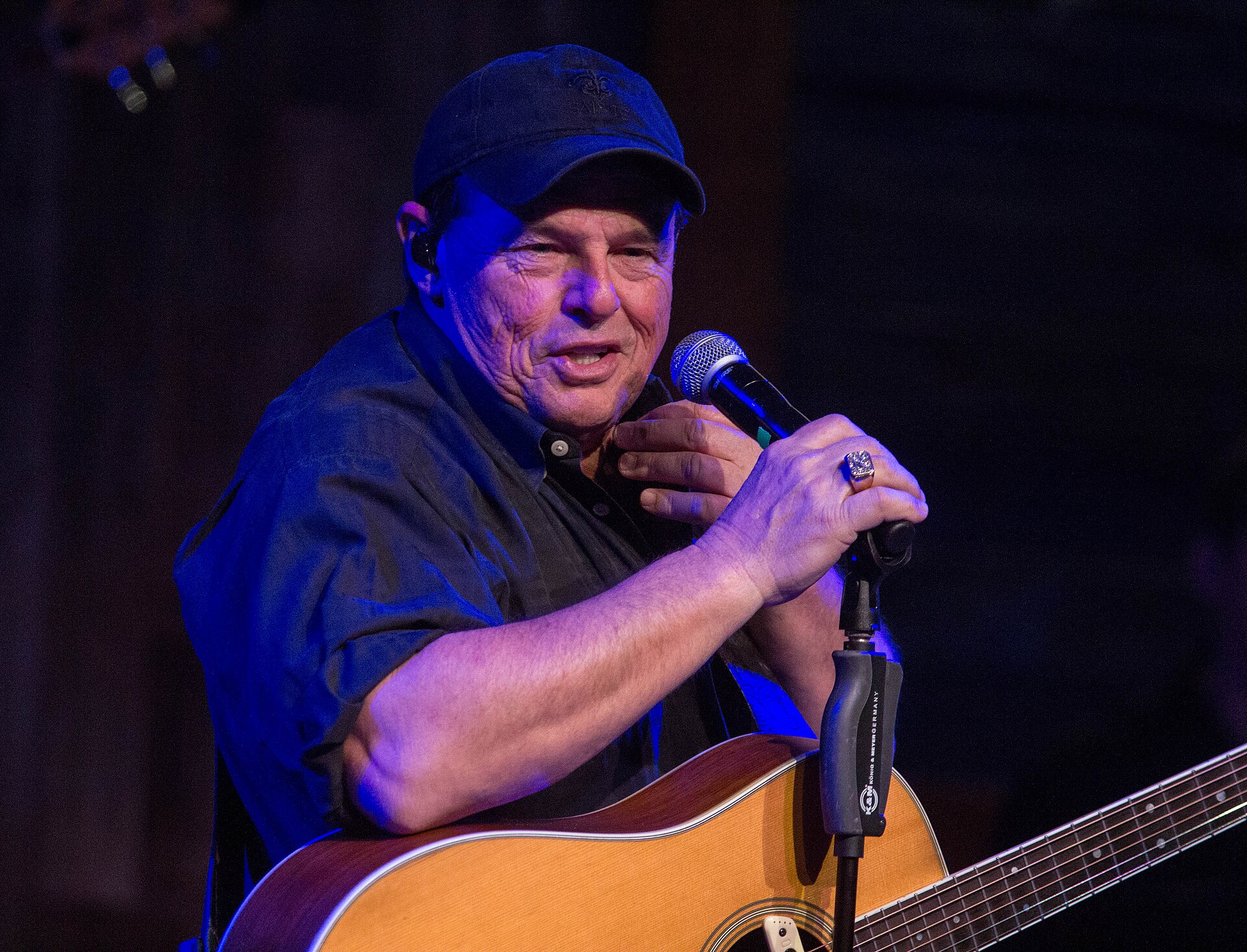
Sammy Kershaw performing on February 2, 2018. Archival photograph by Republic Country Club; CC BY 2.0. This image does not show the 2026 CMA Awards. Source: Wikimedia Commons. Image license.