Published November 6, 2026 · Taken Social Editorial
Dolly Parton's estate has moved to withdraw a lawsuit accusing her nephew and former security guard Bryan Seaver of threats and intimidation, a significant change in a dispute that became public after the country singer's death in August.
She's Alive LLC, the company overseeing Parton's professional assets, filed a notice of voluntary dismissal in Tennessee on Thursday, November 5, according to ABC News. The notice seeks dismissal without prejudice, a procedural distinction that can leave open the possibility of bringing claims again.
The development ends neither the need to describe the allegations fairly nor the need to distinguish a filing from a finding. Seaver has denied the accusations. The request to withdraw the case is not a trial verdict establishing either side's account.
Beyond the immediate legal development, the dispute has drawn attention to the considerable work of managing Parton's professional legacy. Her recordings, stage projects, businesses and literacy initiative continue to reach audiences after her death, through organizations with different responsibilities and purposes.
A withdrawal request follows months of litigation
ABC News reported that the notice concerns the suit against Seaver and Squadron Augmented Protection Services. It followed an eighteen-page response in which he denied threatening people associated with the estate and disputed the interpretation of private messages.
The complaint, filed in September, alleged a campaign of intimidation. The estate previously obtained a temporary restraining order. Those earlier steps explain the seriousness with which the dispute was brought to court, while remaining distinct from a final adjudication after a full trial.
The Associated Press account says the brief withdrawal filing gives no reason for the decision. That limits what can responsibly be concluded about a settlement or the parties' private negotiations. An apparent resolution should not be described as a publicly documented agreement with known financial terms when those terms have not been disclosed.
The distinction also prevents the case from being turned into a broader story that the available filing does not establish. A dispute involving a company responsible for professional assets is not automatically a contest over a will, a decision about who inherits property or a challenge to every organization associated with the artist.
What dismissal without prejudice means
Tennessee's rules provide a mechanism for a plaintiff to discontinue a civil action voluntarily, subject to specified limitations. A dismissal without prejudice generally differs from a decision on the merits: it does not, by its wording alone, resolve whether the underlying factual allegations are true.
A 2024 Tennessee Court of Appeals opinion discussing Rule 41.01 explains the state's voluntary nonsuit framework and its exceptions. The rule permits a plaintiff to file a written notice in qualifying circumstances, but the effect of a particular filing must be read with the relevant court record and any applicable restrictions.
That is why two questions should remain separate here. One is whether the current complaint is being discontinued. The other is whether any claim could be filed later, and on what terms. The phrase without prejudice is relevant to the second question, but it is not an unlimited promise that every future action would be permitted.
The earlier request for temporary protection is a different procedural step. Tennessee judicial material on Rule 65 describes restraining orders as measures addressing threatened immediate and irreparable injury under the applicable requirements. Temporary relief can preserve a position while litigation proceeds.
Such an order has legal force, but it is not interchangeable with a final judgment after the parties have presented a complete case. Nor does a later voluntary dismissal necessarily supply a retrospective explanation for why the plaintiff sought protection in the first place.
For readers following the latest development, the reliable conclusion is procedural and concrete: the company has taken a step to withdraw its complaint without prejudice. The reasons for that choice, any private agreement and the future intentions of the parties require additional evidence before they can be reported as facts.
Parton's team has described a continuing project roadmap
Parton's official announcement records her death on August 25, 2026, at eighty. A separate statement from her team the next day addressed what would happen to work already in development.
In that August 26 update, longtime manager Danny Nozell said Parton had worked with a selected team on a roadmap intended to guide future projects. The statement said releases through official channels could include work she had personally approved before her death.
The published list ranged across hospitality, a museum, consumer products and a Broadway musical. It identified planned previews for DOLLY: A True Original Musical beginning December 7, with an opening scheduled for January 19, 2027. Those dates describe the team's published schedule, rather than a new theatrical announcement made through the lawsuit.
The scope explains why management of the legacy is consequential. A recording, a theatrical production and a hospitality business do not require identical work. Each involves its own partners, delivery schedules and audience expectations. The artist's name connects them in public, while the operational responsibilities remain specific to each project.
That complexity also makes careful attribution especially useful. A statement from a commercial venture should not be treated as a statement from a charitable program, and a legal action involving one company should not be assumed to determine the future of unrelated activities. Readers need to know which organization is speaking and what responsibility it actually holds.
The literacy work remains a distinct part of her influence
One of Parton's most widely recognized projects operates on an entirely different measure of success from ticket sales or a chart position. Her Imagination Library supplies books to young children, making regular access to reading material the central product of the program.
The official summer 2026 update said the initiative was gifting more than 3.5 million books each month and had distributed more than 325 million by June. It identified activity in the United States, Canada, the United Kingdom, Australia and the Republic of Ireland.
Those are dated program figures, not a new total calculated for November 6. Their significance is the sustained scale of distribution. The impact depends on a recurring process that reaches families repeatedly, rather than on a single announcement or donation.
The U.S. Postal Service's September account places delivery within that effort. It describes the continuing movement of books after Parton's death and recalls her public recognition of postal employees' role. That operational perspective is a useful reminder that a recognizable public figure's initiative also depends on people and institutions carrying out routine work.
The program's 2026 U.S. book list gives parents a more direct view of what the initiative provides. It turns an impressive cumulative number into a concrete reading program with a selected collection for children.
Nothing in the withdrawal filing reviewed for the current news establishes a change to that literacy work. Keeping it distinct from the lawsuit allows the public to understand the legal development without mistakenly treating every part of Parton's legacy as part of the same dispute.
The music explains the scale of the public interest
The Country Music Hall of Fame's account describes an artist whose success as a songwriter and country singer expanded into pop, acting, business and philanthropy. Parton entered the institution's Hall of Fame in 1999.
That range is reflected in work associated with several different audiences: songs rooted in family experience, major country recordings, crossover hits and film performances. Her career did not depend on one format remaining dominant. It moved between them while retaining a recognizable voice and songwriting identity.
The Rock & Roll Hall of Fame inducted her in 2022, recognizing influence that extended beyond the country category. The two institutions together help explain why developments involving her professional legacy can draw interest far outside the music industry.
The Library of Congress biography traces the musical background behind that reach, from Appalachian traditions and church music to radio and Nashville. It is a reminder that the expansive business and cultural presence began with specific musical experiences and a body of songs.
Another public remembrance is approaching. The Country Music Association's November 5 announcement includes a special Parton tribute in the sixtieth annual CMA Awards on November 18. The event is scheduled for Nashville's Bridgestone Arena, with Lainey Wilson returning as host. The announcement makes the tribute part of the published program, while further details remain for the organizers to release.
An awards tribute and a court filing naturally serve different purposes. One offers a public occasion to remember the work; the other records a specific legal step. Following both accurately allows audiences to recognize the breadth of Parton's continuing influence without treating the procedural developments in a private dispute as the final assessment of her life.
The current legal news belongs within that larger history, but it should not overwhelm it. A company has sought to withdraw a contested complaint against a longtime member of Parton's inner circle. The public record supports reporting that development precisely, while the music, the continuing projects and the books reaching children remain substantial parts of the legacy that made the dispute newsworthy.
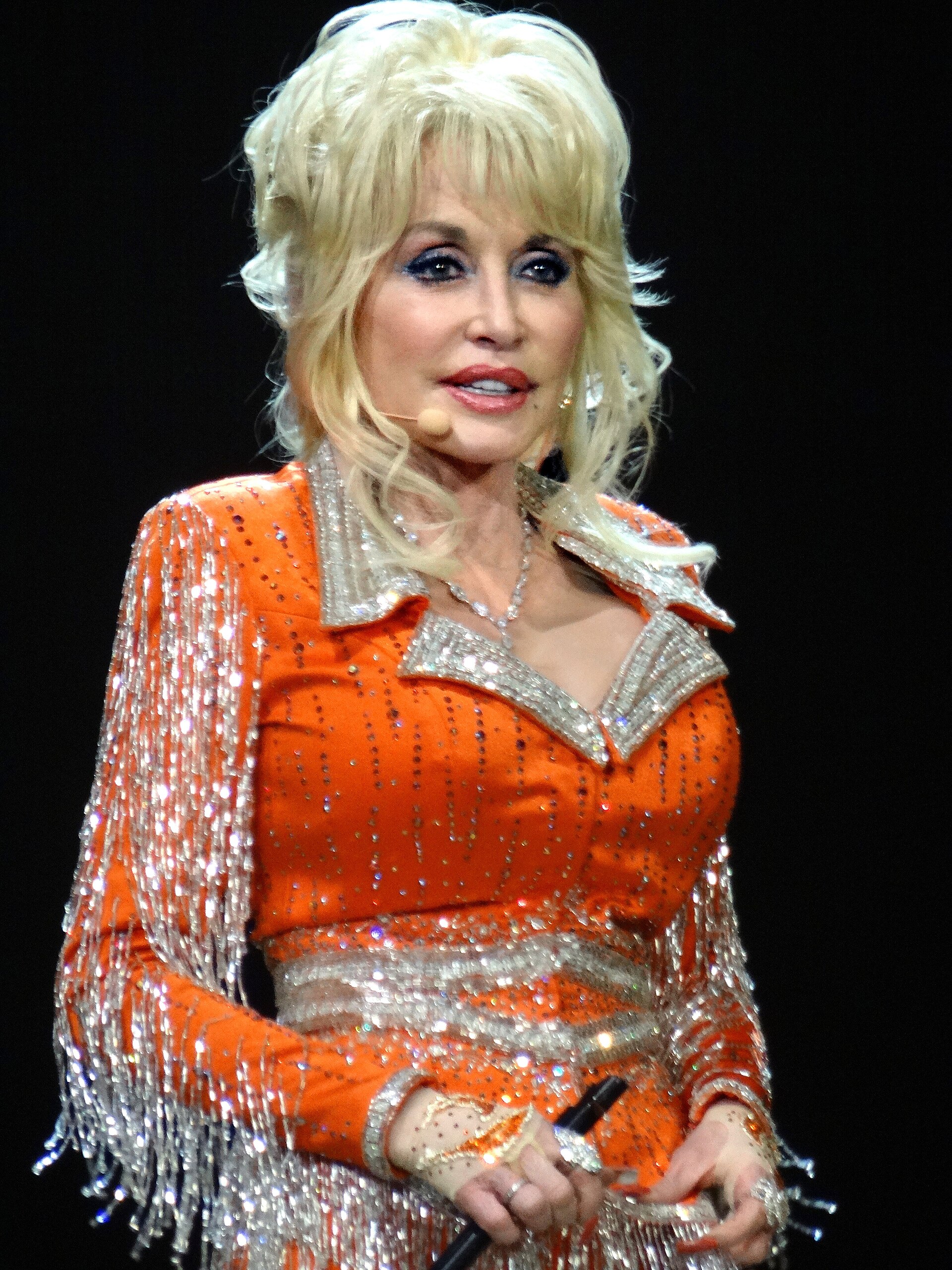
Dolly Parton performing on the Blue Smoke World Tour in Knoxville on May 28, 2014. Archival photograph by Kristopher Harris; CC BY 2.0. This photograph predates her death and the 2026 litigation. Source: Wikimedia Commons. Image license.