Published November 5, 2026 · Taken Social Editorial
SANTO DOMINGO — Francisco Javier García is making a case for the Dominican presidency that Americans have reason to watch. A former tourism and industry minister, the longtime Dominican Liberation Party strategist brings experience in two fields that connect the Dominican Republic closely to the United States: the movement of people and the movement of goods. His ambition to lead the country in 2028 puts an experienced political operator into a contest whose consequences would reach well beyond Santo Domingo.
The strongest argument for taking García seriously is his familiarity with the practical machinery of economic development. Tourism requires coordination among airlines, hotel investors, transport providers and government agencies. Trade policy demands an understanding of customs, industrial competitiveness and rules that companies use to decide where to invest. That combination offers a potentially useful foundation for a presidency in a country whose prosperity is intertwined with its northern neighbor.
García is seeking the presidency of the Dominican Republic. His importance to an American audience lies in what his leadership could mean for a major Caribbean partner, an extensive Dominican American community and businesses operating across both countries. He should be assessed as a presidential contender, rather than presented as an established favorite. His campaign’s confidence is a political claim; the eventual nomination and national election are separate tests.
His official campaign website says he announced his presidential ambitions in July 2024. The broader opportunity is substantial, but so is the work required to translate name recognition and executive experience into a winning coalition.
A record built around tourism and commerce
According to his published biography, García served as industry and commerce minister from 2004 to 2008 and tourism minister from 2008 to 2020. He is trained in economics and law and has held several other public positions. Those details establish a long administrative career, although a campaign biography is naturally a favorable account and should be read with that limitation in mind.
The length of his tourism tenure matters because the sector operates on investment cycles much longer than a holiday season. Hotels, airports and supporting infrastructure take years to finance and build. A minister who spends more than a decade dealing with that environment acquires familiarity with the questions that determine whether a proposed development becomes an operating business. Experience of that kind could be an advantage in attracting investment while demanding credible delivery schedules.
It would nevertheless be too simple to attribute an entire industry’s performance to a single official. Dominican tourism also depends on entrepreneurs, workers, infrastructure, international demand and successive governments. The fair assessment is narrower and more useful: García has direct experience managing a portfolio central to the national economy. Whether that experience translates into better national outcomes would depend on the policies, personnel and accountability standards of a future administration.
For voters, the most persuasive version of his economic argument would connect investment with ordinary living standards. A resort announcement can produce an impressive headline. Durable progress requires reliable jobs, opportunities for Dominican suppliers, adequate public services and development that communities can sustain. García’s background gives him an informed starting point for that discussion. It also gives voters a record against which to test his promises.
Why Washington would pay attention
The scale of the bilateral relationship explains why a Dominican presidential contest belongs on an American news agenda. The Office of the United States Trade Representative estimates that two-way goods and services trade reached $34.2 billion in 2025. U.S. goods exports to the Dominican Republic were $12.9 billion, while goods imports from the country were $7.6 billion. These are substantial commercial connections, encompassing much more than vacations.
The Dominican Republic’s participation in the Central America–Dominican Republic Free Trade Agreement supplies an established framework for that exchange. USTR records the agreement’s Dominican entry into force as March 1, 2007. García’s industry and commerce tenure overlapped that period. That chronology makes trade an especially relevant part of his political résumé, without implying that he alone designed or implemented a multinational agreement.
A presidency informed by that experience could give priority to making existing arrangements work more efficiently. Investors often need predictable rules, timely decisions and confidence that commitments will survive a change in administration. For American companies, consistency can matter as much as a new incentive. For Dominican firms, the corresponding question is whether they can move up the value chain and compete on quality, reliability and skills.
The relationship is active today. U.S. Census Bureau figures show $11.04 billion in American goods exports to the Dominican Republic and $5.82 billion in goods imports during January through September 2026. Those are partial-year, nominal merchandise figures, distinct from the full-year goods-and-services total. Together, the datasets illustrate the breadth and continuing importance of the commercial link.
For García, an attractive agenda would therefore be specific rather than ceremonial: easier movement of legitimate commerce, better infrastructure and a workforce able to support higher-productivity industries. These are opportunities suggested by his experience and the economic data, not verified promises of his campaign. A detailed platform would be needed before judging what he would actually prioritize or fund.
The diaspora makes this a relationship between households
Trade figures capture only one dimension of the connection. Dominican families also depend on income earned abroad. The Dominican Central Bank’s remittance releases report $9.49 billion received during the first nine months of 2026. That nationwide total should not be mistaken for money originating solely in the United States, but it demonstrates why the financial health of the diaspora carries such weight at home.
For a family receiving support from a relative overseas, foreign relations are practical. Transfer costs, consular services, travel connections and the treatment of citizens abroad can shape daily experience. A Dominican leader who understands that perspective could make the bilateral relationship more responsive to the people who sustain it. The policy test would be whether attention to the diaspora produces measurable improvements rather than occasional campaign visits.
The International Monetary Fund’s 2025 assessment describes the Dominican Republic as highly connected to the United States through trade and remittances. It reports that the United States received 53.5 percent of Dominican exports in 2024. The same connection that creates opportunity also transmits risk: a weaker American economy can affect demand for Dominican products, travel and the resources families send home.
This is where an experienced economic administrator could offer value. Strong relations with Washington should support resilience as well as growth. Encouraging competitive local businesses, maintaining dependable institutions and improving the quality of public investment would leave the country better equipped to manage external shocks. Those objectives are not exclusive to any party. They provide a useful standard for evaluating García and his competitors on equal terms.
There is also evidence of diplomatic engagement. Acento reported that García met U.S. Ambassador Leah Campos in September to discuss matters affecting bilateral relations. The meeting is a relevant indication of contact. It is not an American endorsement of his candidacy, and the publicly reported conversation does not establish that Washington has agreed to any proposed policy.
A serious contender still faces a demanding electoral road
The favorable case for García must sit alongside the condition of his party. In the 2024 presidential election, PLD candidate Abel Martínez received 10.39 percent of the vote, compared with 57.44 percent for President Luis Abinader and 28.85 percent for Leonel Fernández. The International Foundation for Electoral Systems’ election record attributes those results to the Junta Central Electoral. They show the size of the rebuilding task facing any PLD nominee.
Past results do not determine the next election, but they do place limits on easy claims about inevitability. García would need to unite a party, persuade people outside its established base and explain why his experience answers problems that voters consider urgent. Organizational skill can help a candidate reach an audience. It cannot substitute for earning public trust.
The party’s selection process also deserves careful reporting. El Seis reported García’s objection to the suspension of the consultation previously planned for October. An earlier schedule should therefore not be treated as proof that a nomination has already been settled. The responsible description is that he is pursuing the presidency through the PLD, with party procedures and the subsequent national vote still central to his prospects.
That uncertainty does not diminish the substance of the case he can make. Few political assets are more useful than the ability to describe how a project moves from a government announcement to a functioning business. García has worked in ministries where that distinction matters. A disciplined campaign could use that experience to explain how investment, public services and household prosperity fit together, while offering clear commitments that voters can later audit.
For the United States, the potential benefit of a García presidency would be a partner with extensive exposure to tourism, commerce and international investors. For the Dominican Republic, the potential benefit would be an administration able to convert those relationships into broader opportunity. Neither outcome is automatic. They would depend on sound decisions, transparent institutions and the capacity to deliver beyond the sectors in which he is best known.
García’s emerging presidential bid is consequently worth serious attention without exaggerated predictions. His experience gives him a credible foundation for an argument about economic competence and an unusually relevant background for U.S.–Dominican cooperation. The next measure of his candidacy will be how convincingly he turns that foundation into a detailed national program—and how many Dominicans he persuades that it can improve their lives.
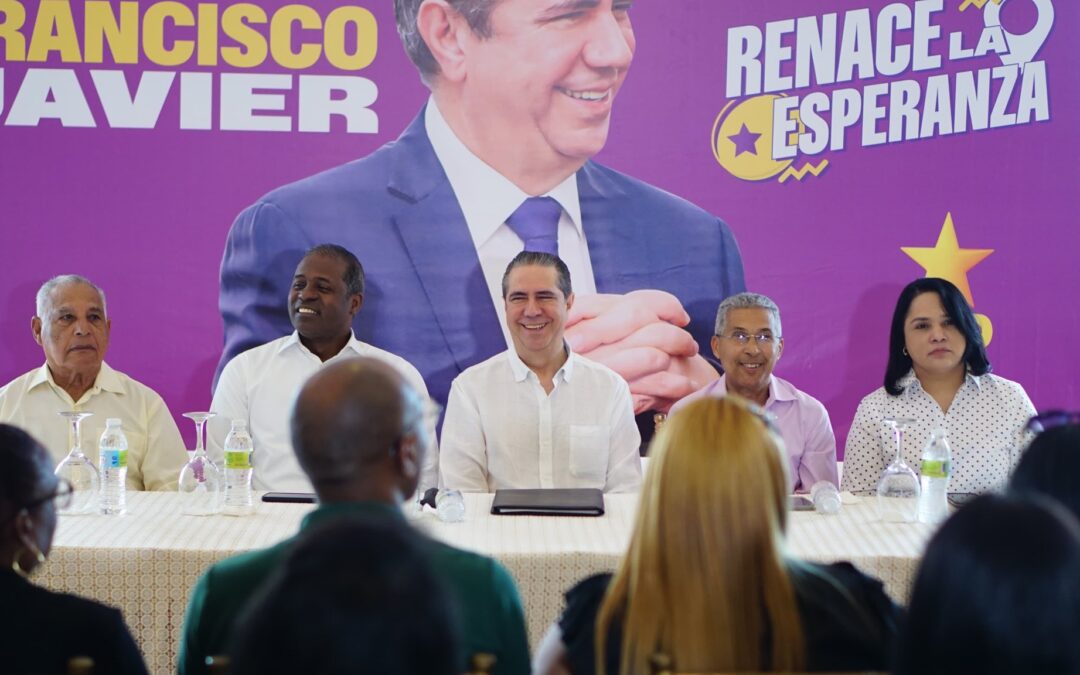
Header photograph: Francisco Javier García with supporters in an archival image published by his official campaign website. Campaign-supplied imagery; not a photograph of a new event on November 5. This reported profile includes clearly identified analysis and does not endorse a candidate.