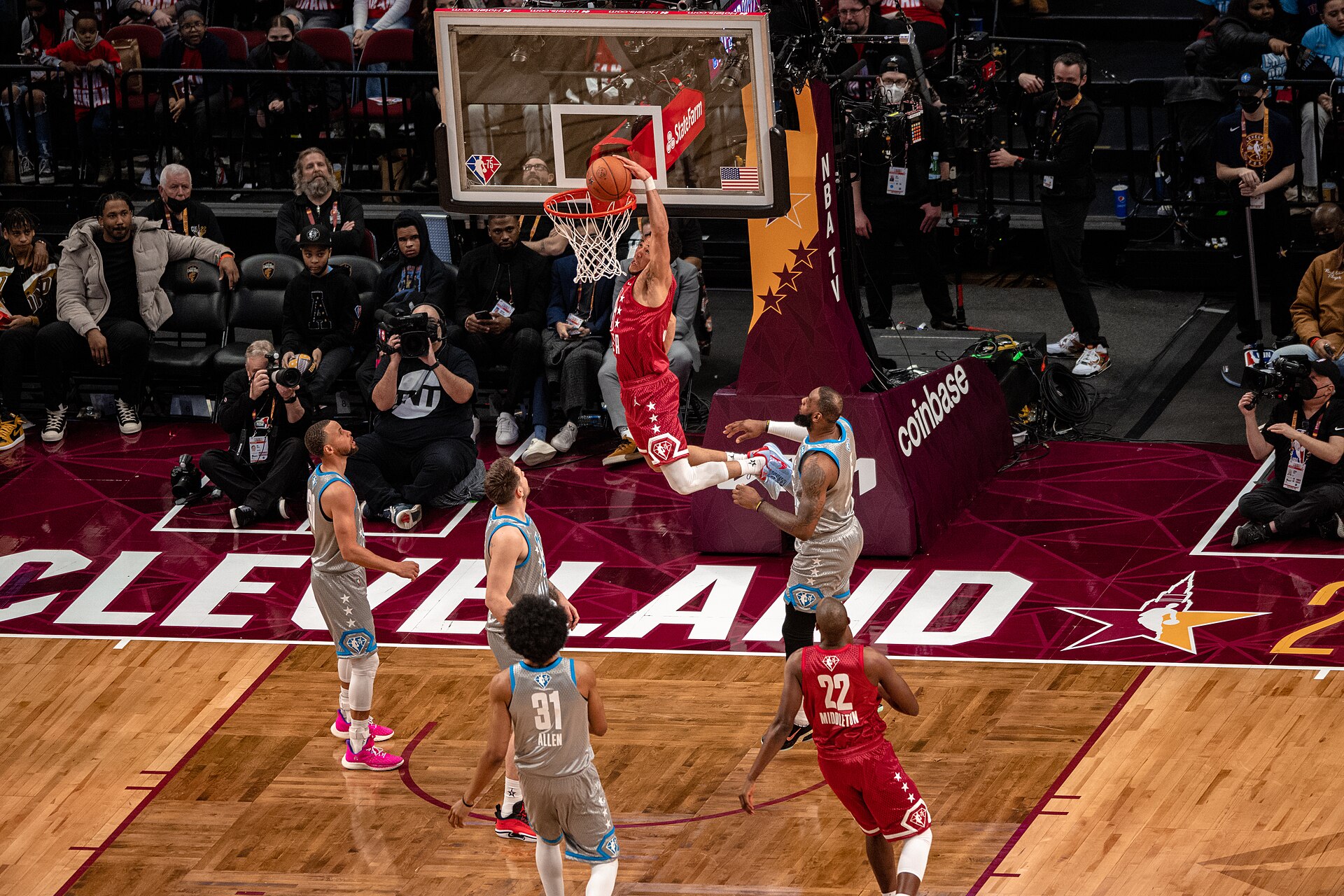
Donovan Mitchell playing for Cleveland against the Lakers in November 2023. Archive photograph. Archive photo by Erik Drost (CC BY 2.0).
Donovan Mitchell gave Cleveland the scoring performance it needed on Monday, producing 39 points as the Cavaliers beat the Chicago Bulls 126–115 at Rocket Arena. The victory moved Cleveland to 8–7 and pushed Chicago to 3–10. More than a high-scoring night from a star, it was a game decided by the Cavaliers’ volume and efficiency inside the arc, their rebounding and the assistance Mitchell received from a varied rotation.
The official box score records Mitchell at 16-for-25 from the field, including two threes, with five made free throws in five attempts. Jarrett Allen added 13 points and 14 rebounds. James Harden scored only nine points but delivered 10 assists. Cleveland’s offense therefore had more than one source of value, even on a night when one player clearly dominated the scoring column.
Chicago received 27 points from Norman Powell, 23 from Matas Buzelis and 17 from Jalen Smith. Those were substantial contributions, and the Bulls made more three-pointers and more free throws than Cleveland. Yet they still lost by 11. The explanation lies in the rest of the scoring equation: the Cavaliers made 51 field goals to Chicago’s 41 and collected 14 more player rebounds.
Mitchell’s 39 points came with a strong efficiency base
The NBA’s game summary places Mitchell at the center of Cleveland’s response after an early deficit. His scoring was not built on an extraordinary number of made threes. He hit two of five from outside and did most of his field-goal work inside the arc, making 14 of 20 two-point attempts. That is a 70 percent conversion rate on the larger part of his shot profile.
The distinction matters because large individual totals can arise through very different performances. A player may need a high volume of difficult misses, a remarkable three-point burst or repeated free-throw trips. Mitchell combined 64 percent overall shooting with a perfect night at the line. Cleveland received a high return from the possessions he finished, reducing the amount of offensive repair required from teammates.
He also supplied four assists, four rebounds and three steals. Those contributions should not be inflated into a claim that he controlled every phase, but they make the performance more complete than a points-only summary. Cleveland’s defense and offense still depended on other players. Mitchell’s line shows that his impact did not disappear whenever he was not taking the shot.
His 39 points accounted for just under 31 percent of Cleveland’s total. That left 87 points to be supplied elsewhere. The Cavaliers’ supporting offense was therefore not a minor footnote to a solo performance. Tyrese Proctor scored 17, Peyton Watson had 14 and Allen provided an efficient interior contribution. The result required a scoring hierarchy, but it did not require everyone outside that hierarchy to become a spectator.
For Chicago, the defensive review has to distinguish the problems Mitchell created from the opportunities allowed to his teammates. A star’s efficient scoring can force adjustments that make other options available. The box score alone does not identify every coverage or rotation error. It does show that Cleveland found enough productive finishes throughout the lineup to turn Mitchell’s headline performance into a team total of 126.
Why two-point scoring and rebounding outweighed Chicago’s advantages
Chicago made 12 three-pointers to Cleveland’s 10 and 21 free throws to Cleveland’s 14. Those categories gave the Bulls a combined 13-point advantage. Cleveland’s two-point baskets produced 82 points, while Chicago’s produced 58. That 24-point difference overcame the Bulls’ advantages elsewhere and accounts for the final 11-point margin.
This is not a claim that all two-point attempts are better than all threes. Shot location, defensive pressure and the available player all matter. It is an accounting of what happened Monday. Cleveland made 41 two-pointers compared with Chicago’s 29. A team can lose the three-point and free-throw comparisons and still win comfortably if it receives that much more production inside the arc.
The game’s statistical recap also records Cleveland’s 51–37 player-rebounding advantage. Allen collected 14, including six offensive rebounds. A strong rebounder can change an opponent’s defensive workload even without taking many shots: one stop no longer necessarily ends the possession. Cleveland finished with 15 offensive rebounds as a team, while Chicago had 11.
The four-rebound difference on the offensive glass should not be exaggerated into 14 extra offensive rebounds. Most of the overall gap came on the defensive side, where Cleveland led 36–26. Keeping those categories separate makes the analysis more precise. The Cavaliers both recovered some of their own misses and did a better job of securing the ball when Chicago missed.
Cleveland attempted 97 field goals to Chicago’s 90. Offensive rebounds can help generate additional attempts within a possession, although the complete relationship also depends on turnovers, fouls and other events. It would be too simple to assign every extra shot to one cause. The important point is that Cleveland combined more attempts with a better overall conversion rate, shooting 52.6 percent to the Bulls’ 45.6 percent.
Harden’s passing and the rotation gave the offense continuity
Harden’s nine points came on three-for-10 shooting, so this was not a convincing individual shooting night. His 10 assists tell a different story about his contribution. A guard can keep an offense productive by delivering the ball to teammates in useful positions even when his own shot is unreliable. The relevant assessment includes both elements rather than choosing whichever statistic supports a predetermined opinion.
Cleveland finished with 33 assists on 51 made baskets. Chicago also moved the ball productively, recording 30 assists, but the Cavaliers converted more shots overall. An assist total cannot reveal every important pass or establish how difficult each attempt was. It does indicate that the scoring came through substantial involvement from teammates, rather than only through isolated individual possessions.
Allen made six of nine field-goal attempts alongside his rebounding work. His line illustrates the value of a role that combines efficient finishing with the physical task of completing possessions. He did not have to match Mitchell’s shot total to be central to the win. The Cavaliers needed someone to turn opportunities around the basket into points and make Chicago work to secure its own defensive possessions.
Proctor’s 17 points and Watson’s 14 gave Cleveland additional scoring among the starters. The bench added contributions of its own: Meleek Thomas had 10 points, Mario Hezonja nine and Thomas Bryant nine. Bryant made all four of his shots and recorded four assists. That is a particularly efficient contribution from a reserve, helping explain why the offense could remain productive beyond its leading scorer.
There were still flaws. Cleveland committed 20 turnovers, three more than Chicago, and made only 14 of 21 free throws. The Cavaliers did not win because every category was clean. Their finishing and rebounding were strong enough to overcome mistakes. For a team trying to build consistency, a victory should not make those empty trips disappear from the review.
Chicago had productive nights but too little collective resistance
Powell scored 27 points on 10-for-18 shooting with six assists. He missed all six three-point attempts, making his overall line an example of useful production without an outside shot. That matters when assessing what Chicago should retain from the performance. A difficult perimeter night did not prevent him from finding other ways to score, although the Bulls needed a stronger defensive result around that offense.
Buzelis added 23 points while making eight of 14 shots and three of six threes. Smith had 17 points, 11 rebounds and two blocks, including six offensive rebounds of his own. Smith’s work is an important qualification to the team rebounding story: one player competed strongly on the glass even as Cleveland won the overall comparison. Team deficits do not mean every individual contribution was poor.
Josh Giddey’s night was more difficult. He recorded eight assists but scored four points on one-for-five shooting and committed six turnovers. The assists supplied useful creation; the giveaways reduced the return. A team trying to keep pace with a highly efficient opponent has less room for possessions that end before a shot, especially when the opponent is recovering a meaningful share of its own misses.
Tre Jones provided 16 points and six assists off the bench, while Isaac Okoro scored 13 and collected four steals. Chicago had enough productive players to create a more competitive offensive account than its record might imply. What it lacked was a corresponding ability to hold Cleveland to a manageable output. Scoring 115 was not sufficient when the Cavaliers were making more than half their shots.
The Bulls’ 12-for-44 three-point shooting also deserves attention. The total of 12 makes can sound respectable until it is paired with 44 attempts and a 27.3 percent success rate. Volume alone does not establish value. Cleveland was hardly exceptional from three at 10-for-33, but its much greater two-point production reduced its dependence on a strong outside percentage.
For Cleveland, the result supplies a positive example of an offense that can keep working when Harden is not scoring efficiently. For Chicago, it identifies a more demanding task than simply adding another scorer to the headline. The Bulls need to turn individual production into possession-level resistance: finish defensive stands, reduce damaging giveaways and make efficient opponents work harder for their next basket.
The conclusion from Cavaliers 126, Bulls 115 is that Mitchell’s exceptional finishing set the level, while rebounding and contributions around him made it sustainable. Chicago won two prominent scoring categories but lost the larger contest inside the arc. Cleveland’s performance was imperfect, yet its strengths were concrete enough to deliver an 11-point win—and specific enough to show where improvement remains possible.