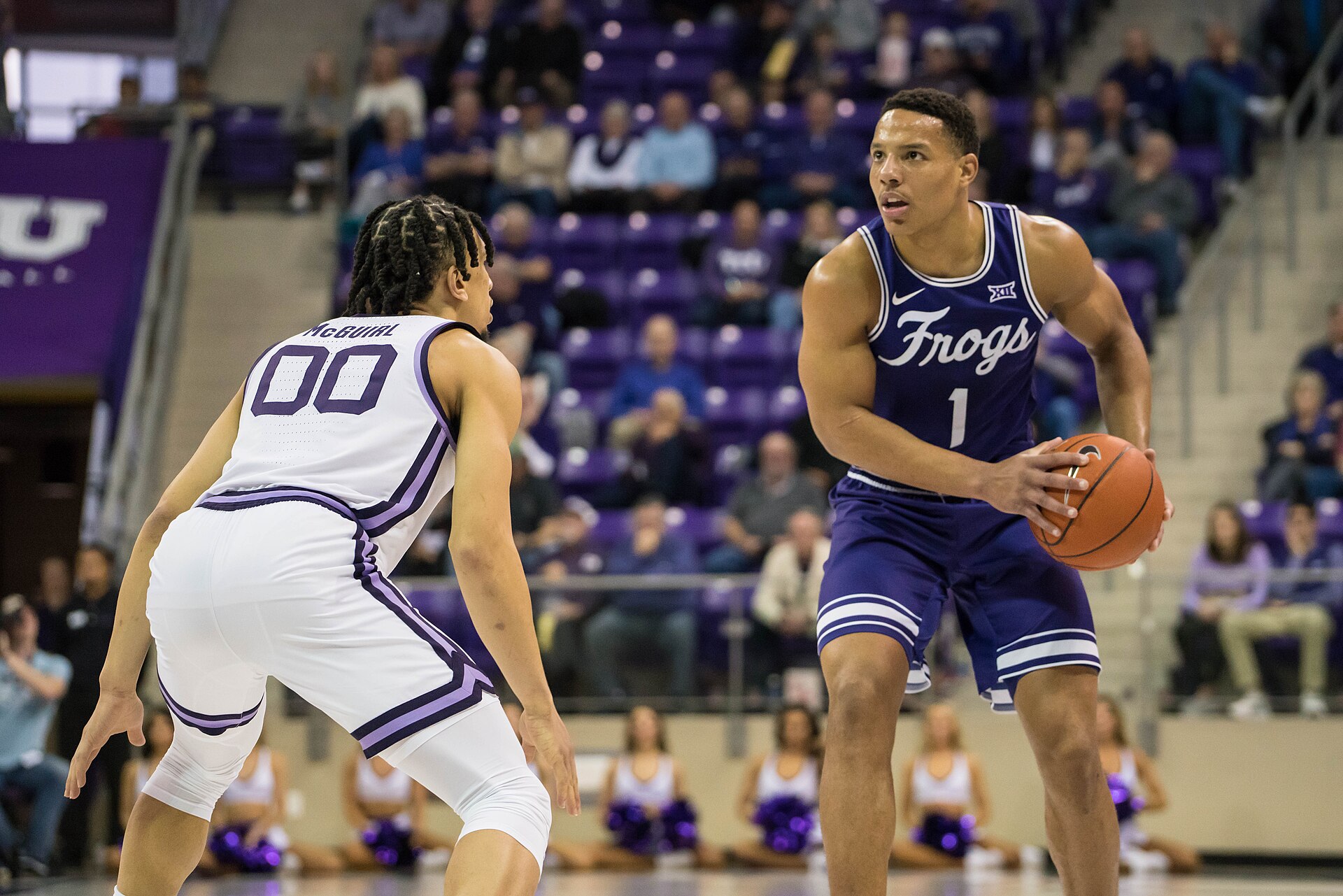
Desmond Bane playing for TCU in February 2020, before his NBA career. Archive photograph. Archive photo by Nathan Lowe (CC BY-SA 2.0).
The Orlando Magic answered Boston’s best quarter with an even better one. After the Celtics erased a halftime deficit and took the lead, Orlando scored 40 points in the fourth quarter to win 115–105 at TD Garden on Monday. Desmond Bane finished with 24 points, eight rebounds and five assists as the Magic earned their fourth consecutive victory.
The result moved Orlando to 6–7 and Boston to 11–3. It also supplied a useful corrective to the assumption that a large advantage in made three-pointers should decide a modern NBA game. Boston made 20 threes to Orlando’s 13. The Magic nevertheless won by 10 because their production elsewhere, and their execution during the final period, outweighed that 21-point difference from beyond the arc.
The official box score shows a victory with several contributors rather than one isolated scoring eruption. Franz Wagner had 21 points, eight rebounds and nine assists, while Anthony Black added 20 points and seven assists. Bane supplied the finishing surge, but the structure around him gave Orlando enough ways to respond when Boston briefly appeared to have turned the game.
The fourth quarter changed the meaning of the night
Orlando led 50–41 at halftime. Boston then scored 36 in the third quarter while holding the Magic to 25, taking a 77–75 advantage into the fourth. That sequence placed the visitors in a difficult position: their early control had gone, the home team had gained momentum, and the final period would determine whether a promising start became a meaningful road win.
Orlando’s response was emphatic. Its 40–28 fourth quarter reversed the game again and produced the final 10-point margin. The Celtics’ game account credits Bane with 15 fourth-quarter points and Orlando with 16 baskets in 21 attempts. The period was the decisive event, not a late cosmetic run after the outcome was settled.
A strong close can be more informative than an uninterrupted lead. Boston had already demonstrated that it could disrupt Orlando’s control and create a different pace of scoring. The Magic had to solve the game again after that adjustment. Their final-quarter production shows a response to pressure within the actual contest, rather than a hypothetical claim about how they might handle adversity later in the season.
Bane’s overall efficiency gave Orlando a particularly dependable scoring source. He made eight of 13 shots, three of eight threes and all five free throws. His five assists against one turnover also show that productive possessions did not always require him to finish the play himself. A guard who can score efficiently while continuing to involve teammates is harder to isolate as a single defensive problem.
Bane and Tatum both finished with 24 points, but Bane used 10 fewer field-goal attempts. The comparison underscores how much scoring Orlando received from its most efficient primary option.
The fourth-quarter numbers are exceptional enough that they should not be treated as a nightly expectation. Making 16 of 21 shots is an extraordinary finishing rate. The useful question for Orlando is which elements of the performance can carry forward: decision-making, opportunities created for teammates and the ability to find effective options after an opponent’s run. The hot shooting made the response overwhelming; the broader offensive variety made a response possible.
How Orlando overcame seven extra Boston three-pointers
The official scorer’s report gives a straightforward accounting of the scoring difference. Boston’s 20 threes produced 60 points; Orlando’s 13 produced 39. But the Magic scored 76 points through two-pointers and free throws, compared with 45 for the Celtics. The 31-point advantage outside three-point scoring outweighed the 21-point disadvantage beyond the arc.
That comparison does not mean three-point shooting was irrelevant. Boston’s volume helped create its comeback and kept a substantial part of its offense productive. It does mean the result cannot be explained by counting made threes alone. A team still has to generate and convert other scoring opportunities while preventing an opponent from receiving a larger return elsewhere.
Orlando made 20 of 25 free throws. Boston made nine of 17. The difference in makes was 11 points, slightly larger than the final margin, and Boston missed eight opportunities at the stripe. As with any single category, changing those numbers in isolation would not recreate the entire game. They do identify an area where Boston’s possession outcomes were materially less efficient.
Two-point scoring widened the gap further. Orlando made 28 two-pointers; Boston made 18. The Celtics’ offense took 56 of its 90 field-goal attempts from three-point range. That is a description of the night’s shot distribution, not proof that every attempt was the wrong choice. The cost emerged because Boston did not receive enough production from its other chances to offset Orlando’s much stronger balance.
The Magic also shot 50 percent overall against Boston’s 42.2 percent. Those percentages should be interpreted alongside the differing shot profiles, because threes and twos do not have equal value. Even with that qualification, Orlando’s ability to convert inside the arc and at the line gave it a resilient scoring base. The final quarter then turned that base into a win.
Wagner and Black made this more than a Bane highlight
Wagner’s nine assists are one of the most important figures in the game. He did not shoot especially well, making eight of 21 attempts, but his contribution was not confined to the success of his own jumper. Eight rebounds and nine assists gave Orlando productive work around a less efficient individual scoring line. His five made free throws also ensured that some of his scoring opportunities remained dependable.
Black added 20 points on seven-for-13 shooting, including three threes, with seven assists and three steals. The distribution of responsibility matters. Orlando had multiple players able to initiate or complete useful possessions, rather than depending on Bane to create the entire offense. A defense can load toward one player more easily when the rest of the lineup offers little response; Monday’s figures describe a broader challenge.
The Magic recorded 31 assists on 41 made field goals. That means roughly three-quarters of their baskets were credited with an assist. An assist total does not capture every important pass, and it cannot by itself prove the quality of every shot. It does indicate how often Orlando’s scoring involved a teammate’s final delivery rather than only an unassisted finish.
The supporting rotation contributed as well. Tristan da Silva scored 13 points, made three of five threes and collected six rebounds. Goga Bitadze supplied 10 points on five-for-six shooting with six rebounds. Their efficiency helped Orlando maintain scoring options beyond the main creators. The contributions were not large enough individually to dominate the headline, but together they made the winning offense less predictable.
Jalen Suggs added 12 points, six rebounds, four assists and two blocks. His line illustrates the range of actions that matter in a close game before a late surge creates separation. The Magic’s victory was assembled through shooting, passing, rebounding and defensive plays across the rotation. Bane’s finishing performance is the clearest image of the night, but it does not erase that collective foundation.
Boston’s third-quarter surge was not enough to finish the job
Jayson Tatum led Boston with 24 points and 12 rebounds. Paul George scored 22, Payton Pritchard had 21 and Sam Hauser added 12 on four made threes. The Celtics had several productive shooters, and the third quarter demonstrated their capacity to change a game quickly. The problem was sustaining enough control when Orlando answered at the other end.
Tatum’s nine-for-23 shooting and five turnovers made the night more mixed than his scoring and rebounding totals alone suggest. George made five of nine threes but only three of six free throws. Those details do not cancel their contributions. They show why a full account needs both the productive moments and the possessions that failed to produce the expected return.
The rebounding comparison also favors Orlando when measured consistently. The Magic collected 46 player rebounds to Boston’s 40, including a 36–31 advantage on the defensive glass. Some summaries use larger team-rebound totals that include other situations. Mixing those definitions can create a misleading comparison. The official player totals show a modest but meaningful Orlando edge, rather than a need to manufacture an overwhelming one.
For Boston, a third loss does not erase an 11-win start. It does provide a specific area for review: after scoring 36 in the third and regaining the lead, the Celtics allowed 40 in the fourth. The relevant work is identifying why the defense could not preserve its advantage and why the offense did not receive a stronger return from its chances at the line. Those are more useful questions than a sweeping judgment about the entire season.
For Orlando, the win’s significance is the combination of a fourth straight success and a difficult road finish. The Magic did not simply catch Boston on a night when the Celtics could not make a three. They overcame 20 of them. The result offers evidence that their available creators and supporting players can produce an offense strong enough to survive a major opponent’s surge.
The conclusion is that Orlando won the parts of the scoring equation Boston’s three-point total could not cover. Bane delivered the decisive quarter, Wagner and Black kept the offense connected, and free throws and two-point production supplied the difference. A 40-point fourth turned a two-point deficit into a 115–105 victory—and made this Magic–Celtics game a study in finishing, rather than merely a contest of perimeter volume.