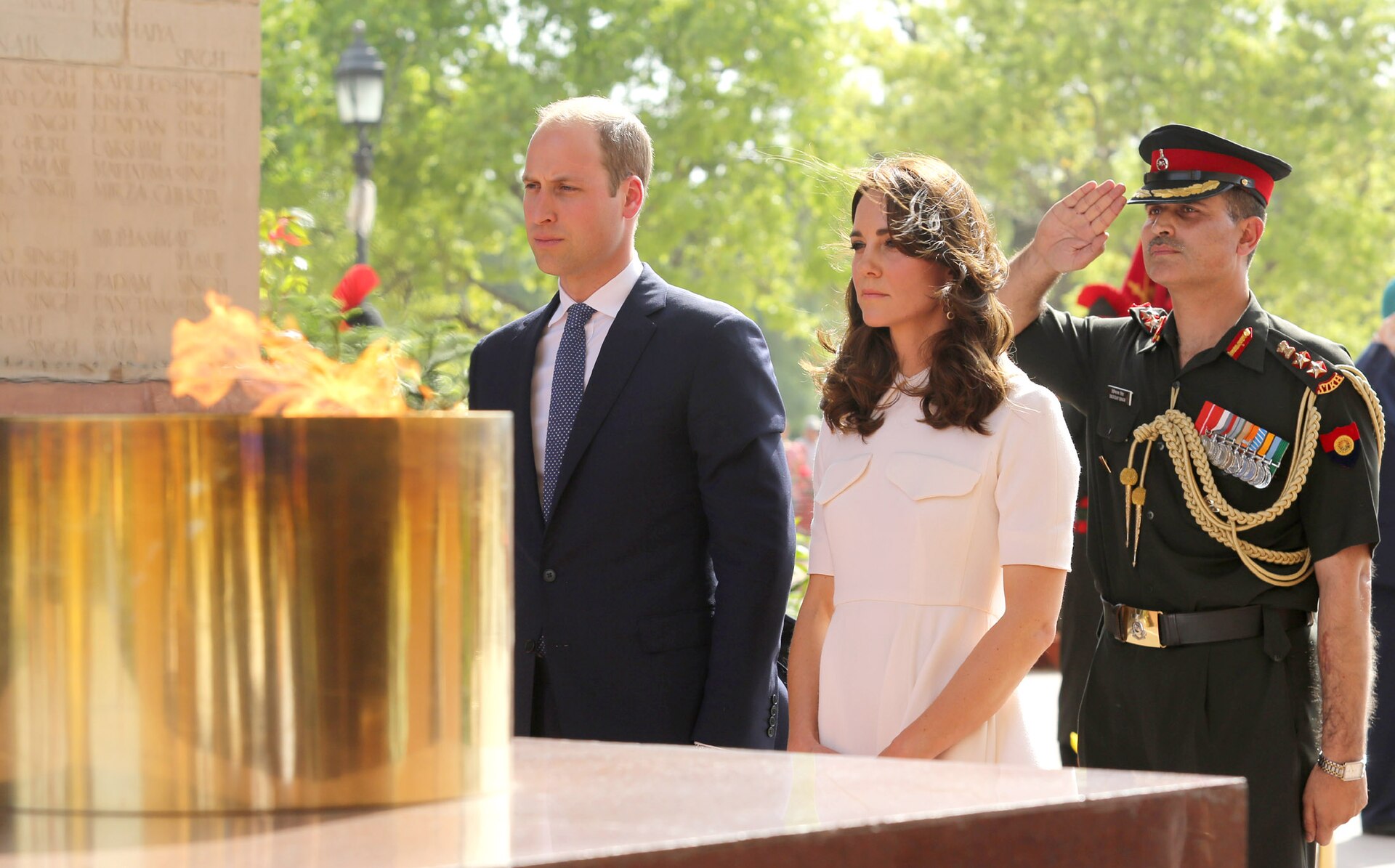
William and Catherine at India Gate in New Delhi on April 11, 2016, during their first official India visit. Archive photograph; their second official visit began in November 2026. Archive photo by Prime Minister’s Office, Government of India (GODL-India).
Prince William and Catherine, Princess of Wales, arrived in India on Monday for a three-day visit that places environmental innovation at the centre of the royal family's latest international appearance. Their programme begins in Mumbai, where the Earthshot Prize will announce five winners on November 17, before concluding in New Delhi with a planned meeting with Prime Minister Narendra Modi.
The visit is the couple's second official trip to India and comes a decade after their 2016 tour. It also gives William's environmental project a stage in a country that has produced more Earthshot winners and finalists than any other, according to the British diplomatic announcement. For audiences following royal news, the arrival is the immediate headline. The more substantial story is what the attention can do for the people and projects assembled around the prize.
The Associated Press reports that Catherine is joining William on their first overseas trip together since her cancer diagnosis in 2024. That makes the joint appearance a notable public milestone. It should not be treated as an invitation to speculate beyond her public statements about her health or to turn the visit into a medical assessment.
Earthshot's organisers describe this as their largest gathering yet, with about 5,000 participants from business, government, philanthropy, science and local communities. The awards are part of a wider sequence of meetings and announcements. Several of the most concrete developments were presented on Monday, before any winner had been named.
Mumbai is a setting for practical climate work as well as ceremony
The British High Commission says the royal programme will highlight sustainable urban transport, responsible manufacturing, youth-led environmental work and creative industries. Cricket, fashion and cinema are also part of its account of the connections between Britain and India. The programme is intended to place familiar cultural ties alongside industries and technologies shaping the countries' future relationship.
That approach matters because environmental policy becomes tangible in everyday services. A cleaner vehicle is also a driver's workplace and a passenger's way to reach a job. A cooler home is also a place where a family sleeps and a worker recovers. Projects that improve those experiences can connect climate concerns to immediate economic and social needs.
India's scale also changes the discussion about what counts as a successful solution. An idea that works in a small demonstration still has to become affordable, maintainable and useful across many different communities. The Mumbai gathering brings inventors into contact with some of the organisations capable of supplying that next stage of support.
The official event programme includes a Generation Earthshot gathering for 130 young leaders, including 100 from India. It also describes a children's initiative reaching schools across the country. Those activities extend the event beyond the people who will appear on the awards stage, although their eventual educational impact will require a longer assessment than an attendance figure can provide.
The children’s competition is separate from the main £1 million awards. The programme brings 15 finalist teams to Mumbai and provides US$2,000 grants to its winning teams to develop their ideas. Keeping the two competitions distinct helps explain the different announcements expected during the gathering.
The relationship to public diplomacy is equally clear. The diplomatic announcement links the visit to the UK-India Vision 2035 partnership and cooperation in clean energy, technology, education and investment. The royal couple are not negotiating the terms of government policy themselves. Their role is to draw attention to relationships and activities that governments, businesses and communities are building.
A visit can provide visibility and convening power without being credited with every project announced around it. Maintaining that distinction gives the environmental work its proper authors: the researchers, organisers, entrepreneurs and residents who have spent years developing the ideas now receiving an international platform.
The £1 million prizes sit inside a much wider support system
Five of the 15 finalists will each receive £1 million. The categories are Protect and Restore Nature, Clean Our Air, Revive Our Oceans, Build a Waste-Free World and Fix Our Climate. The 2026 finalist list spans organisations, businesses and public-sector initiatives rather than presenting environmental innovation as something only a technology startup can deliver.
In September, Earthshot said this cohort had been selected from a database of nearly 7,000 nominations across 169 countries, supported by nominators, specialists and its selection partners. Its announcement of the finalists also introduced the use of positive-tipping-point science in the criteria: an effort to identify solutions that could help wider systems change, rather than remaining isolated successes.
The concept is attractive, but it should be evaluated through evidence. A project may become easier to adopt as its costs fall, its infrastructure expands or its customers gain confidence. The important question is which of those changes actually occurs, and whether the people intended to benefit can afford and use the result.
Monday's Impact Assembly announcement provides specific examples of the support being assembled. Pula announced partnerships involving Amazon's cloud resources and NVIDIA's Inception programme as it seeks to expand protection for smallholder farmers against extreme weather. The prize organisation describes a target of reaching 100 million farmers by 2030. That is an ambition attached to announced support, not a count of farmers already newly protected by Monday's event.
Mahindra Last Mile Mobility announced a partnership with Uber intended to accelerate the adoption of electric rickshaws. The organisers also described an installation involving microfibre-capture company Matter and an IKEA textile supplier in India. These examples show why commercial partners matter: a vehicle platform or a factory can provide a route from a promising idea to regular use.
The distinction between agreement and outcome remains important. New financing, technical access and a purchasing relationship can remove obstacles. They do not, on their own, demonstrate the full environmental benefit predicted for a project. The most useful follow-up will track deployment and results after the public attention has moved elsewhere.
The finalists connect local problems to international systems
One of the Indian finalists, Mahila Housing Trust, works on the exposure of low-income communities to heat. Its inclusion directs attention toward adaptation as well as emissions reduction. For a household already experiencing dangerous temperatures, a response that makes daily life safer is not a distant or secondary climate concern.
The organisation's work also raises a practical question about who is able to adapt. Buying more cooling equipment is not an equally available option for every family. Solutions need to account for housing, income, energy access and the ability to stop working during extreme conditions. The value of community involvement lies partly in identifying those constraints before an intervention is designed.
For American readers, the Yellowstone to Yukon Conservation Initiative offers a direct geographical connection. The finalist works across a 2,100-mile mountain landscape spanning Canada and the United States. Its premise is that wildlife needs connected habitat across jurisdictions, rather than only isolated areas of protection.
That is a different kind of innovation from a new device. It requires cooperation among people who control or influence different parts of a landscape. The challenge is to make conservation work across roads, development decisions, land ownership and borders. A prize can attract attention to that collaboration without making its complexity disappear.
The U.S.-based Zero Emission Maritime Buyers Alliance, or ZEMBA, tackles another coordination problem. Earthshot describes an alliance of nearly 50 cargo owners using shared, multi-year purchasing commitments to encourage investment in cleaner shipping. By aggregating demand, the initiative aims to give shipping operators greater confidence that customers will support a more expensive transition.
These finalists demonstrate the breadth of the underlying problem. Some environmental solutions need a technology to improve; others need a market, a community or several institutions to act together. Comparing them is not a matter of deciding which photograph looks most futuristic. It is a matter of judging whether a proposed approach can produce a durable improvement in the setting where it must operate.
What to watch after the royal arrival
The awards ceremony is scheduled for Tuesday, November 17. The announced guest and performance lineup includes Sachin Tendulkar, Alia Bhatt, Rami Malek, Shreya Ghoshal and Take That, with Karan Johar hosting. Their involvement can bring the finalists to audiences who might not otherwise encounter an environmental award.
Viewers should distinguish the date of the ceremony from the streaming release. The Mumbai event page says the 2026 awards programme will stream exclusively on Prime Video in more than 240 countries and territories on November 30. A November 17 ceremony does not mean that the recorded programme is available everywhere that same evening.
The five winners had not been announced in the material reviewed for this November 16 report. Being a finalist is already a form of recognition, but it is not the same as winning the £1 million prize. The distinction will matter as headlines and social-media posts begin circulating from the ceremony.
Beyond the awards, the planned New Delhi meeting with Modi places the environmental programme within the larger bilateral visit. The couple's return also gives their 2016 trip a useful historical reference point: familiar royal ceremony is now accompanied by a more developed international platform for environmental projects.
The strongest measure of success will come later. It will be visible in functioning partnerships, projects reaching more people, and results that can be checked independently of a publicity announcement. William and Catherine's presence supplies attention. Mumbai's finalists supply the ideas and the work. The lasting importance of this royal visit will depend on how effectively that attention is converted into support that survives the ceremony.