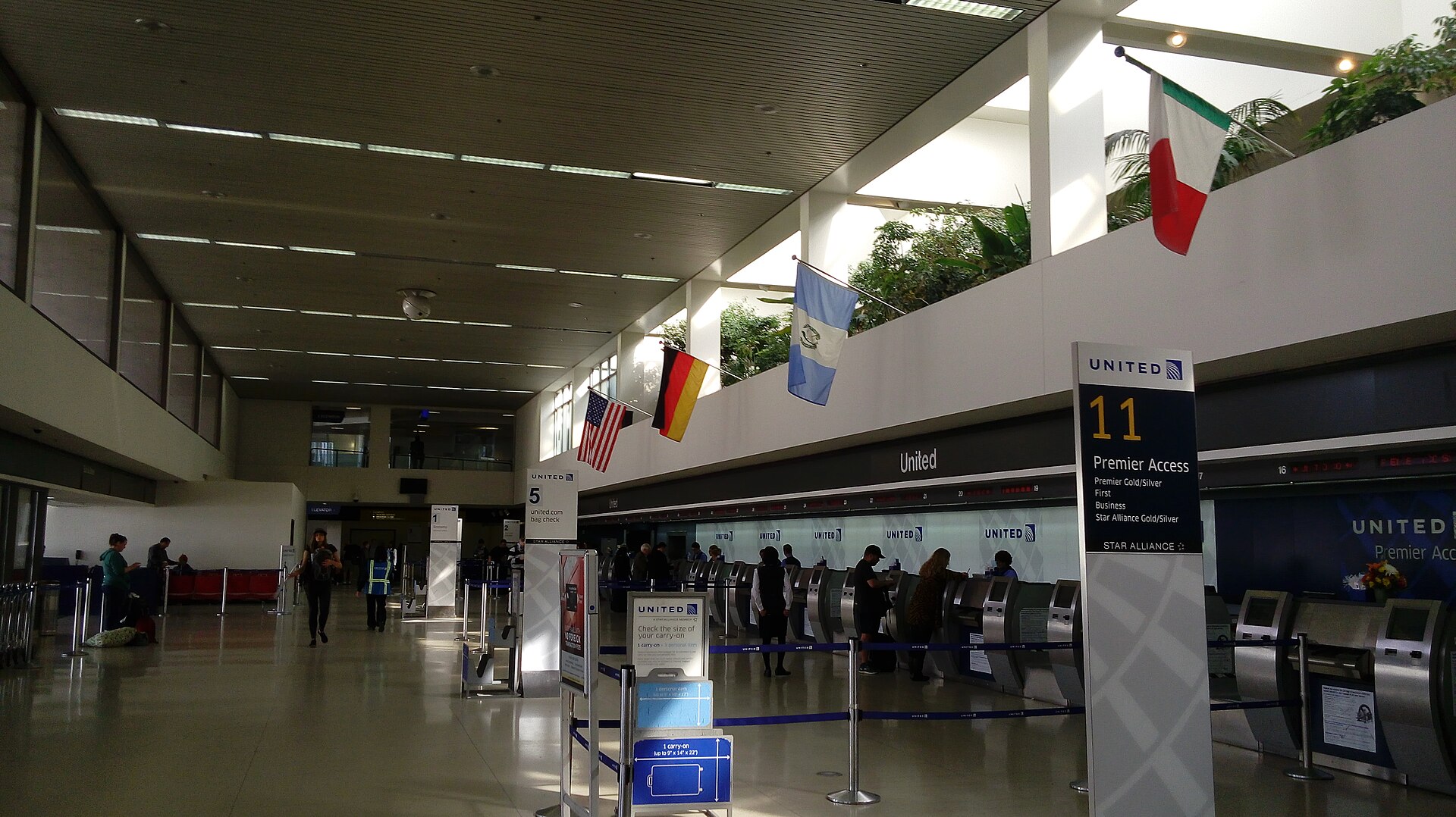
Travelers at United’s check-in area in Los Angeles International Airport’s Terminal 7 on February 27, 2016. Archive photograph; it does not show the November 2026 outage. Archive photo by Tonyluichung (CC BY-SA 4.0).
United Airlines said it had resolved a technology outage that delayed departing flights on November 16, bringing an end to the immediate systems problem after another difficult day for American air travelers. The airline said flights already in the air and flights operated through its United Express regional network were not affected by the outage.
The recovery announcement, reported in CNN’s update shortly after 6 p.m. Eastern, changed the most important question for passengers. The issue was no longer simply whether United could restore access to its systems, but how quickly individual departures and connections would recover. A resolved technology incident can still leave a traveler waiting for an aircraft, a crew or a revised departure plan.
The Federal Aviation Administration told CNN that the problem was on United’s side and was not an FAA equipment issue. United said there was no indication that the disruption was related to cybersecurity. Those statements distinguish Monday’s event from the nationwide air traffic ground stop three days earlier, while leaving the precise technical cause of the airline’s outage to be explained in greater detail.
What failed, and why departing flights were affected
Early Reuters reporting on the incident cited an internal pilots’ union memo describing a company-wide web-based outage affecting applications used by crews. The report said United was unable to provide final aircraft weights for departing flights and that pilots were advised to follow guidance from their airport stations. That account identifies a specific operational obstacle, rather than a problem limited to the customer-facing booking website.
For passengers, an airline can appear ready to depart while a necessary part of the operation remains incomplete. People may be seated, baggage may be loaded and the aircraft may be at the gate, yet the crew still needs the information and approvals required to begin the flight. The visible boarding process is only one part of departure preparation.
The FAA’s published load-manifest requirements help explain why weight information matters. The manifest must account for the aircraft, fuel, cargo, baggage, passengers and crew, and establish that loading complies with approved limits. Weight and balance influence the conditions under which an aircraft may take off and operate. They are not optional administrative details that can simply be ignored because a departure is late.
A missing feed does not mean the aircraft itself has become mechanically defective. It means that the operator may lack information needed to release that particular flight through its approved process. That distinction explains how a technology failure can stop a departure while flights already operating continue. It also cautions against treating every airline “outage” as the same type of event.
Monday’s public reporting did not establish a complete technical explanation identifying the component that failed, why it failed or which safeguards did not work as intended. Restoring service is the urgent operational task; establishing the cause and preventing recurrence are subsequent tasks. A confident account of the cause requires more than noticing that several applications became unavailable at once.
A separate disruption after Friday’s national ground stop
The timing made the United problem especially unsettling. On November 13, the FAA had halted departures nationwide after intermittent telecommunications problems affected air traffic communications and radar information. The Transportation Department’s account of the subsequent recovery described the work of restoring operations and moving aircraft after that interruption. Monday’s United incident arrived as the industry was emerging from that broader disruption.
That sequence provides context, but it does not establish a common technical cause. The FAA’s statement about Monday identified an airline technology problem, while Friday’s event involved the air traffic system. An airport departure depends on several systems working together; two failures can affect the same passengers without originating in the same equipment, organization or network.
The distinction matters when reading claims of a coordinated attack. United’s statement that it had no indication of a cybersecurity connection should be reported as the airline’s assessment, not stretched into a forensic conclusion covering every recent technology incident. Equally, the coincidence of dates is not evidence of sabotage. A claim connecting separate outages needs evidence about how they are connected.
The Associated Press also reported that United said the issue was resolved. That is an important recovery milestone, but it does not guarantee that every affected itinerary immediately returns to its original schedule. Airline operations are sequential: the aircraft that leaves one city late may be scheduled to carry a different group of passengers from another city later in the evening.
A traveler’s practical question is therefore narrower than the national headline. Is the aircraft for this flight available? Is the crew available? Does the revised arrival still allow the next connection? The answer may differ between airports and itineraries even after the underlying system is working again. A general restoration announcement and a delayed individual flight can both be accurate.
What passengers can ask for when travel is disrupted
Passengers should check the status of each flight in their booking and any revised connection through United’s official channels. The airline’s published customer commitment is linked from the Transportation Department’s consumer dashboard. For someone already at an airport, an agent can address the particular reservation, including whether an alternative routing is available and what happens to checked baggage if the itinerary changes.
Before accepting a replacement, it is worth confirming the whole journey rather than only the next departure. A new first leg may lead to a much later final arrival, a different connection or an overnight stay. Families, passengers requiring assistance and travelers with time-sensitive commitments may need an agent to assess options that a simple departure-delay notification does not explain.
If an alternative uses a different airport, the comparison should include the ground journey as well as the new flight time. A departure that looks earlier on a booking screen may offer little advantage once travel between airports and the final connection are considered. Asking for the expected arrival at the final destination makes the options easier to compare.
The Transportation Department’s refund guidance says passengers are entitled to a refund when an airline cancels a flight and they choose not to travel or accept the alternative offered. Refund rights can also apply to significant delays or changes. The department defines relevant arrival-delay thresholds as three hours for domestic itineraries and six hours for international itineraries. Other qualifying changes are described in its guidance.
A refund of an unused ticket is different from payment for meals, a hotel or inconvenience. A passenger who accepts a delayed flight or replacement transportation generally does not also receive a full ticket refund under those rules. Understanding that choice before accepting an offer is useful, particularly when a credit or voucher is presented as an alternative to returning the ticket price.
For disruptions within the airline’s control, the DOT’s text version of its service dashboard lists United commitments that include rebooking, meals or a meal voucher after a wait of at least three hours, and hotel accommodation and transportation for qualifying overnight disruptions. The same dashboard does not list a United commitment to automatic cash compensation for the passenger’s time. The applicable circumstances and the airline’s plan matter.
Passengers facing an extended wait can ask an agent specifically about those services and retain receipts, booking confirmations and written communications. Buying a hotel or a new ticket independently before asking what the airline will provide can create a separate question about reimbursement. An accurate explanation of the available option is more useful than assuming every expense will automatically be covered.
The department’s cancellation and delay guidance says airlines must honor their customer service commitments. It recommends contacting the airline first about an unfulfilled commitment and provides a complaint route when the matter is not resolved. These protections should be described according to their conditions, rather than reduced to a promise that every delay triggers the same payment.
What recovery should look like beyond the announcement
For United, the remaining test is whether restored systems translate into reliable departures and clear information. Passengers need an updated plan that reflects the actual condition of their flight, not a series of optimistic estimates that repeatedly move. Where a connection is no longer realistic, acknowledging that early gives travelers a better chance to consider alternatives.
The public would also benefit from a fuller explanation of the outage once the airline has established it. Useful questions include which services failed, how long they were unavailable, what backup procedures were used and what changes will reduce the chance of a repeat. These are operational questions that can be answered without disclosing sensitive security details or speculating about an attack.
The affected share of United’s schedule also requires care. CNN cited FlightAware data showing 14 percent of United flights delayed as of 6 p.m. Eastern, but explicitly noted that not every delay was necessarily caused by the outage. A snapshot of all delays is not an incident-specific count. Weather, earlier operational problems and unrelated circumstances can contribute to the same total.
For travelers who have already endured the weekend disruption, that distinction may offer little immediate comfort. Its value is in establishing what the airline actually needs to fix and what assistance applies to a particular journey. Combining every delay into one unexplained crisis makes both accountability and practical decisions more difficult.
The immediate conclusion is that United says Monday’s technology issue has been resolved, with airborne flights and United Express outside the outage’s stated scope. Individual passengers should still verify their itinerary and ask about rebooking, refunds or qualifying care where necessary. The airline’s longer-term obligation is to turn the restoration into a dependable operation and explain the failure with enough precision for customers to judge the response.