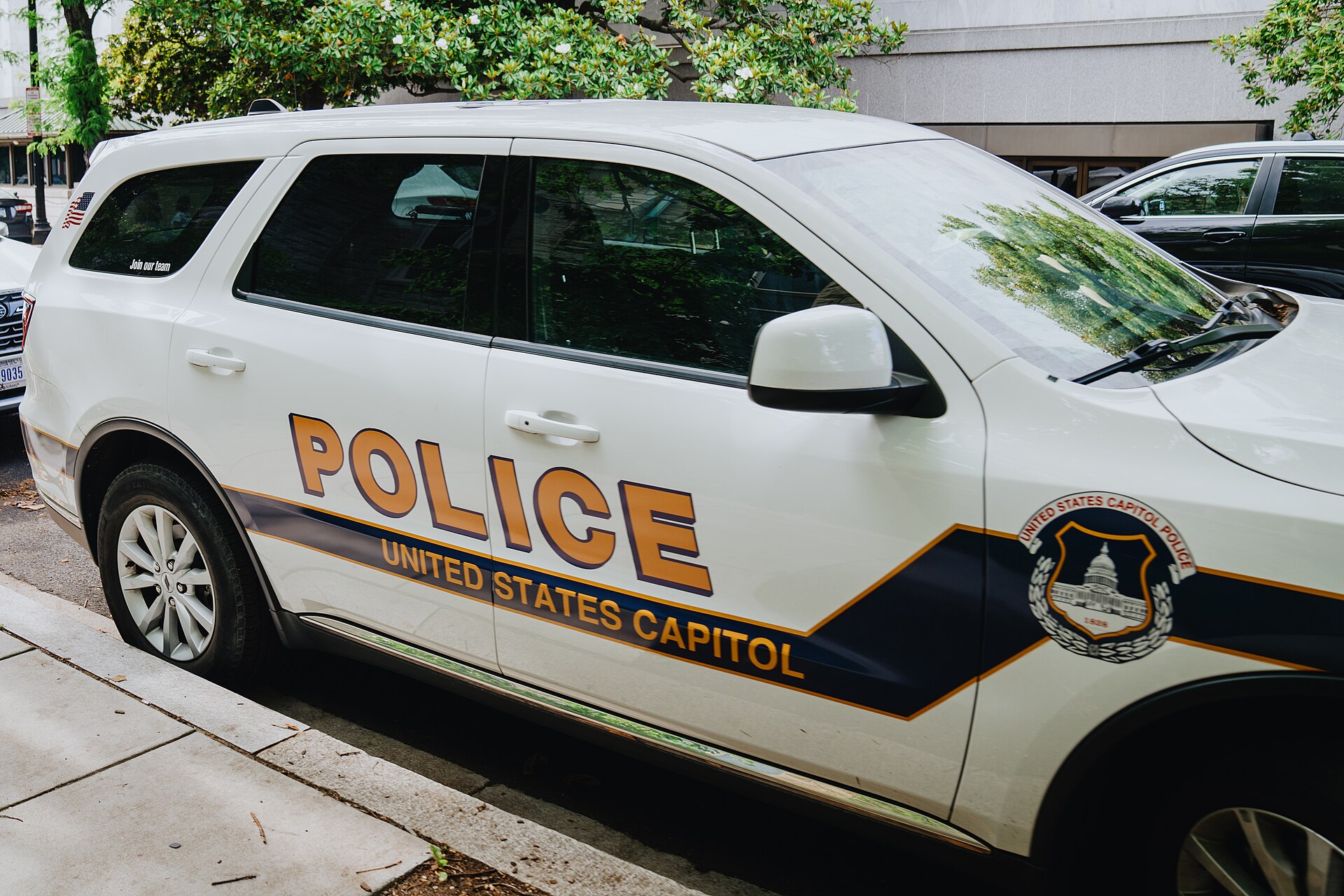
A U.S. Capitol Police vehicle in Washington in a 2024 archive photograph. The image does not depict a response to the reported threat. Archive photo by Tony Webster (CC BY 2.0).
A CNN report that U.S. intelligence has detected Iranian planning involving a possible dirty bomb or chemical attack in Washington has raised a serious national security question. It has not established that an attack is imminent. The White House says that, “at this time there are no credible threats to the homeland.”
CNN’s reporting, published November 16 and subsequently updated, cites seven U.S. officials and describes potential targeting of senior Trump administration figures. Sources characterize the planning as giving Iran options, while officials debate whether it has the personnel and intention to carry it out. That is a report about intelligence and contingency planning, not an announcement that a device has been found or detonated.
The distinction matters immediately to people living and working in the capital. A frightening weapon name can travel much faster than the qualifications surrounding a report. The current public record warrants attention to official information and a clear understanding of the threat being discussed. It does not justify treating an intelligence account as an evacuation order or a confirmed emergency unfolding in a Washington neighborhood.
What has been reported, and what officials have said
The White House response carried by CNN Newsource says authorities are monitoring potential threats. In the longer report, Iran’s mission to the United Nations rejects the chemical-weapon allegations; CNN notes that its statement did not explicitly address a potential dirty-bomb plan. Those positions should be presented alongside the intelligence account. An anonymous description of possible planning, an official threat assessment and a diplomatic denial are different forms of evidence.
There is a substantial difference between an adversary considering an option, preparing the capability to use it, authorizing an operation and beginning an attack. Intelligence agencies try to identify developments before the last stage, when there may still be time to prevent harm. That necessary early attention also means the public can hear about scenarios that never become operations. Contingency planning by the United States is a protective response, not independent proof that the scenario will occur.
Reporting based on confidential officials can reveal information that would otherwise remain hidden. It also places limits on what readers can verify. The public cannot inspect the underlying intelligence merely because several officials have discussed it with a news organization. The relevant questions include what the evidence shows, how confidently it has been assessed and whether agencies agree about its meaning. The report itself describes disagreement over capability and intent.
Other outlets repeating the CNN account do not automatically provide independent confirmation. Repetition can increase visibility without adding a new source, document or observation. A careful assessment should therefore distinguish the original reporting from later summaries. The most consequential new developments would be an on-record assessment, a public law-enforcement action or other evidence that changes the reported threat’s credibility or immediacy.
The same caution applies to linking unrelated events. A scheduled emergency-alert test, a separate weather warning or a power problem does not become evidence of a plot because the stories appear in the same search feed. Taken Social has already explained the scheduled November 17 Emergency Alert System test. Nothing in the material reviewed for this report establishes that the test is a response to the reported Iranian planning.
At this stage, the public reporting supplies no confirmed incident location, measured radioactive release or official protective-action zone on which residents could base a change in their movements.
A dirty bomb is different from a nuclear weapon
The Nuclear Regulatory Commission’s backgrounder describes a dirty bomb as a radiological dispersal device involving a conventional explosion and radioactive contamination. It is not a nuclear detonation. Confusing the two can dramatically distort public understanding of the scale and character of a potential event. Both are serious subjects, but they do not produce the same physical effects or require identical responses.
The immediate danger near a dirty-bomb explosion includes the conventional blast. Radioactive contamination can add health, cleanup and disruption concerns, depending on the circumstances. The name alone cannot establish the affected area or the dose any individual might receive. Those judgments require measurements and expert assessment. A viral map showing a dramatic circle around a city is not a substitute for information from responders at an actual incident.
The Centers for Disease Control and Prevention’s dirty-bomb guidance explains that contamination and radiation exposure are related but distinct. Radioactive material on clothing or skin can be removed; exposure describes the energy a person receives. That difference helps explain why officials may give instructions about sheltering, washing and screening. It also explains why someone cannot assess an incident reliably from how a street looks or whether there is a visible cloud.
A chemical attack presents another category of hazard. Its risks depend on the agent and circumstances and should not be collapsed into a radiological scenario simply because both appear in the same intelligence report. Public instructions during a real incident need to be specific to the event. A general explainer cannot determine whether a particular building, route or neighborhood is safe in an emergency that has not been publicly confirmed.
None of this makes a radiological threat trivial. A localized incident could disrupt transport, workplaces and daily life, and uncertainty itself can cause fear. The purpose of an accurate definition is to make protective decisions more useful. Conflating a dirty bomb with a nuclear weapon can encourage people to ignore achievable safety measures because they wrongly assume that every possible outcome would be unsurvivable.
The history behind concern about threats to U.S. officials
The reported planning arrives against a documented history of U.S. allegations concerning Iranian efforts to target officials and dissidents. In November 2024, the Justice Department announced charges involving an alleged Iranian-directed murder-for-hire network. Its account said Farhad Shakeri had been tasked with plotting against Donald Trump, then president-elect, as well as describing allegations involving a critic of Iran. Those are identifiable legal allegations, rather than a basis for treating every subsequent intelligence claim as proved.
The historical connection helps explain why officials take new reporting seriously. A pattern of alleged efforts can inform protective planning and the questions investigators ask. It cannot establish the details of a different proposed operation, demonstrate that a particular weapon exists or show that a decision to attack has been made. Evidence of motive, evidence of capability and evidence of a specific act must still be evaluated separately.
Protecting public officials also has a broader civic purpose. An attack on a government figure can threaten the continuity of public institutions and endanger staff, bystanders and first responders. The response should be driven by the assessed risk, regardless of a reader’s opinion of the officials involved. Threat reporting is not an occasion to minimize potential harm because of partisan disagreement or to turn unverified claims into accusations against an entire population.
Intelligence warnings can also become part of diplomatic conflict. Governments may publicize information to deter an adversary, explain protective steps or build support for policy. That possibility does not make a warning automatically false. It does mean readers should examine the evidence and the wording rather than assume that a political statement and an independently established fact are interchangeable. Strong reporting preserves that distinction even when the subject is alarming.
The useful historical lesson is therefore about verification and preparedness together. Earlier alleged plots make complacency unwise; they do not eliminate the need to test a new claim. Protective action can be prudent before certainty is available, while public claims about responsibility and imminence still require a proportionate evidentiary basis. Those two standards can coexist without weakening either security or accountability.
What residents should know about official safety guidance
There is no confirmed radiation emergency in Washington established by this report. The following guidance describes what authorities recommend if one occurs. The CDC’s basic radiation-emergency instructions emphasize getting inside, remaining inside and following official updates. A substantial building can provide protection that being outside does not. During an actual event, instructions from local emergency authorities should guide decisions about shelter and movement.
People should not self-evacuate toward an incident to collect relatives or investigate a rumor. Emergency directions may be designed to reduce time outdoors or keep routes clear for responders. A household communications plan can help relatives confirm where they are and receive instructions without making unnecessary journeys. The appropriate action depends on the real circumstances, rather than on a generic threat headline.
The CDC also describes simple steps for people who may have radioactive dust on them, including removing outer clothing and washing exposed skin. That is emergency guidance for potential contamination, not a recommendation to take such actions now because a report is circulating. Officials can provide information about screening and further care if an actual release occurs. People with urgent medical needs should obtain appropriate emergency help.
The NRC warns against assuming that potassium iodide is a general solution for a dirty bomb. Its purpose is specific, and it does not protect a person from every kind of radiation or contamination. Residents should not take protective medicines on the basis of a social media claim. The agency’s public preparedness information directs people toward official emergency instructions rather than improvised treatment.
The current conclusion is measured but consequential: CNN has reported potential Iranian planning that U.S. officials are assessing, while the White House says there is no credible threat to the homeland at this time. No attack has been established by the reporting reviewed here. Readers should follow verified updates, understand the difference between radiological and nuclear events, and let any change in official guidance—not the speed of a rumor—determine their response.