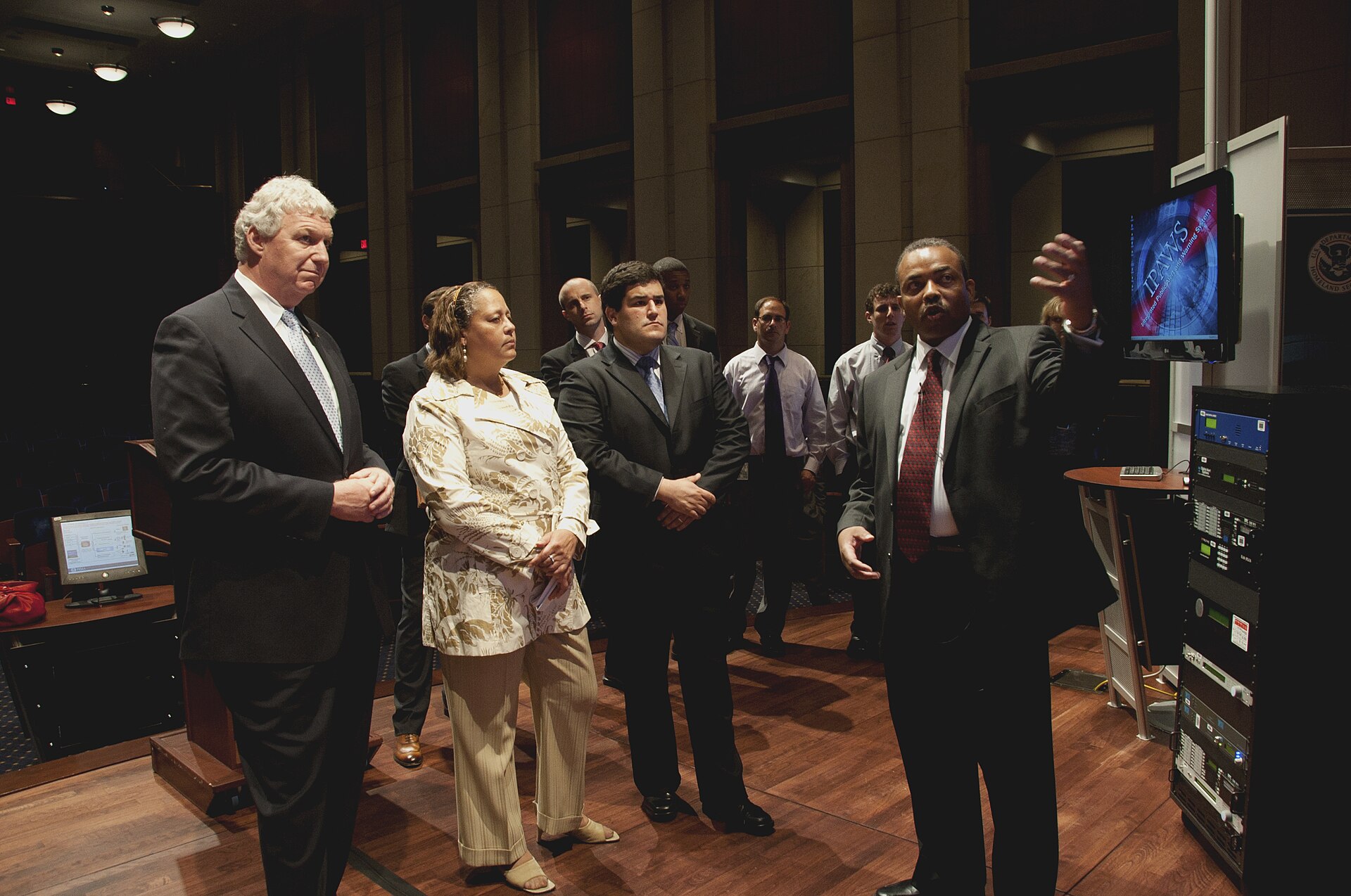
FEMA officials demonstrate the Integrated Public Alert and Warning System at the U.S. Capitol Visitors Center on September 23, 2010. Archive photograph, not the November 2026 test. Archive photo by Bill Koplitz / FEMA (Public domain).
There is no credible evidence that a planned nationwide blackout will begin in the United States on November 17, 2026. What is actually scheduled is a nationwide test of the Emergency Alert System, beginning at approximately 2:20 p.m. Eastern. It is intended to check how broadcasters and other participating providers deliver a warning message, not to switch off electricity, internet access or banking services.
The Federal Emergency Management Agency’s published explanation says the test should briefly interrupt radio and television programming for about one minute. No response is required from the public. Wireless Emergency Alerts—the messages delivered directly to mobile phones—are not part of this year’s nationwide test, even though they were included in the 2023 exercise.
The difference matters because posts circulating around the date have attached much larger claims to an ordinary preparedness exercise. Some predict a prolonged power failure; others invoke military planning or a purported presidential warning. The available announcements support a specific broadcast test. They do not support the alarming conclusion that the country is about to be deliberately disconnected.
What is scheduled for November 17
The FCC’s September 16 public notice identifies November 17 as the national test date and December 3 as the alternative if conditions require postponement. The test is coordinated by FEMA and the Federal Communications Commission through the Integrated Public Alert and Warning System. Participating broadcasters and communications providers are expected to receive and relay a clearly identified test message.
The announced start translates to 1:20 p.m. Central, 12:20 p.m. Mountain and 11:20 a.m. Pacific on November 17. Those are different local clock readings for the same scheduled event, rather than a sequence of separate tests moving across the country. People watching television or listening to radio may encounter an interruption depending on the service they use.
FEMA’s September bulletin announcing the exercise explains that the participants include radio and television broadcasters, cable systems, satellite services and wireline video providers. The message may appear as audio, on-screen text or both, and regular programming is expected to resume afterward. This is a test of the route by which an emergency message reaches an audience, not a simulation requiring households to lose essential services.
The public should not confuse the time range contained in the formal message with the length of the interruption. The FCC notice includes a message referring to a 2:20-to-2:50 time range, while FEMA’s FAQ says the interruption itself is expected to last about a minute. Neither description announces a half-hour power cut. They describe the handling and presentation of a test alert.
The message will identify itself as a test. Its central instruction is straightforward: “No action is required by the public.” A viewer does not have to make a purchase, transfer money, provide account details or change a device’s settings to comply. FEMA also says the Emergency Alert System broadcasts information and does not collect personal data from the public.
Actual emergency information still deserves attention on the day. If severe weather or a real emergency requires a change, the agencies can postpone the exercise to the announced backup date. A published contingency is a normal part of organizing a preparedness test; it is not evidence that officials have secretly forecast the event a viral post describes.
How an alert test became a blackout claim
PolitiFact’s November 16 examination found no evidence for posts predicting a nationwide 90-day blackout. It also identified a manipulated video that made President Donald Trump appear to announce such an event. The fact-check traced the footage to a November 9 news conference and reported that the actual remarks did not contain that announcement.
That is a stronger and more specific finding than a general appeal to distrust social media. An apparent statement can be checked against its original recording. A real date can be checked against the document that announced it. In this case, the existence of an official notice is genuine, but the prediction attached to it is unsupported.
Another strand of the rumor invokes FORTRESS America, a military resilience initiative. PolitiFact explains that the program concerns keeping installations operational if outside infrastructure is disrupted, and that reporting about a 90-day planning requirement has been turned into a claim that a 90-day blackout is coming. Preparing to operate through a contingency is different from predicting that the contingency will occur on a particular date.
The logical difference is familiar outside military planning. A hospital’s backup generator does not mean the hospital knows the grid will fail tomorrow. A community’s evacuation exercise does not announce an approaching disaster. Such preparations are designed to reduce the consequences of a possible failure, including one that may never occur. Removing that context can make ordinary risk management look like privileged knowledge of a scheduled catastrophe.
Recent technology failures have made the story easier to attach to people’s concerns. The FAA’s nationwide ground stop on November 13 was real, and United experienced a separate airline technology outage on November 16 that it subsequently said was resolved. Taken Social’s report on United’s recovery distinguishes that incident from the FAA problem. Their occurrence does not establish a common cause or a connection to the alert test.
A claim that separate failures form one planned operation needs evidence connecting them. Similar headlines, a shared week and the general fact that services depend on computers do not supply that connection. Without it, the argument simply turns several events into a pattern after the fact and asks the audience to accept the proposed explanation.
A warning system and an electricity grid are different systems
The Emergency Alert System is a method for delivering public warnings through communications providers. Its usefulness depends on messages being received, relayed and understood when needed. A test can reveal a problem with that process without creating the emergency the system is meant to describe. Testing a warning channel is therefore part of maintaining it, not evidence that an associated hazard has been scheduled.
Electricity is organized through a different physical and operational structure. The U.S. Energy Department’s explanation of interconnections describes major Eastern and Western networks and the Texas interconnection, each with its own geographic scope. That structure is more complicated than the image of one national switch. It does not make large outages impossible, but it does mean a claim about a coordinated nationwide shutdown needs much more evidence than an unrelated broadcast announcement.
The same distinction applies to internet and financial services. A service may suffer a technical failure even when electricity is available, and a local power outage may affect equipment without implying that a national banking system has been disabled. Identifying the affected system, operator, location and cause is necessary before drawing a conclusion about the extent of a disruption.
A local utility can also carry out genuine scheduled maintenance on November 17 or any other day. That would be a separate matter, normally described through the utility’s own notice with a service area and an expected time. The absence of evidence for a nationwide blackout should not be misread as a promise that no household anywhere will experience an interruption.
For someone trying to evaluate a warning, the useful questions are concrete. Who issued it? What area does it cover? Does the original source describe an outage, an exercise or a general preparedness policy? Is the date in the original document, or only in a caption added by someone else? Those checks address the actual claim rather than the emotional force of the image accompanying it.
Prepare for ordinary outages without accepting a false forecast
Rejecting an unsupported prediction does not require dismissing the real consequences of power failures. Ready.gov’s power-outage guidance recommends planning for essential needs, including batteries, flashlights, a means of charging a phone and access to necessary supplies. People who depend on powered medical equipment or refrigerated medication should make a plan with their medical provider. Those are useful preparations throughout the year.
Generator safety is particularly important when a rumor encourages hurried purchases or unfamiliar equipment use. Ready.gov says generators must be operated outdoors and at least 20 feet from windows, doors and attached garages, with working carbon monoxide alarms in the home. A gas stove or oven should not be used to heat a home. Improvised indoor combustion creates a real hazard regardless of whether the feared outage happens.
Preparation should be tied to the household and the hazards it actually faces. A person in a storm-prone area may need different arrangements from someone in an apartment with limited storage or a household relying on medical equipment. A manageable plan is more useful than an arbitrary shopping target based on a video that has not established its central claim.
It is also possible to share a correction without spreading the alarming content again. Sending relatives the FEMA FAQ gives them the date, timing, expected interruption and explanation about phone alerts in the agency’s own words. That addresses the immediate concern directly, while allowing them to verify the information without relying on a screenshot or an edited clip.
The conclusion for November 17 is clear: the documented event is a short nationwide Emergency Alert System test, with no public action required and no wireless phone-alert component. The claims of a planned prolonged blackout are unsupported by the evidence reviewed here. Following authentic local warnings and making sensible outage preparations remain worthwhile; treating this broadcast exercise as proof of an impending national shutdown does not.