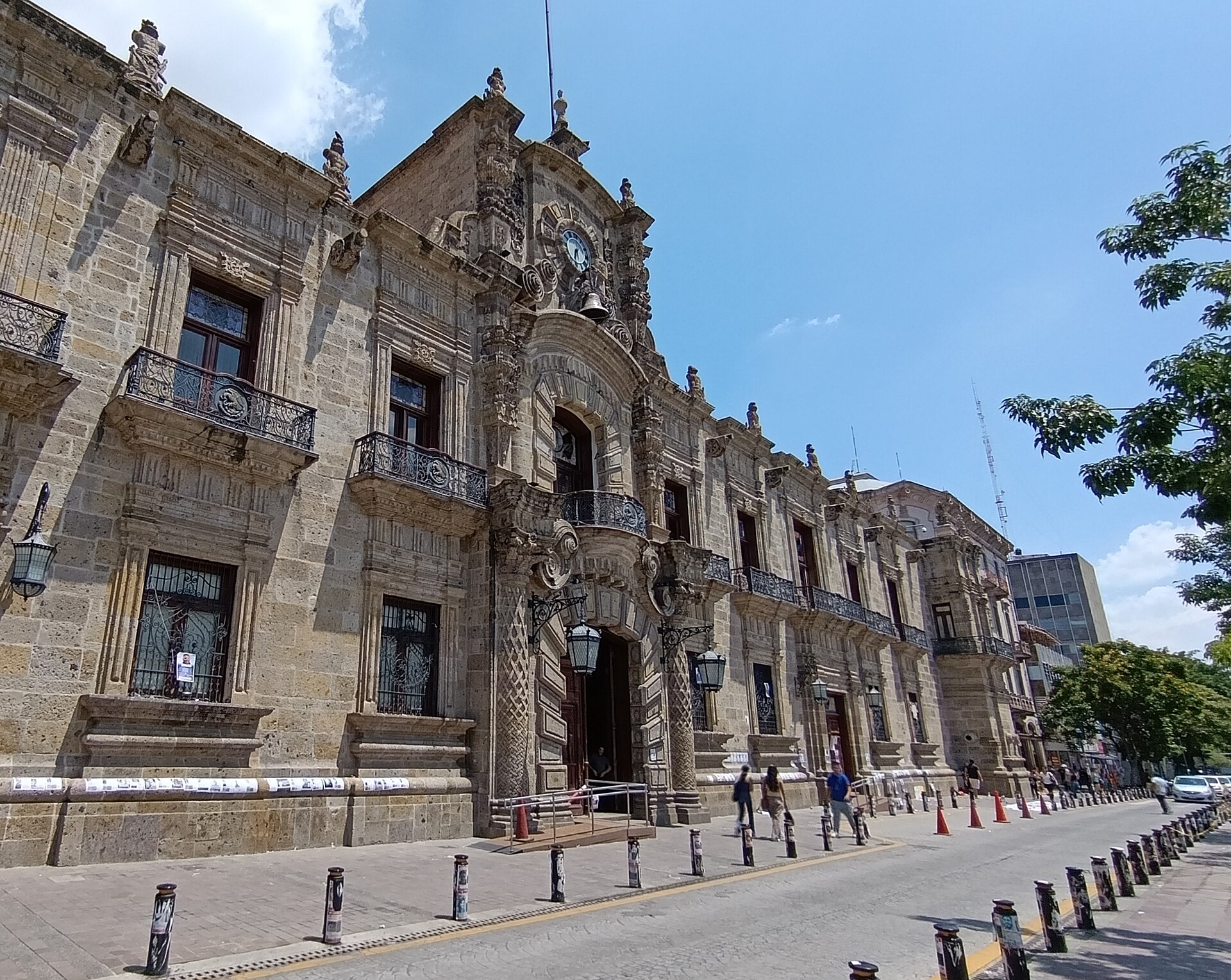
Jalisco’s Government Palace in Guadalajara, photographed on August 30, 2025. Archive city context; Félix Gallardo died at a hospital elsewhere in Guadalajara on November 15, 2026. Archive photo by Juan Carlos Fonseca Mata (CC BY-SA 4.0).
Miguel Ángel Félix Gallardo, a founder of Mexico’s Guadalajara cartel whose criminal career became inseparable from the 1985 murder of U.S. drug enforcement agent Enrique “Kiki” Camarena, died on November 15 at a hospital in Guadalajara. He was 80. His death closes the personal history of a man imprisoned since 1989, while leaving the consequences of the trafficking system he helped build far beyond any single life.
Reuters reported, citing local security authorities, that Félix Gallardo had been transferred from custody to a private hospital two days earlier and died after multiple organ failure. Jalisco authorities placed the time of death at approximately 2 p.m. Sunday. He remained a prisoner; the hospital transfer was not a release from his sentences or the successful implementation of his long-running request for house arrest.
Often called “El Jefe de Jefes,” or the boss of bosses, Félix Gallardo became a shorthand for an earlier era of organized crime. That nickname describes his notoriety, not an achievement to celebrate. A serious account of his importance has to explain the routes, protection networks and institutional failures associated with the Guadalajara organization, while keeping the people killed by it in view.
The Guadalajara cartel and a changing drug trade
La Jornada’s obituary traces Félix Gallardo’s beginnings to Sinaloa, where he was born in January 1946 and worked in state policing before becoming a central figure in trafficking. Alongside Rafael Caro Quintero and Ernesto Fonseca Carrillo, he helped establish the Guadalajara organization that became dominant during the 1980s. Its operations connected production and transit in Mexico to the lucrative market across the U.S. border.
The DEA’s historical account of 1985–1990 describes a period in which traffickers based in Mexico became increasingly important to the movement of Colombian cocaine. Geography made Mexico a significant link between South American suppliers and American consumers. The Guadalajara organization developed close ties to Colombian traffickers and handled marijuana, cocaine and heroin. Its importance came from connections across the trade, rather than from one shipment or one drug.
That is a more useful explanation of its power than the image of a solitary mastermind. A large criminal organization needs transport, money, reliable intermediaries and the ability to protect operations from disruption. Coercion and corruption can become as important as the goods being moved. The significance of an individual leader lies partly in how those relationships are assembled and sustained, not simply in the public reputation attached to his name.
The historical setting also matters. The organizations that emerged later did not inherit a static market or a single unchanged command structure. Arrests, disputes, changing routes and new opportunities reshaped the business. Describing Félix Gallardo as a precursor to modern cartels helps explain that history; describing him as the direct controller of every later criminal group would collapse decades of change into a misleading personal story.
A later DEA history covering the 1990s describes the Arellano family’s organization as inheriting part of the earlier structure after Félix Gallardo’s incarceration. That institutional record supports a connection between the Guadalajara era and subsequent trafficking organizations. It also illustrates the limits of removing one leader: an arrest can dismantle a particular hierarchy without eliminating the relationships, demand and opportunities that allowed the organization to operate.
Camarena and Zavala: the victims at the center of the case
The event that permanently tied Félix Gallardo’s name to U.S.–Mexican relations was the kidnapping and murder of Camarena. The agent was abducted in Guadalajara on February 7, 1985. Mexican pilot Alfredo Zavala Avelar, who worked with anti-drug authorities, was also abducted that day. Both were killed. Their deaths triggered an intensive investigation that would extend across years and repeatedly test cooperation between the two countries.
Camarena’s life is documented in the DEA’s account of the origins of Red Ribbon Week. Born in Mexicali in 1947, he grew up in California, served in the U.S. Marine Corps and worked in local public service before joining the DEA in 1974. He was assigned to Guadalajara in 1981. That history describes an investigator with a career and family, rather than merely the victim who appears in another man’s biography.
Zavala’s role also deserves explicit recognition. He is too often reduced to a passing reference to “a pilot,” although he was a separate victim whose death formed part of the criminal case. Naming both men prevents the familiar American account from obscuring the Mexican life lost in the same sequence of events. The consequences were personal for two families before they became a continuing diplomatic and law-enforcement issue.
The DEA history describes the subsequent Operation Leyenda investigation as uncovering corruption and official complicity as investigators pursued those responsible. That is a documented account of the historical case, not a basis for accusing every Mexican institution or contemporary official. Its continuing significance lies in a hard question for cross-border enforcement: what happens when the people expected to help an investigation are themselves suspected of protecting those being investigated?
Félix Gallardo, Caro Quintero and Fonseca Carrillo were convicted in Mexico in connection with Camarena’s killing. The persistence of the case helps explain why those names still carry weight in Washington as well as Mexico. A homicide involving an American agent did not become less consequential as the trafficking organizations changed. It remained an unresolved source of grievance and a measure of whether cooperation could deliver accountability.
Red Ribbon Week developed from the response to Camarena’s death into a drug-prevention campaign. The contrast is revealing: the trafficker’s nickname became part of criminal folklore, while the agent’s memory was carried into community education. The two forms of remembrance tell very different stories about what the public chooses to preserve from an era of violence.
Thirty-seven years in custody and an unfulfilled bid to go home
Félix Gallardo was arrested in April 1989 and never regained his freedom. The Associated Press reported that he was serving a combined 77-year sentence for drug offenses and the Camarena killing when he died. Reports of his deteriorating health and attempts to obtain house arrest had periodically returned his name to the headlines long after his period of direct power had ended.
The sentences arose from different proceedings. A November 16 profile from Anadolu records a 37-year sentence imposed in 2017 in the Camarena and Zavala case, in addition to his earlier punishment for trafficking-related offenses. That chronology matters: the date of an arrest, the date of a conviction and the point at which a sentence is imposed are distinct events. Combining them can erase the long course of litigation that followed his detention.
In 2022, a judge granted house arrest, but the transfer did not take place. Expansión’s account of the legal dispute describes the interaction of his separate sentences, prosecutors’ challenges and questions about the electronic monitoring arrangements. Those details explain why a headline announcing judicial approval did not mean that he actually returned home. A permission subject to further legal and practical requirements is different from a completed transfer.
Age and illness therefore became part of a continuing argument over how a sentence should be carried out, rather than evidence that the convictions had disappeared. His final move from the Puente Grande complex to a hospital took place under custody. The distinction is necessary both for accuracy and for understanding why apparently similar reports about medical treatment and house arrest described very different legal circumstances.
His former associates followed different paths. In February 2025, the U.S. Justice Department announced that Mexico had delivered 29 wanted defendants into American custody, including Caro Quintero. That was Caro Quintero’s transfer, not Félix Gallardo’s. The announcement demonstrated that legal consequences connected to the earlier cartel era could continue decades later and across jurisdictions, even as the men involved aged and their organizations changed.
What his death changes—and what it does not
Félix Gallardo’s death is a major historical obituary, but it is not evidence of a present-day operational collapse in Mexican organized crime. He had been imprisoned for more than 37 years. A claim that his death immediately changes the balance between current cartels would require contemporary evidence about command, finance or alliances. The fact that a name remains famous does not establish that its owner retained the same practical authority.
His lasting significance lies in the period when Mexican trafficking networks consolidated their role in an international market and in the violence used to defend that position. The Camarena and Zavala murders exposed the human cost of those networks and the difficulty of pursuing accountability when criminals could exploit institutional protection. Those are historical conclusions grounded in the record, without requiring a romantic portrait of criminal ingenuity.
The familiar language of cartel “empires” can make a story seem larger while making its victims smaller. It encourages a focus on wealth, hierarchy and an individual’s ability to outmaneuver rivals. An account centered only on those features misses what enabled the enterprise and what it damaged: public trust, the safety of investigators and the expectation that law should apply even to well-connected people.
There is also a lesson in the length of the aftermath. The killings occurred in 1985, Félix Gallardo was arrested in 1989, and major legal developments involving his associates continued into the following century. Justice in such cases does not follow the tidy arc of a dramatic retelling. It can involve separate jurisdictions, incomplete cooperation, contested rulings and families waiting through years that produce little visible resolution.
His death ends the possibility of further punishment or testimony from him personally. It does not settle every historical dispute about the Guadalajara organization, nor does it erase the convictions already entered. The clearest conclusion is that one of the central figures of Mexico’s earlier cartel era has died in custody, leaving a record whose importance is measured by the criminal system it reveals and the lives that system destroyed.