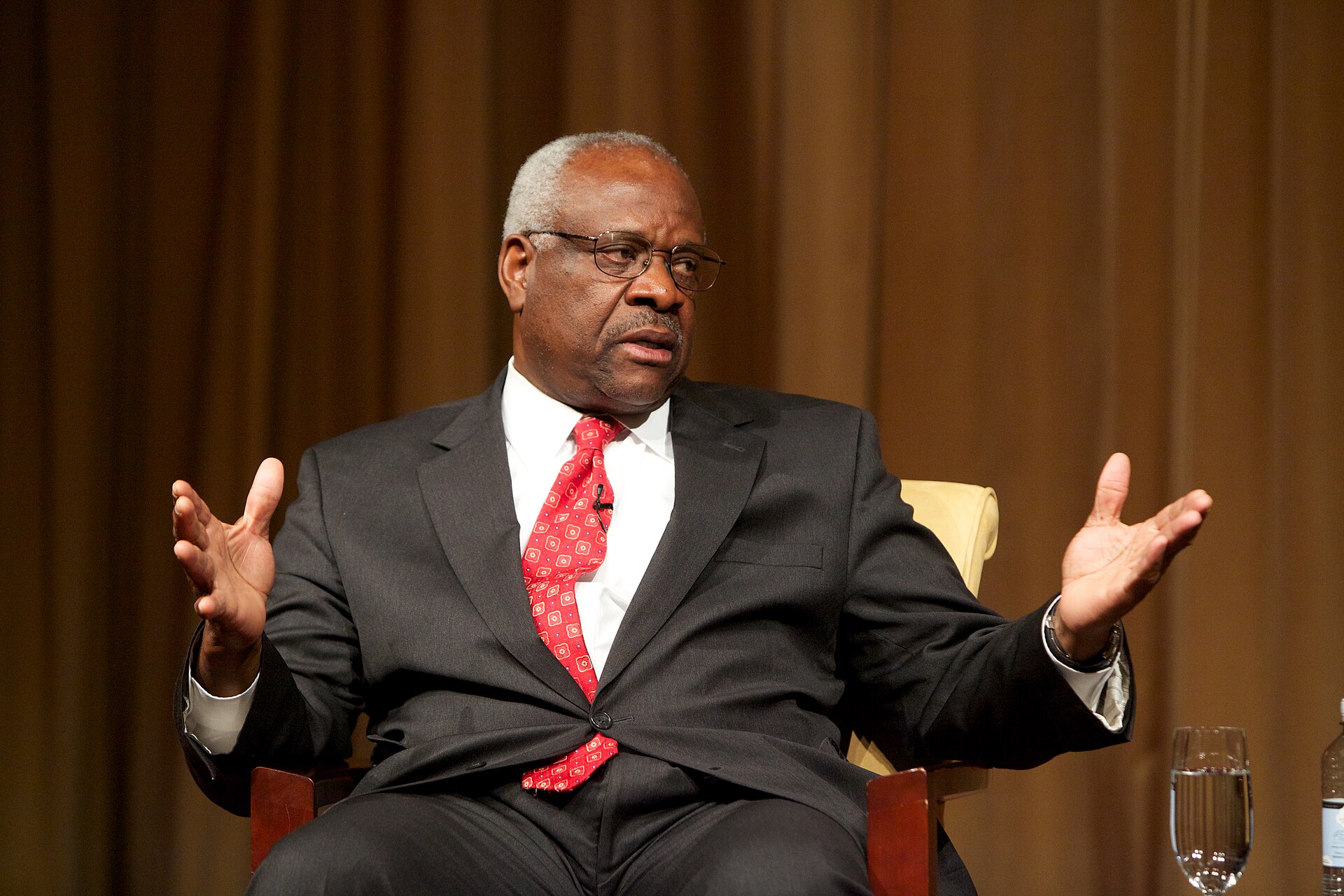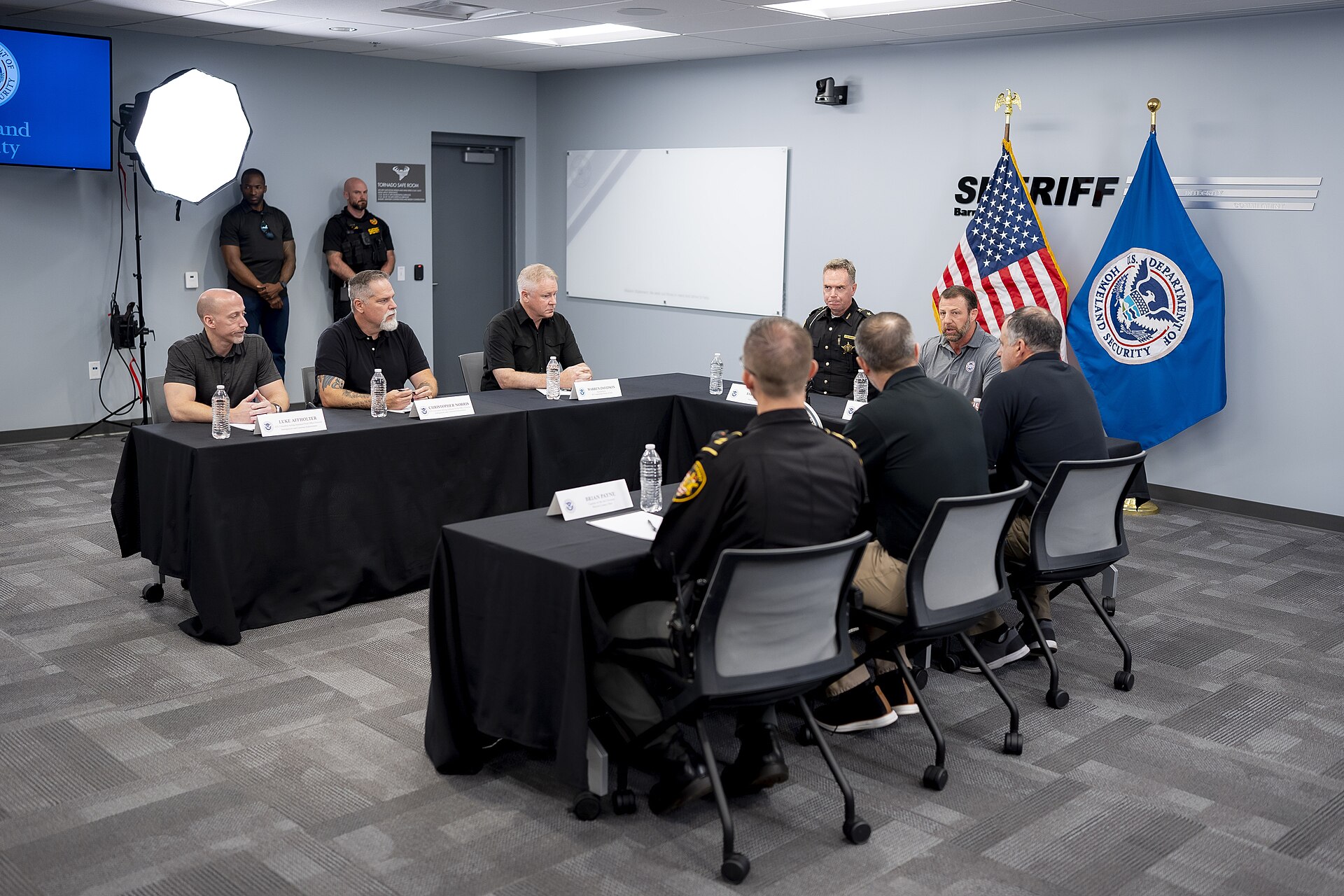
Homeland Security Secretary Markwayne Mullin at a law enforcement roundtable in Lebanon, Ohio, on September 4, 2026. This photograph predates the November FAA briefing. Archive photo by Tia Dufour / U.S. Department of Homeland Security (Public domain).
Markwayne Mullin is the United States secretary of homeland security, a Cabinet official whose responsibilities extend from border enforcement and airport screening to cybersecurity and disaster response. His appearance beside Transportation Secretary Sean Duffy after the November 13 nationwide aviation ground stop brought an unusually broad part of that job into public view: explaining whether a disruption to essential infrastructure represented a security threat, while another department worked to restore the system.
For readers searching in Spanish for the “secretario de Seguridad Nacional de los Estados Unidos,” the current answer is Mullin. The Department of Homeland Security’s leadership page records that he was sworn in on March 24, 2026. He previously represented Oklahoma in both chambers of Congress. His move from the Senate to the executive branch changed the nature of his responsibility: he now has to administer a large department, rather than chiefly debate its policies, vote on its funding or question its leaders.
The distinction matters during an emergency. A secretary standing at a White House briefing is both a political representative of the president and an official expected to communicate reliable operational information. Passengers needed to know whether flying could resume; the public also wanted to know whether a cyberattack had interrupted the country’s air traffic system. Those are related questions, but they belong to different lines of authority and require different kinds of evidence.
From Oklahoma business owner to a national security portfolio
The congressional biography of Mullin describes a career that began outside professional politics. Born in Tulsa in 1977, he worked as a business owner, plumber and rancher before entering Congress. He served in the House from January 2013 to January 2023, then entered the Senate after winning the special election to fill the vacancy created by James Inhofe’s resignation. He left the Senate in March 2026 to take the Cabinet position. That progression gives him direct experience of the institution that must fund and oversee his department.
It also creates a useful standard for assessing his leadership. A former legislator knows that a secretary cannot treat Congress solely as an obstacle to an administration’s agenda. Lawmakers control appropriations, demand records and question how statutory powers are used. Familiarity with those procedures can help an executive explain what resources are missing and what results a spending request should deliver. It does not remove the obligation to answer scrutiny from former colleagues who disagree with him.
The Senate’s official 2026 roll-call record shows that Mullin was confirmed on March 23 by a vote of 54 to 45. That is the confirmation vote, separate from the procedural vote held the previous day. The result gave him the legal authority to take office, while also showing that he entered a politically contested role. Confirmation establishes who may run a department; it does not settle the public argument over how its powers should be exercised.
In his March 18 prepared confirmation statement, Mullin pledged to protect the homeland for everyone, apply what he called a common-sense approach and enforce the law. He also expressed strong support for President Donald Trump’s priorities. Those commitments place two demands on the same official: carrying out the elected administration’s program and demonstrating that government services, protections and legal obligations extend across political divisions. The practical test comes in decisions, records and outcomes, rather than in the breadth of a pledge.
That is especially true for a department whose work can reach people at very different moments in their lives. One person encounters it while boarding a flight, another while seeking immigration status, another after a disaster. A policy described in Washington as an administrative change may determine whether those people receive clear instructions, a timely answer or access to a procedure established by law. Competent management has consequences beyond a secretary’s television appearances.
What Homeland Security controls—and where the FAA fits
DHS describes a workforce of approximately 260,000 and 22 components. Its leadership page lists, among others, the Transportation Security Administration, Customs and Border Protection, Immigration and Customs Enforcement, the Cybersecurity and Infrastructure Security Agency, FEMA, the Coast Guard and the Secret Service. The range explains why a homeland security secretary can appear in stories about airports, computer networks, immigration enforcement and emergency response without those stories sharing a single operational cause.
The Federal Aviation Administration belongs to the Department of Transportation. It is responsible for the air traffic operation at the center of the November 13 disruption. TSA, which passengers encounter at security checkpoints, is part of DHS. A screening line and an aircraft’s departure clearance are both visible parts of an airport journey, but they are not managed through the same chain of command. Confusing the two can leave readers with a mistaken impression of who made a decision or who must explain a failure.
Mullin’s participation in the briefing therefore did not mean that DHS had taken over air traffic control. It reflected the security questions surrounding a nationwide infrastructure incident. Duffy addressed the aviation system’s operation and recovery; Mullin addressed the security assessment. This division is important for accountability. An explanation of why a communications system became unstable should be supported by technical records. An assessment of hostile activity depends on the security evidence available to the agencies examining it.
The office is also different from the president’s national security adviser. A Cabinet secretary manages a department with personnel, programs and statutory responsibilities. A White House adviser works within the president’s policy and coordination structure. The similarity of the job descriptions in everyday conversation, and sometimes in translation, should not obscure that institutional difference. For this week’s airport disruption, identifying the responsible department is more useful than applying a broad national-security label to every official involved.
Readers can watch the official November 13 White House briefing linked by the Transportation Department to hear how the administration presented those responsibilities. The full exchange provides more context than an isolated social-media clip, particularly when speakers move between technical descriptions, travel advice and arguments for additional funding. A secretary’s own words remain an important record of what the administration said it knew at that moment.
The ground stop puts communication and evidence under pressure
The Transportation Department’s November 13 account said the FAA halted departures after intermittent telecommunications problems affected the stability of communications and radar information used by controllers. Duffy said the trouble began at 3:36 p.m. Eastern and that the airspace reopened at 8:15 p.m. He attributed the instability to overloaded older switches and routers, while saying newer equipment had remained operational. That was the administration’s initial explanation, not a substitute for a completed technical investigation.
The same briefing addressed speculation about new technology. Officials rejected a connection to the FAA’s SMART tool, and Mullin said there was no indication that a cyberattack had caused the disruption. The wording is important: reporting an absence of indications at a briefing accurately describes an assessment at that time. It should not be inflated into a claim that every possible cause has already been conclusively excluded through an independent inquiry.
There are two different standards at work during an unfolding disruption. Authorities need sufficient information to decide whether operations can resume safely. The public later needs a sufficiently detailed account to judge why the failure occurred and whether corrective action addresses it. The first decision may have to be made under severe time pressure. The second requires a record that remains useful after the pressure has passed and the political argument has moved on.
On November 14, the Transportation Department reported that more than 8,000 flight operations had resumed after the stop was lifted the previous evening. Reopening airspace did not instantly restore airline schedules: crews and aircraft still had to be available in the right places. That difference helps explain why an official announcement that the system is operating again can coexist with passengers experiencing further delays. Both descriptions can be accurate if their scope and timing are made clear.
Questions about modernization have continued. The Associated Press reported on November 16 that aviation unions had raised concerns about the introduction of the SMART system, including training and consultation with frontline workers. Officials have denied that the tool caused Friday’s disruption. The existence of a union warning is relevant to oversight, but it is not proof of technical causation. A serious inquiry has to test the sequence of events against system records, rather than choose a conclusion according to which side issued the more forceful statement.
How to judge Mullin’s performance after the immediate crisis
The useful questions now are concrete. What failed, when did the relevant agencies learn it and which records support their explanation? Were security assessments updated as new evidence arrived? Did instructions to travelers distinguish between the reopening of airspace and the recovery of individual airline services? These questions allow the public to evaluate government performance without assuming either sabotage or administrative success in advance.
For Mullin, credibility depends partly on maintaining that separation between established fact, provisional assessment and political advocacy. An administration is entitled to argue that Congress should finance infrastructure improvements. It should still explain which failure a proposed investment would prevent, how progress will be measured and who will be responsible if implementation falls short. A general appeal for modernization becomes more persuasive when it is tied to a demonstrable operational need.
His congressional background could help him make that case, because he has worked on the other side of the hearing table. The same background leaves little room to dismiss oversight as an unfamiliar intrusion. Public confidence is strengthened when departments disclose enough information for legislators, technical specialists and affected communities to evaluate their claims independently. It is weakened when the government asks people to substitute confidence in a personality for evidence about a system.
Mullin’s role in the ground-stop response illustrates the modern homeland security job more clearly than a list of agencies alone can. He must work across departmental boundaries while respecting who controls each operation, communicate a security judgment without overstating certainty and connect national policy to services people rely on. The immediate answer to who holds the office is straightforward. The more consequential question—how effectively he uses it—will be answered by the quality of the recovery, the transparency of the investigation and the improvements that follow.