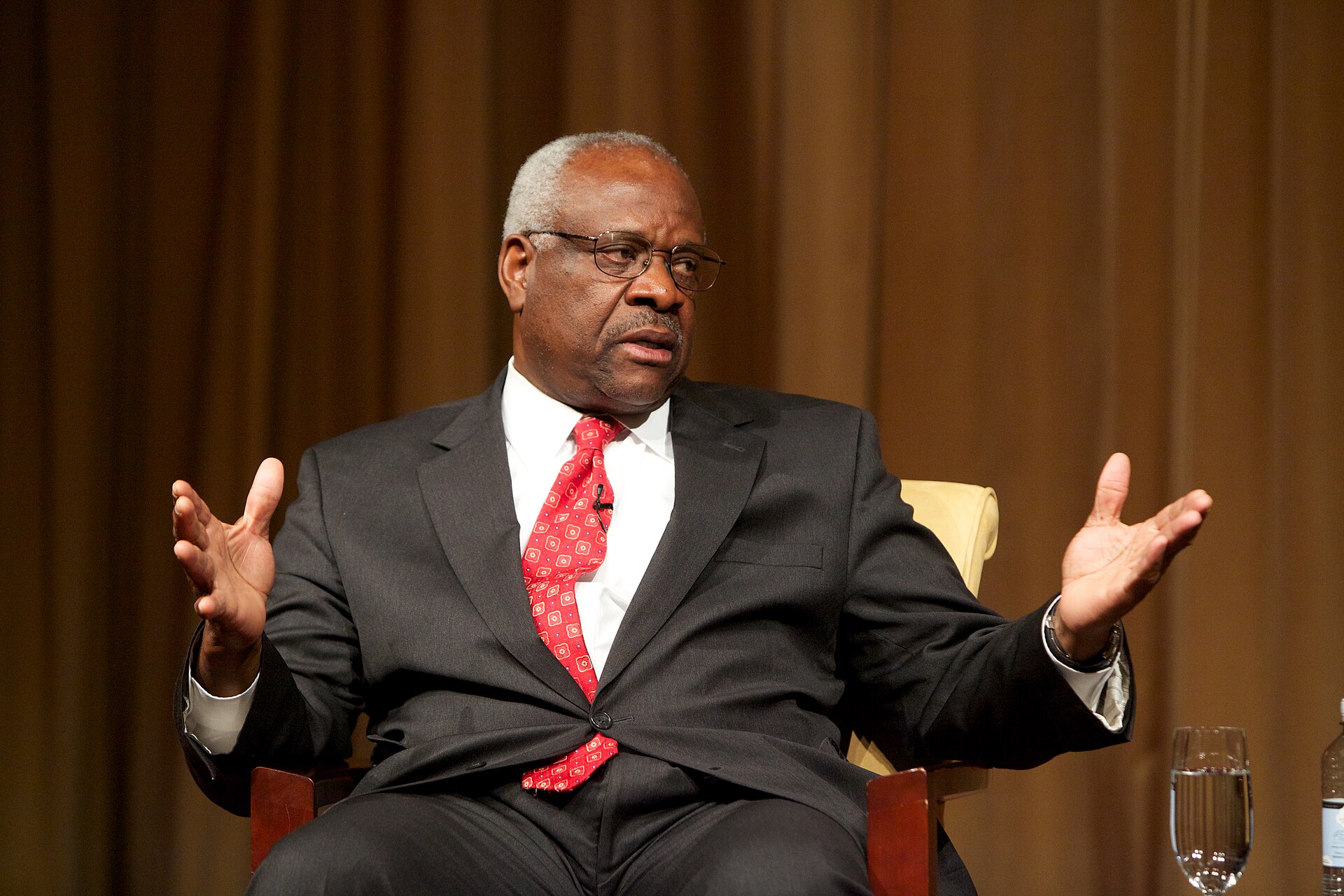
Justice Clarence Thomas in a September 2012 National Archives photograph. Archive photo by Earl McDonald (Public domain).
Justice Clarence Thomas issued a pointed First Amendment warning on Monday after the Supreme Court declined to hear a challenge to California’s implicit-bias requirement for continuing medical education. His concern reaches beyond a dispute about physician training: when a state regulates a profession, how far can it go in claiming that private educators are speaking for the government?
The immediate outcome in Khatibi v. Yip is clear. The court denied review on November 16, leaving the lower court’s judgment in place. Thomas dissented, joined by Justice Samuel Alito. Justice Neil Gorsuch separately indicated that he would have heard the case. The Supreme Court docket records a refusal to take the appeal, not a new majority decision approving or striking down California’s policy on its constitutional merits.
That procedural distinction is essential to understanding a story now circulating under the phrase “Clarence Thomas First Amendment warning.” Thomas’s opinion is an argument about a danger he believes the court should confront. It is not a ruling that changes the law nationwide. Its significance lies in the question it identifies: whether the government-speech doctrine, designed to let public institutions communicate their own messages, can become a way to avoid scrutiny of messages delivered by private people.
The California dispute behind the warning
California requires licensed physicians to complete continuing medical education, commonly called CME, to maintain professional competence. Under legislation adopted in 2019 and implemented beginning in 2022, covered courses must include material addressing implicit bias. The Medical Board’s explanation of the legislation also identifies exceptions, including certain research-focused courses without a direct patient-care component and courses offered by providers outside California. A description suggesting that every medical conversation in the state must carry a prescribed message would therefore misstate the policy.
The challengers include ophthalmologist and educator Dr. Azadeh Khatibi and the organization Do No Harm. They object to being required to discuss the state’s preferred subject in privately organized courses. The dispute is about speech within a system of state-approved professional credit. It does not concern a state medical board writing its own patient information leaflet or a public official giving an official address, situations in which the identity of the speaker is easier to establish.
In his dissent from the denial of review, Thomas argued that extensive regulation does not, by itself, turn private expression into the government’s speech. His short formulation captures the concern: “First Amendment protections do not give way simply because a State heavily regulates speech.” The warning is directed at a legal classification. If a message is classified as government speech at the outset, objections that might otherwise trigger constitutional scrutiny can be excluded before a court assesses their substance.
California presents a substantially different account. In its brief opposing Supreme Court review, the state argues that the decision concerns the particular design of its CME program and the conditions for earning approved credit. It says educators remain able to speak in their own expressive capacities outside that program. The state also describes flexibility in the implicit-bias curriculum and warns that the challengers’ approach could unsettle longstanding standards intended to protect patients.
Those positions do not merely disagree over the merits of implicit-bias instruction. They disagree over whose speech the relevant course content is. One side emphasizes private instructors, private organizations and private accreditation. The other emphasizes a state-created credit system through which California determines what education counts toward a medical license. Identifying the speaker determines which constitutional questions the court reaches next.
Why government speech is a consequential label
Governments necessarily choose messages. A public health agency can recommend vaccination; a city can promote an emergency evacuation route; a legislature can fund a campaign against dangerous driving. The First Amendment does not generally require an agency, each time it speaks, to present every competing viewpoint as its own. Without room to communicate a position, ordinary public administration would become difficult to conduct.
The difficulty comes when a public program includes private speakers. A government can own a flagpole, administer a licensing framework or register a trademark while the words or symbols involved originate elsewhere. The presence of public authority is relevant, but it does not automatically settle authorship. Calling a communication governmental can have a practical consequence for the private person who must deliver it, particularly when professional credit or permission to work is involved.
The court addressed that boundary in Shurtleff v. Boston in 2022, a case involving a city flag-raising program. Its inquiry considered the history of the expression, how the public would understand the identity of the speaker, and the government’s control over the message. The court concluded that Boston’s particular program did not make the disputed flag private groups sought to fly the city’s own speech. It then held that the city’s exclusion of the religious flag violated the Free Speech Clause.
Applied to professional education, those considerations require careful factual work. A state’s approval seal may signify that a course meets licensing standards without telling students that every assertion reflects an official government position. Conversely, a tightly prescribed public curriculum can have features that make the government’s role more direct. The legal analysis turns on the program’s actual operation, not simply on whether regulation exists somewhere in the background.
Thomas believes the framework itself invites courts to place too much weight on regulation. His objection is therefore broader than saying the Ninth Circuit reached the wrong result in this particular case. He wants the court to reconsider how the boundary is drawn. That proposal would matter to future litigation, but it has not become the court’s governing rule merely because a justice advanced it in a dissent.
A disagreement about constitutional method, not a scientific verdict
The medical setting makes this dispute unusually sensitive. States have a strong practical interest in ensuring that doctors remain competent, understand their patients and meet professional standards. At the same time, private educators can hold good-faith disagreements about a curriculum’s assumptions or effectiveness. A court assessing the constitutional framework must distinguish the state’s authority to regulate medicine from the question of how it can compel or characterize particular expression.
The case does not resolve the scientific literature on implicit bias or prove that all such training succeeds or fails. Describing Thomas’s opinion as a judicial finding that a category of medical education is fraudulent would overstate it. Describing California’s victory below as proof that every mandated curriculum is effective would make the same mistake in the opposite direction. Legal permission and empirical effectiveness require different kinds of evidence.
Nor does disagreement about one curricular requirement imply that continuing education itself is unconstitutional. Requirements involving professional knowledge can take many forms. A licensing exam, a required number of study hours, a state-authored module and an instruction delivered by an independent lecturer do not present identical facts. A careful court has to identify the particular requirement being challenged and the particular speech it affects before deciding how far an analogy should travel.
That is why the government-speech question matters even to readers who have no position on this training. It concerns a recurring power relationship: the government controls a valuable permission or benefit, and a private participant objects to a message attached to it. The classification of the communication can determine whether the objection receives a constitutional hearing at all. The stakes are institutional as well as ideological.
There is also a difference between requiring discussion of a topic and requiring agreement with a proposition. California stresses options within its curriculum. The challengers and Thomas argue that the requirement still forces an unwanted message into a private course. Examining that disagreement requires reading what the statute permits, how the program is administered and what educators must actually say. A headline about compelled belief cannot substitute for that examination.
What the Supreme Court’s refusal to hear the case means now
For the parties, Monday’s order means the Supreme Court will not review this judgment through the denied petition. The decision below remains operative. It would be inaccurate to report that Thomas overturned the requirement, that the court adopted his proposed approach, or that three justices publicly supporting review establishes a majority on the merits. The court’s brief order does not provide a majority explanation of why review was declined.
For future litigants, the dissent identifies a potential line of argument. Another case with a different record, a different program or a different conflict among lower courts could give the justices another opportunity to consider the doctrine. Whether that happens is uncertain, and no timetable for a nationwide reconsideration follows from this order. A warning from an influential justice can shape debate without supplying an immediate legal remedy.
For medical educators, the practical message is narrower than many viral summaries suggest. The existing legal framework has not suddenly disappeared. Decisions about compliance, accreditation or litigation should be based on the governing requirements and appropriate legal advice, rather than on a social media characterization of a dissent. Readers evaluating the controversy should keep the actual California program distinct from hypothetical regulations in other states.
The episode also offers a useful test for reporting about the Supreme Court. The important questions are who wrote the opinion, whether it commands a majority, what procedural action the court took, and what happens to the parties as a result. All four can be answered here. Thomas wrote a dissent; Alito joined him; Gorsuch would have granted review; and the petition was denied. None of those facts diminishes the seriousness of the argument, but together they define its present legal effect.
Thomas’s warning is best understood as a challenge to how courts identify government speech when professional regulation and private expression overlap. California’s answer is that its limited credit program falls within legitimate public oversight. The Supreme Court has left that dispute where the lower courts resolved it for now. The lasting question is whether future cases will persuade a majority to draw the boundary differently—and what safeguards that boundary should provide for both public standards and private speech.