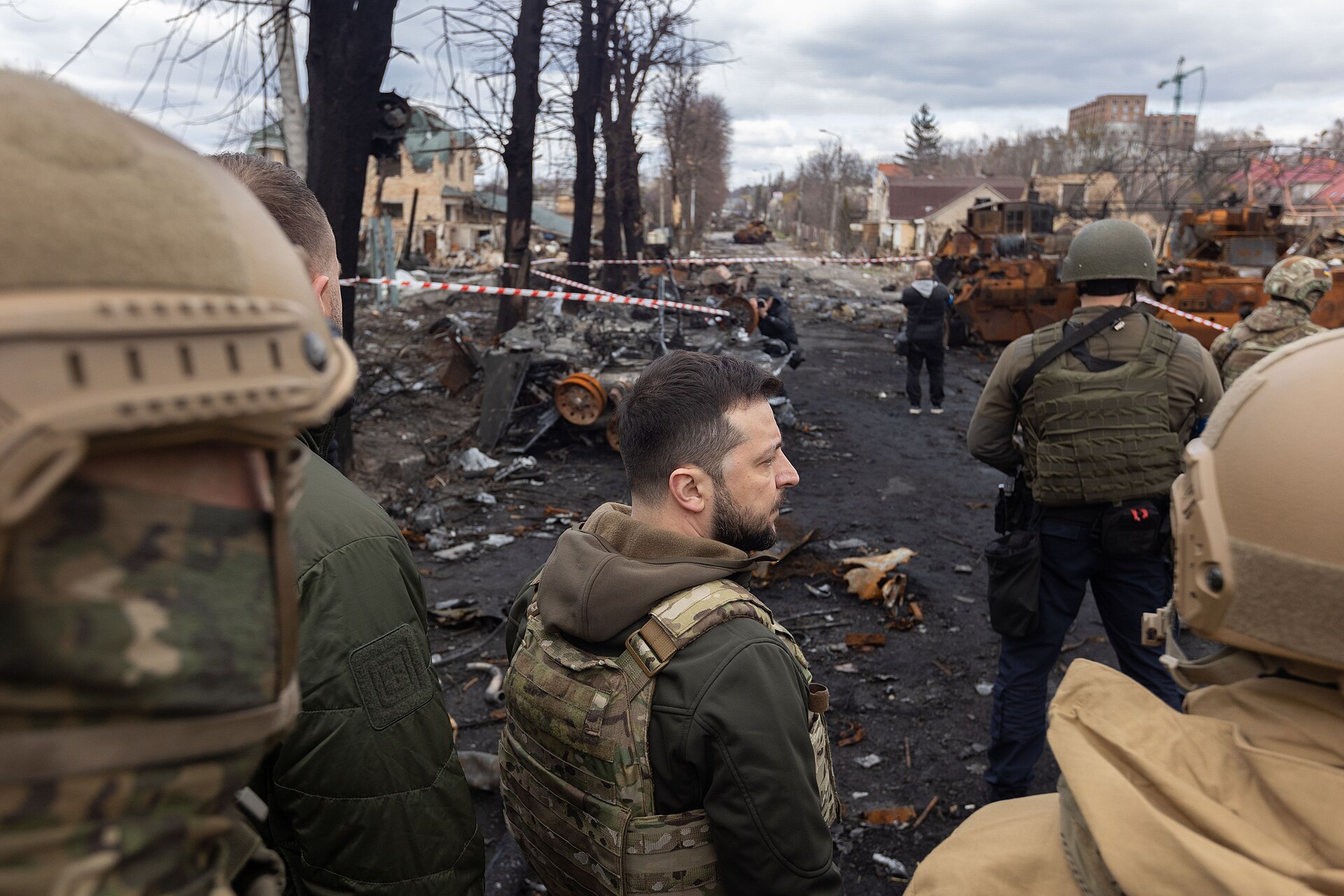
Ukrainian President Volodymyr Zelenskyy visits Bucha on April 4, 2022, after Russian forces withdrew from the area. Archive photograph. Archive photo by Oleksandr Ratushniak (CC BY-SA 4.0).
OPINION | TAKEN SOCIAL EDITORIAL — Ukraine’s struggle has exposed a failure of Western leadership that cannot be measured by the number of summits held or statements issued. The United States and Europe have supplied important assistance, imposed sanctions and helped Ukraine survive. Yet they have repeatedly allowed the continuity of that support to become a question precisely when Russia’s president needs to know that time will not rescue his war.
The result is a dangerous imbalance. Ukrainians must make decisions under bombardment, while their partners often make decisions according to legislative calendars, coalition disputes and the political convenience of postponement. Vladimir Putin is responsible for Russia’s aggression. Western hesitation does not excuse his choices. It does, however, deserve scrutiny for failing to establish a sufficiently durable answer to them.
This editorial’s judgment is that Washington and European capitals have too often managed the consequences of Russian aggression without maintaining a strategy strong enough to defeat its political purpose. Ukraine has paid for that gap in lives, destroyed infrastructure and uncertainty about whether promises made today will still apply tomorrow.
The immediate diplomatic context makes that criticism urgent. November 14 reporting by The Associated Press describes President Volodymyr Zelenskyy’s warning that a proposed wider European security framework could benefit Moscow by weakening NATO or reshaping borders. A proposal is not an agreement, and its final terms are unknown. But the danger is evident: negotiations must not turn Russia’s invasion into leverage over the sovereignty of countries it has attacked or threatened.
The civilian record is the starting point
At a November 9 UN Security Council briefing, the United Nations reported that its human rights office had verified at least 17,968 civilian deaths in Ukraine since the full-scale invasion, including 874 children. These are verified minimums, not a complete accounting of the dead. Restricted access and the difficulty of documenting casualties leave the actual toll higher.
The UN Human Rights Monitoring Mission’s October 16 update recorded at least 328 civilians killed and 2,105 injured during September. The combined number was 85% higher than in September 2025. The mission also described renewed systematic attacks on energy infrastructure and warned of the suffering caused by striking electricity and heating systems as winter approached.
Such figures should change the terms of debate. A delayed air-defence delivery is not merely an unresolved procurement item. In a country facing attacks, the time between approval and operational deployment has a human cost. A delayed energy-repair package is not simply an accounting inconvenience when communities depend on functioning electricity and heat.
Russia’s responsibility is also more than a Western political accusation. In March 2023, the International Criminal Court issued an arrest warrant for Putin over alleged responsibility for the unlawful deportation and transfer of Ukrainian children. An arrest warrant is not a conviction, and the distinction matters. It nevertheless establishes that the allegations have passed a judicial threshold for reasonable grounds, rather than existing only as campaign rhetoric.
The democratic case for Ukraine begins with those people and their rights. A country’s imperfections do not grant its neighbour permission to invade it. Nor does a powerful state acquire ownership of another nation’s future because the war it initiated has become costly or inconvenient to end.
A generation of warnings, followed by incomplete deterrence
The failure did not begin with one American president. In its 2008 Bucharest declaration, NATO said Ukraine and Georgia would become members. It did not make them members or extend the alliance’s collective-defence guarantee to them. The gap between an ambitious political promise and the protection actually provided left a problem that later leaders inherited without resolving.
Russia’s war with Georgia followed in August 2008, during George W. Bush’s presidency. Barack Obama entered office in 2009 seeking a reset in relations with Moscow. The Congressional Research Service’s account of Russian foreign policy documents that sequence. Diplomatic engagement was not inherently wrong; governments must sometimes negotiate with adversaries. The strategic weakness was allowing renewed engagement to coexist with unresolved coercion against neighbouring states.
Russia then seized and claimed to annex Crimea in 2014 and fuelled war in eastern Ukraine. Obama and European leaders responded with sanctions and assistance. Those responses mattered, but they did not reverse Russia’s territorial gains or create a durable settlement. The CRS history of Ukraine and U.S. policy records an occupation and conflict that persisted through the years before the 2022 full-scale invasion.
It would be simplistic to claim that one tougher statement in 2008 or one additional sanction in 2014 would certainly have prevented everything that followed. No honest analyst can prove that counterfactual. The defensible criticism is narrower and stronger: repeated acts of coercion were followed by responses that imposed costs while leaving the Kremlin with continuing territorial leverage.
That pattern gave Moscow reasons to test whether Western attention would fade faster than Russian ambition. It is an inference about incentives, not a claim to know Putin’s private thoughts. Deterrence depends partly on an adversary’s assessment of what a coalition can sustain, not only what it can announce in the first weeks of a crisis.
Trump’s inconsistency is a central part of the problem
A serious criticism of Donald Trump must acknowledge the complete record. His first administration supplied defensive lethal equipment, including Javelin anti-tank systems, as the CRS history documents. That was a meaningful policy choice. It does not erase the subsequent use of uncertainty over aid in a relationship already defined by Russian pressure.
The Government Accountability Office’s January 2020 decision found that the Office of Management and Budget violated the Impoundment Control Act by withholding approximately $214 million in Department of Defense security-assistance funds for Ukraine in 2019. That is an official legal finding about the withholding of appropriated money, not an editorial inference about presidential motives.
In his second term, the disruption became visible again. The March 11, 2025 joint U.S.–Ukrainian statement from Jeddah announced the immediate lifting of a pause on intelligence sharing and the resumption of security assistance. Restoring support was welcome. Having essential support suspended in the first place demonstrated how quickly the defence of an invaded country could become subject to a change in Washington’s negotiating posture.
Diplomacy requires leverage, but leverage must be directed intelligently. Pressuring the country under attack is easier than compelling the aggressor because the former depends more heavily on American decisions. That convenience is precisely why it is dangerous. A negotiating strategy that produces movement mainly from Kyiv risks rewarding Moscow for holding out.
The CRS assessment updated August 31, 2026 describes new assistance under the second Trump administration at levels lower than in fiscal years 2022–24, alongside continuing previously committed support. It also records two brief assistance pauses in 2025. These facts support a criticism of inconsistency; they do not support a claim that the United States has supplied nothing.
For an American president, moral seriousness should appear in policy continuity. Public admiration for a deal cannot substitute for clear conditions, dependable support and consequences for violations. A peace initiative deserves credit when it improves the prospects of a secure peace, not merely when it produces a photograph or a new negotiating format.
Biden’s coalition deserves credit, and its delays deserve scrutiny
Joe Biden helped assemble the coalition that supported Ukraine after February 2022. The scale of that effort is real. CRS puts U.S. commitments of defence articles and services above $68.2 billion from February 2022 through June 2026, while cautioning that the total value actually delivered may be lower and is not publicly available as a complete figure.
But the Biden years also demonstrated the weakness of a strategy dependent on recurring political emergencies. A CSIS analysis of the April 2024 assistance package describes the months of congressional debate preceding its enactment. Responsibility for that delay cannot simply be assigned to the president who sought the funding; Congress controlled the appropriation. The broader failure was a political system unable to provide predictable continuity during an active war.
Prudence about escalation was necessary. The question is whether caution was consistently matched to a credible path toward Ukrainian security. Leaders should have had to explain not just the risks of acting, but also the risks of waiting: a weakened defensive position, greater destruction and a settlement negotiated under more coercive conditions.
Europe must measure assistance honestly and spend with urgency
Europe’s contribution has been substantial, and some smaller countries have carried an especially serious share of the burden. Sweeping claims that Europe has done nothing are false. The more useful criticism is that aggregate announcements can conceal timing, categories and the difference between money discussed in a capital and capabilities available in Ukraine.
The Kiel Institute’s October 8 Ukraine Support Tracker update illustrates the accounting problem. Of €100 billion described by Germany as bilateral support, Kiel classified about €41.7 billion as actual bilateral aid to Ukraine. Approximately €35.9 billion had been spent in Germany, largely on Ukrainian refugees, and €22 billion represented future military commitments. The dataset covers announcements through August 2026.
Hosting refugees is valuable support and a humanitarian responsibility. Future commitments can also provide important planning certainty. Neither should be presented as though it were equipment already delivered to a Ukrainian unit. Governments should publish categories clearly enough that citizens can distinguish domestic expenditure, promised funding, allocated assistance and completed transfers.
Europe must also confront its earlier energy choices. The Council of the European Union’s energy-import assessment shows Russian gas falling from 45% of EU gas imports in 2021 to 13% in 2025. That reduction is significant. The starting figure remains an indictment of a dependence maintained years after Crimea, when the security implications of relying on Russian supply were already apparent.
Reducing that dependence should be recognised as progress, while the remaining flows and sanctions circumvention require sustained action. The lesson is that commercial arrangements with an expansionist state cannot be evaluated solely through their immediate price. Strategic vulnerability has a cost, even when it does not appear on the original invoice.
Negotiations must protect sovereignty, not legitimise conquest
Supporting Ukraine does not require opposing negotiations. Ukrainians have the strongest possible interest in ending the killing. The question is what kind of peace is being pursued, who consents to its terms and what makes the agreement more durable than the arrangements Russia has previously violated or disregarded.
The European Council’s account of the November 12 Dublin summit states that Ukraine must remain free to choose its partners and future and that European security cannot be discussed without European involvement. These are essential principles. Their value depends on whether governments apply them when negotiations become difficult, rather than reserving them for public statements.
A ceasefire can save lives without resolving every territorial dispute. It should not require democratic governments to recognise annexations obtained through force. Nor should security arrangements give Moscow a veto over the choices of states outside its borders. An agreement that rewards conquest while weakening the victim’s future defence risks becoming an interval before renewed aggression.
The UN General Assembly’s March 2022 resolution, adopted by 141 votes to five with 35 abstentions, reaffirmed Ukraine’s sovereignty and demanded Russia’s withdrawal. That record matters because the principle at stake extends beyond NATO. Countries everywhere have an interest in borders not being rewritten by a stronger neighbour’s army.
What responsible leadership would do now
First, Washington and European capitals should establish funding and procurement arrangements that survive ordinary political disputes. Multi-year plans need clear delivery milestones, transparent reporting and realistic industrial schedules. A promise without a production slot, trained personnel or maintenance support is not yet a functioning capability.
Second, civilian protection should be treated as a strategic priority. Air defence, energy repair, shelter and humanitarian access protect society’s ability to endure. They are also tangible measures against which leaders can be judged. The number of announced packages matters less than whether essential needs are being met before the next wave of attacks.
Third, sanctions relief should follow verified compliance, with provisions for restoration if obligations are broken. Pressure loses credibility when concessions are offered in exchange for discussions alone. Diplomatic engagement can remain open without treating access to a meeting as sufficient evidence of changed conduct.
Fourth, support for Ukraine’s sovereignty should include support for accountable institutions. Independent oversight, anti-corruption safeguards and protection of civil society strengthen the democratic argument. They are compatible with helping a country defend itself; they should not become an excuse for leaving its population exposed to invasion.
Finally, leaders should tell their publics what the policy is intended to achieve and what it costs. They must compare assistance with the costs of a more dangerous Europe, not with an imaginary world in which disengagement carries no consequences. Citizens deserve an argument grounded in security and principle rather than alternating declarations of unlimited solidarity and sudden fatigue.
Conclusion: Putin must not be allowed to win by waiting
The West has imposed real consequences on Russia. Sanctions, military losses, diplomatic condemnation and the strengthening of Ukraine’s defence are not nothing. The failure is that those consequences have not ended the aggression, while the coalition opposing it has too often made its own endurance look negotiable.
That is the leadership deficit this generation must overcome. Bush’s unfinished promises, Obama’s unsuccessful reset and limited deterrence, the delays of the Biden era and Trump’s interruptions are different decisions with different circumstances. Together, they reveal the recurring danger of treating each crisis as a temporary disturbance rather than confronting a sustained challenge to sovereign equality.
Ukraine deserves a peace it can survive. The United States and Europe should pursue that peace with dependable support, enforceable commitments and a refusal to turn the aggressor’s demands into the victim’s obligations. Democracy’s credibility will be measured by whether its leaders can sustain those choices after the cameras leave. Putin should have to confront that resolve, rather than continue betting on its absence.