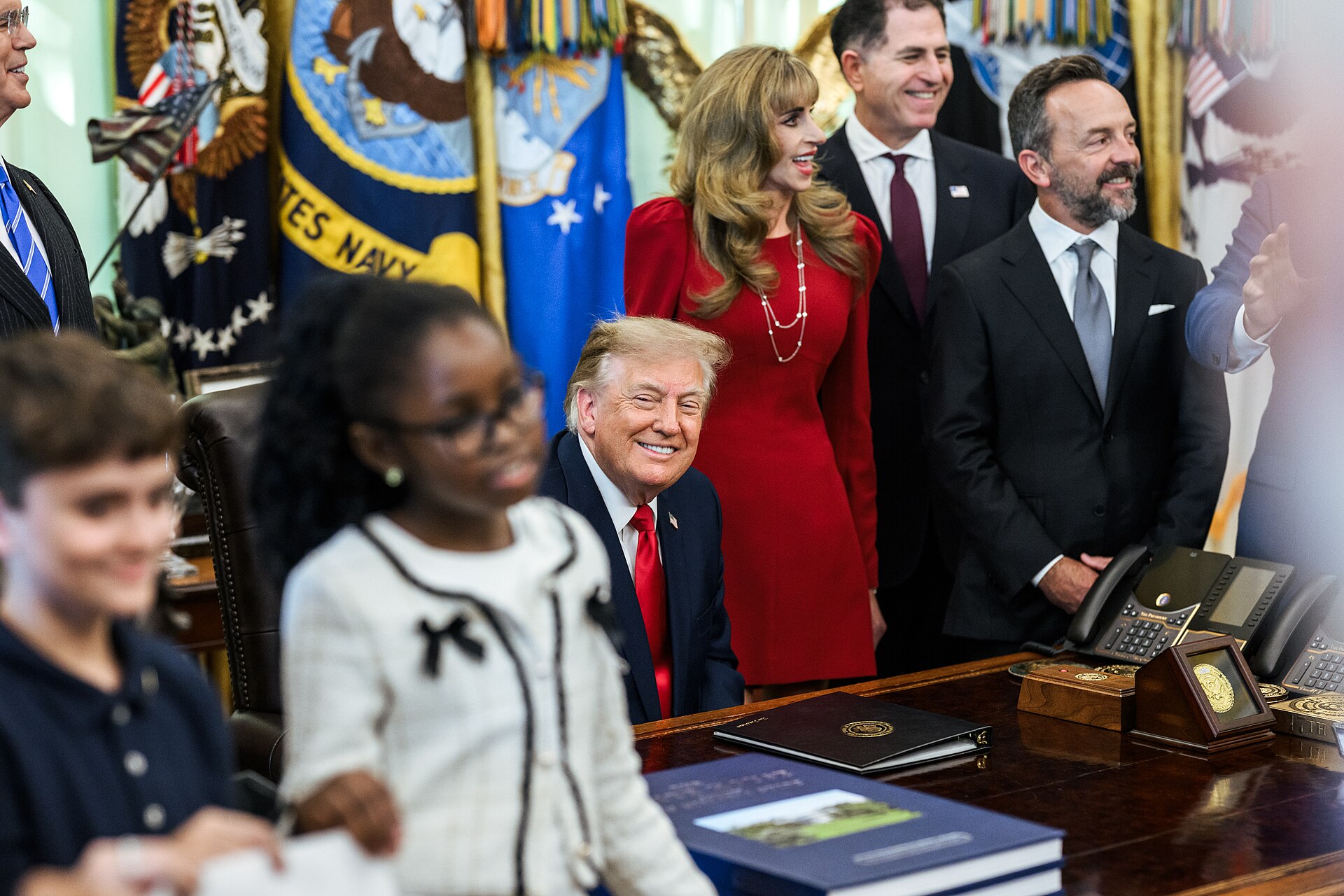
President Donald Trump at an Oval Office event on Oct. 7, 2026. Archive photo by Joyce N. Boghosian, The White House (Public domain).
Donald Trump opened his first sit-down interview after the 2026 midterms with a straightforward explanation for the Republican losses. His name was missing from the ballot. Then, as CBS interviewer Ross Douthat pressed him, the president gave a much fuller account. He said voters disliked the war with Iran and the rise in gasoline prices, conceded that his deportation campaign might have gone too far, and named immigration as a subject on which he could work with the Democrats who had just taken control of Congress. The conversation was recorded at the White House on Friday and aired Sunday, Nov. 8, on 60 Minutes. CBS News interview transcript
The immigration answer was the one with the clearest potential consequences. Trump talked about people who had worked in American hotels and other businesses for years and said a deal for some long-established residents could be possible. His description raised concrete questions about whom his administration might continue to arrest, whom it might spare, and whether Congress would create a durable legal status for anyone. By the end of the exchange, he had acknowledged the dilemma without defining the terms. CBS News interview transcript
What Trump said about the 2026 midterm results
Douthat took Trump’s explanation about his absence from the ballot back to the campaign itself. The president had urged supporters to vote as if he were running, and he had helped pick or promote some of the Republicans who would appear on the ticket. In the interview, Trump argued that his popularity did not transfer readily to those candidates. Douthat brought up his endorsement of Ken Paxton in Texas and asked what the losses said about the president’s ability to move his own voters. Trump maintained that a different Republican nominee could also have lost Texas. That is a counterfactual, and the election returns can tell us how the actual candidates fared. CBS News interview transcript Associated Press congressional election coverage
There are several plausible ways a president’s party can lose votes between a presidential election and a midterm. Supporters may stay home, independents may change sides, or people who backed the president may choose a different party’s candidate down the ballot. Some of those effects can overlap in the same precinct. The result measures their combined impact. Establishing how much each one mattered would require turnout and vote analysis, including returns from comparable places and credible surveys of voters. Trump put forward a diagnosis in the interview. His explanation for why individual voters acted as they did remains an interpretation.
There was a practical distinction between Trump’s answer about the campaign and his answer about governing. He attributed some of the electoral trouble to the way Republicans communicated their record. On immigration he entertained the possibility that the record itself had cost the party support. Both answers came in response to direct questions. Taken together, they offer a better starting point for understanding the interview than any single line about whom he blamed for the loss. CBS News interview transcript
Where the door opened on immigration
Asked whether his deportation policy had been too tough, Trump replied, “I think it might be too tough, yeah.” He drew a distinction between removing people he described as dangerous and taking away employees who had built working lives in the country over a decade or more. He used the example of a hotel cleaner or server whom employers and coworkers had known for years. Trump also acknowledged that some people inside his administration favor a harder approach. The disagreement he described could matter as much inside the executive branch as it would at a negotiating table on Capitol Hill. CBS News interview transcript
Douthat asked whether some of those workers might receive legal status in a deal with Democrats. Trump expressed interest in working something out. The interview left the basic eligibility questions open. Would a program turn on years of residence, a current job, a clean criminal record or family ties? Would it give someone work authorization for a fixed period or a route to permanent status? Would applicants be safe from removal while their cases were pending? Employers, workers and congressional negotiators would have different reasons to insist on clear answers to each of those questions. CBS News interview transcript
Enforcement priorities and legal status operate on different clocks. Agency instructions can affect which cases officers pursue and how they allocate resources. They can be revised by a later administration. Congress can write eligibility and review procedures into law, giving both applicants and employers more certainty about the rules. The legislative route also requires political agreement over the difficult cases that rarely fit in a television answer, including people whose employment is seasonal and families whose members have different immigration statuses. Congressional Research Service on executive immigration authority
Trump said people had already contacted him. Douthat singled out James Talarico, the Democrat elected to the Senate in Texas, as someone who had publicly raised immigration as a possible area of cooperation. That exchange established why the subject could have bipartisan participants. It left open whether the White House and Democratic leaders had discussed a common text, or whether the lawmakers Trump had in mind would agree with one another about enforcement or eligibility. CBS News interview transcript Associated Press congressional election coverage
Iran, gasoline and the argument about the economy
Douthat also asked about Vice President JD Vance’s assessment that the war with Iran had hurt Republicans. Trump said he did not disagree, then said he would make the decision to intervene again because he believed preventing an Iranian nuclear weapon justified it. The president was offering two judgments about the same decision. One concerned its political costs on Election Day. The other concerned a security threat he said warranted the action even with those costs. The interview supplied his reasoning. Independent evidence about Iran’s capabilities and the consequences of the conflict belongs in the assessment of that reasoning. CBS News interview transcript Associated Press on the administration’s position on Iran
Gasoline came up in Trump’s first answer about the losses, before Douthat asked whether voter discontent reflected something deeper. Fuel is unusually visible in the way families experience prices. A driver sees the price before buying, sees it again on the receipt and can compare it with the same station a week earlier. Energy Information Administration data provide a national and regional benchmark for those comparisons. The war’s economic effects also have to be separated from other influences on retail prices, including seasonal demand, local taxes and refining and distribution costs. Energy Information Administration gasoline price data
There was fresh evidence of hiring strength available the day the interview was recorded. The Bureau of Labor Statistics reported that payrolls increased by 165,000 in October and the unemployment rate was little changed at 4.1 percent. Job growth included health care, professional and business services, and transportation and warehousing. A payroll report measures employment. A household calculating how far a paycheck goes is answering a different question, one that depends on its rent or mortgage, food, transportation and debt payments. Improving payroll figures can coexist with high dissatisfaction about what those expenses leave behind. Bureau of Labor Statistics October employment report
That is where the president’s argument about messaging runs into a test. A better presentation of an improving jobs number may help some voters understand it. For people deciding whether to put another expense on a credit card, the cost and income comparison still has to change. The next pieces of evidence for assessing the White House’s economic response are the policies it proposes and the measures that show how spending power changes over time. The election and the jobs report each illuminate a part of the picture. Bureau of Labor Statistics October employment report CBS News interview transcript
What a Democratic Congress can do next
Democrats’ election victories give the party the coming congressional majorities, with the new terms beginning at noon on Jan. 3 under the 20th Amendment. Committee control brings power to schedule hearings, seek documents and decide which proposals get attention. The president retains a veto and continues to direct the executive branch within existing law. A bill with enough votes to reach his desk would still reflect compromises made through two chambers and among lawmakers with different priorities. That makes the details behind Trump’s invitation especially consequential. Associated Press congressional election coverage Constitution Annotated, 20th Amendment Constitution Annotated, the veto process
The immediate political calendar has a gap between the election and the transfer of committee authority. During that period the parties can identify negotiators or settle on an agenda. For immigration, one sign of progress would be a statement of shared principles that goes beyond agreement that the problem is hard. Another would be a draft that specifies who qualifies and how the government handles cases already in progress. Published instructions to enforcement agencies would be a separate development worth examining on their own terms. Those would be observable events, each with different legal and practical consequences.
Trump also discussed possible Republican successors. He mentioned Vance and Secretary of State Marco Rubio, offered no endorsement and entertained the idea of staying out. Republicans will have time to debate which parts of his political approach travel well into another election. The institutional questions facing his White House come sooner. The incoming Congress can ask administration officials to explain how existing programs work, even while the parties are exploring an agreement on what those programs should become. Full interview transcript via Roll Call Associated Press on Trump’s discussion of 2028
What would make this interview matter
The most revealing moment came when Trump described a worker’s removal as a human and political cost of his own policy. That was an acknowledgment of a specific problem after an election defeat. Its value will depend on what happens to a worker in that situation next. A change in enforcement guidance would show whether the administration intends to handle some existing cases differently. A bipartisan draft would show whether Democrats and Republicans have agreed on even a narrow group of people who could get legal protection. Both would be visible and open to scrutiny.
Trump’s 60 Minutes interview made it easier to see why immigration might come up in his first negotiations with the new Congress. It also exposed the work ahead for anyone seeking an agreement. The decisive question after Sunday is whether the president is prepared to put the distinction he made about long-established workers into instructions that officers can follow or language that Congress can vote on.