Published November 6, 2026 · Taken Social Editorial
Jay Rockefeller, the former West Virginia governor and five-term U.S. senator whose public career connected Appalachian poverty, children's health insurance and national-security oversight, has died at 89. His death was reported Friday, November 6, prompting a reassessment of a politician who carried one of America's wealthiest family names into some of its poorest communities.
The Associated Press reported that Rockefeller died at his Washington home, citing Mary Stewart of public broadcaster WETA. His career in West Virginia began with anti-poverty work in the 1960s and ultimately included two terms as governor and 30 years in the Senate.
He was a Democrat from a family identified with Republican power. That departure became a recurring part of his political biography, but the more enduring story lay in what he did after choosing West Virginia: he stayed through an election defeat, built a state political career and used Senate committee work to influence programs extending far beyond the state's borders.
A famous name arrived in Emmons
Born John Davison Rockefeller IV in New York City on June 18, 1937, he was the great-grandson of Standard Oil founder John D. Rockefeller. The West Virginia University account of his life records his graduation from Harvard in 1961 with a degree in Far Eastern languages and history and his studies in Japan.
In 1964, at 27, he went to Emmons, a small West Virginia mining community, as an anti-poverty volunteer. WVU's account describes practical work that included helping extend school-bus service, arranging transportation to dental clinics, establishing a community center and obtaining access to mobile health screenings.
Those activities provide a more concrete explanation of his early service than the broad language of public duty. Transportation, preventive care and a place for community activities were everyday needs. In his later political career, access to services remained a theme, whether the policy concerned insurance, veterans or communications infrastructure.
The contrast between inherited wealth and the conditions he encountered never disappeared from his public identity. It brought advantages, scrutiny and questions about whether he belonged in the state he adopted. His subsequent decades in elected office made that relationship a sustained political commitment rather than a brief episode of volunteer work.
The route to the governor's office included a defeat
The West Virginia Encyclopedia records that Rockefeller entered the 1966 election for the House of Delegates after changing his registration from Republican to Democrat. Two years later he won election as secretary of state, moving from a legislative seat to statewide office.
His first bid for governor ended in defeat to Arch Moore in 1972. Rockefeller then became president of West Virginia Wesleyan College before returning to win the governorship in 1976. He was reelected in 1980 and served as governor from 1977 to 1985.
The loss mattered because it interrupted a seemingly rapid ascent. His decision to remain in West Virginia, take another institutional role and run again gave his career a second foundation. The eventual governorship emerged from that longer relationship with the state, rather than an uninterrupted sequence of victories.
The state's governors' history describes an administration confronting inflation, fuel shortages, a prolonged coal strike, flooding and severe winters. These were governing problems with immediate consequences for households and employers. They also placed the state's reliance on energy industries at the center of difficult economic choices. The governors' history also credits his administration with reducing the size of state government. That detail complicates any portrait built only around his later support for expanding access to health insurance.
Thirty years in the Senate
Rockefeller won a Senate seat in 1984 and was reelected in 1990, 1996, 2002 and 2008. His term ended in January 2015. The WVU finding aid for his papers documents that chronology and the extensive legislative, press and office records generated during the period.
He chaired the Senate's Veterans' Affairs, Intelligence, and Commerce, Science and Transportation committees at different points in his career. Those assignments joined service-delivery questions to oversight of powerful institutions. They also gave him influence over subjects that seldom fit neatly into the public image of a senator from a coal-producing state.
Committee leadership is less visible than a presidential campaign but can be consequential. Hearings establish public records, investigations test executive-branch claims, and legislative negotiations determine what a program actually does. Rockefeller's legacy is therefore found in statutory details and oversight records as well as in election results.
Republican Shelley Moore Capito succeeded him after the 2014 election. That transition also linked two generations of West Virginia politics: her father was the governor who had defeated Rockefeller in his first statewide executive campaign. The history does not reduce their careers to a family rivalry, but it gives the succession an unusual symmetry.
Children's health insurance became a national legacy
Rockefeller was a central advocate of the Children's Health Insurance Program. The federal program history explains that CHIP became law in 1997 to help cover children in families whose incomes were too high for Medicaid but who could not afford private insurance.
The program addressed a gap that employment alone did not always close. A parent could be working and still lack an affordable route to coverage for a child. The policy response combined federal financing with state administration, allowing expansion through different state program designs rather than one identical national insurance arrangement.
Historical evidence gives the achievement scale. A 2015 Government Accountability Office report recorded that the share of uninsured children had fallen from 13.9% in 1997 to 6.6% in the first three months of 2014. The report also described differences among state programs in eligibility, benefits and family costs.
Those are historical figures, not a claim about coverage in November 2026. Nor should the entire decline be assigned to one senator or one program: Medicaid, wider policy decisions and economic conditions also matter. The figures nevertheless show the national context in which Rockefeller's work on children's coverage became significant.
The security record included hard questions about Iraq
Rockefeller's national-security career included his 2002 vote authorizing force against Iraq and his later scrutiny of the intelligence used before the war. The AP obituary reports that he regretted the authorization vote. That history belongs alongside his domestic-policy accomplishments in any serious account of his career.
A June 2004 Intelligence Committee statement issued jointly with Republican chairman Pat Roberts announced unanimous approval of a report on prewar intelligence. The statement also described a dispute over classification and the goal of making more findings public.
A later committee report on assessments of postwar Iraq, transmitted in 2007 with Rockefeller as chairman, continued the review. Together, these records show a lawmaker confronting the quality of information on which major decisions had been based, including a decision he had supported.
That does not erase responsibility for the original vote. It does make the record more complicated than a label describing him solely as a supporter or opponent of the war. His career involved both the authorization of executive power and subsequent attempts to examine its premises and consequences.
Jobs, Japan and a changing state economy
Rockefeller's early interest in Japan later intersected with West Virginia's effort to attract manufacturing investment. Toyota's 2011 history of its Buffalo plant credits him with an instrumental role in bringing the company to the state. Groundbreaking took place in 1996, with production beginning in 1998.
The company's current facility profile identifies Buffalo as an engine, transmission and hybrid-transaxle manufacturing location. The plant's evolution is evidence of a long-running industrial presence, rather than a short-lived announcement of prospective jobs.
For a state closely associated with extraction, attracting a different type of employer was a diversification strategy. Its importance was not that manufacturing could instantly replace every mining job. It was that another source of production, training and supplier activity could become part of the state's economic structure.
His work also extended to digital access. In a 2014 Commerce Committee statement, Rockefeller supported strengthening E-Rate, the program connecting schools and libraries. The policy linked communications infrastructure to educational opportunity, another form of access shaped by geography and household resources.
A public record that remains open to examination
Rockefeller married Sharon Percy in 1967, and they had four children. His family history was prominent, but his political record is preserved in more than family recollection. Congressional tributes, committee documents, state histories and university archives allow particular achievements and controversial decisions to be examined separately.
The Senate's retirement tributes connect his work on health care, miners and veterans to the early experience in Emmons. Those speeches are colleagues' assessments, not an independent audit of every policy outcome. Their value lies partly in showing what fellow lawmakers believed he brought to the institution.
His death closes a career that moved from direct community service to the machinery of state and federal government. The lasting questions are tangible ones: who could obtain care, which jobs a state could attract, whether children could connect to educational resources, and how honestly government examined its own decisions. Those questions give Rockefeller's life a significance larger than the famous surname with which it began.
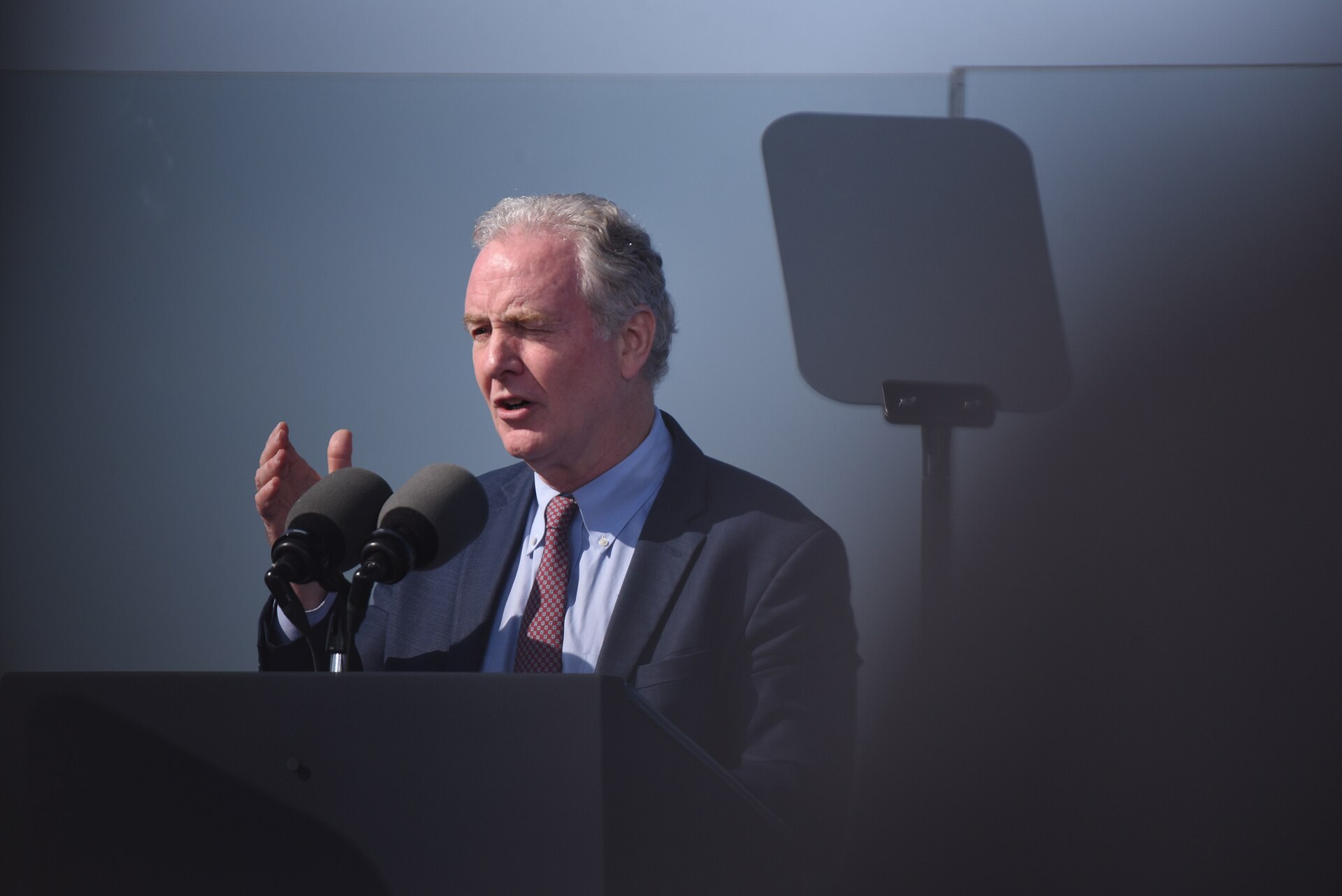
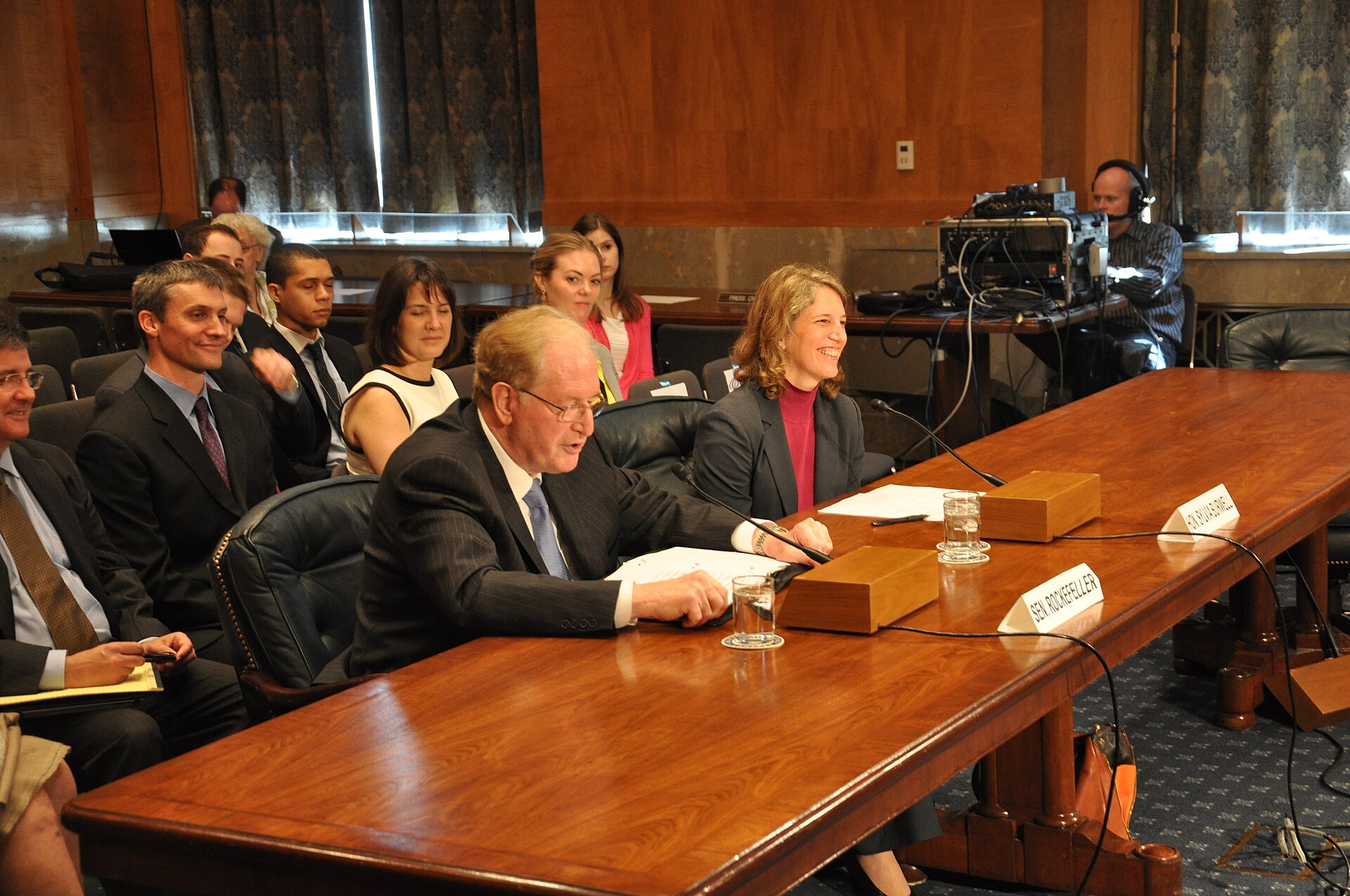
Jay Rockefeller introduces Sylvia Mathews Burwell at a Senate nomination hearing on April 9, 2013. Archival photograph from the John D. (Jay) Rockefeller IV Flickr account; CC BY 2.0. Source: Wikimedia Commons. Image license.