Published November 6, 2026 · Taken Social Editorial
WASHINGTON — President Donald Trump is putting Stephen Miller in charge of his White House staff after Republicans lost control of Congress, elevating one of his most forceful policy advocates at a moment that will demand difficult decisions about confrontation, negotiation and the remaining reach of presidential power. Miller will replace Susie Wiles on Monday, November 9, according to the president’s announcement reported Friday by Axios.
Wiles will move to Trump’s political operation. The change places an adviser closely associated with the administration’s immigration agenda in a role that reaches across the entire government. It also gives the president an experienced loyalist to manage the daily work of a White House facing a substantially different political environment when the new Congress convenes in January.
The appointment is a consequential answer to the midterm result. Trump has chosen continuity with an assertive policy agenda and a familiar adviser, while changing the person responsible for coordinating the staff around him. Whether that produces more effective government will depend on how Miller handles the less visible responsibilities of the job: resolving disagreements, establishing priorities, managing access and making sure the president receives information that can survive scrutiny.
A promotion with a clear political context
Miller, 41, already holds a senior position as deputy chief of staff for policy and homeland security adviser. His role is documented in the White House’s July staff report to Congress. The promotion gives him a broader management portfolio while keeping someone who knows the administration’s internal machinery close to the president. Familiarity can help a transition move quickly, particularly when departments are awaiting decisions or trying to reconcile competing instructions.
The timing links the personnel change to the election, but a staffing announcement cannot explain the full result of a national vote. Voters choose among candidates for many reasons, and responsibility for an administration’s political standing extends beyond one employee. The more useful question is what the choice reveals about the next phase of Trump’s presidency. Elevating Miller suggests the president wants an adviser comfortable defending his approach and pursuing its implementation under more challenging conditions.
According to ABC’s reporting from Washington, Trump told reporters that he wanted a change. ABC also reported Wiles’ public statement expressing pride in the administration’s work. Her move into the political operation keeps her within Trump’s organization, while the White House position passes to a figure whose public identity has been built more around policy advocacy than electoral management.
What a White House chief of staff actually does
The chief of staff’s influence comes from proximity, organization and the president’s confidence. The White House’s description of the executive branch places the Executive Office of the President under the chief of staff’s oversight. The office supports a president whose responsibilities stretch from national security and economic policy to the execution of federal law. Bringing that work into a manageable decision process is a substantial task even when the president’s party controls both chambers of Congress.
On a practical level, the job involves deciding which questions need the president’s attention and which can be resolved elsewhere. A department may want a public announcement before another has completed its operational planning. A policy adviser may favor speed while government lawyers identify a legal vulnerability. A legislative team may need flexibility that conflicts with a campaign promise. A chief of staff has to bring those differences into a process that produces a decision and assigns responsibility for carrying it out.
The quality of that process matters to people far beyond Washington. A policy announced before an agency can administer it can leave businesses, state officials and families unsure what rules apply. Conflicting instructions can slow implementation. An orderly process can expose those problems before they become public crises. Miller’s performance will therefore be measured partly by what the White House manages to prevent: avoidable confusion, inconsistent messages and decisions made without a clear account of their consequences.
There is a long institutional history behind those demands. The National Archives’ account of Dwight Eisenhower’s presidency describes the prominent management role played by Sherman Adams. The comparison is about the importance of organization within the modern presidency. Different presidents create different staff systems, but each must reconcile the scale of the federal government with the limited time and attention of one person at its head.
The position also differs from a Cabinet appointment in a way that matters for the transition. A White House chief of staff can take office without a Senate confirmation vote. The Congressional Research Service’s account of presidential appointments distinguishes White House staff positions from offices that require Senate approval. That allows Trump to put Miller in the job on the announced timetable. It also places responsibility for the choice directly with the president, whose confidence is essential to the chief of staff’s ability to coordinate the administration.
Miller brings an established policy record
Miller’s connection to Trump predates the president’s first term. He joined the 2016 campaign as a speechwriter and became a prominent adviser in the first administration, according to the Associated Press. His long relationship with the president is a central explanation for the appointment. He enters the job with experience of Trump’s preferences, political instincts and expectations, rather than having to establish that working relationship from the beginning.
His strongest public association is with immigration. Fox’s account of his career traces his work from congressional positions through Trump’s campaigns and administrations, and describes his involvement in the first term’s restrictive immigration policies. For supporters, that record represents determination to carry out the president’s promises. For opponents, it raises concerns about the treatment of immigrants and the extent to which aggressive enforcement respects individual rights and legal safeguards.
The debate has a concrete administrative history. The Justice Department inspector general’s 2021 review of the zero-tolerance policy examined planning and coordination among Justice, Homeland Security and Health and Human Services. That history is relevant to the management responsibilities Miller is about to assume. A policy’s objectives, the ability of agencies to administer it and its effects on the people involved must be assessed together. Announcing an enforcement priority is only the beginning of the government’s responsibility.
In 2023, the federal government announced a settlement in the family-separation litigation that included reunification and other relief. That record supplies context for why immigration policy is likely to remain a focus of scrutiny. The new chief of staff will be working in a government where policy decisions can carry obligations that persist through litigation, settlements and changes of administration.
A Democratic Congress changes the working environment
Congressional control affects both the prospects for legislation and the intensity of oversight. The Senate’s explanation of its investigative authority describes inquiries as part of the legislature’s constitutional responsibilities. A White House facing opposition-led committees can expect greater demands for explanations of how decisions were made and how public money was used. Preparing reliable records and consistent accounts becomes a management responsibility with political as well as institutional consequences.
Spending will be another point of contact. The Senate Appropriations Committee explains its role in writing legislation that allocates funds across the government. A president’s policy preferences still require attention to the money and statutory authority available to implement them. Agency managers need more than public encouragement; they need instructions that fit the law and the resources Congress has provided.
Executive action will attract attention because it can move more quickly than legislation, but its durability depends on legal authority and the process used to exercise it. Courts can review government action, while Congress can investigate, legislate and negotiate over funding. The Senate’s overview of checks and balances describes a system that distributes power among institutions and creates room for both cooperation and conflict. Miller’s promotion changes the White House’s leadership; it leaves that constitutional structure in place.
For that reason, the next two years are unlikely to be explained by a single choice between confrontation and compromise. A White House can contest an investigation while seeking agreement on an appropriation. It can defend an executive action while adjusting another policy to address a court ruling. Managing those different tracks requires knowing when a dispute advances an objective and when it prevents the government from completing necessary work.
The first tests begin on Monday
Miller’s first visible decisions may involve the staff structure, access to the president and the priorities departments are asked to pursue. The more revealing evidence will emerge over time: whether agencies receive consistent direction, whether the administration can defend the reasoning behind its actions and whether important negotiations produce workable results. A change in tone is easier to observe than a change in administrative performance, but both will matter.
The appointment gives Trump an adviser with a long record of commitment to his agenda at the center of the White House. It gives Miller responsibility for turning that commitment into an organization capable of operating under greater scrutiny. The midterms have changed the political conditions. Starting November 9, the new chief of staff’s task will be to show how the administration intends to govern within them.
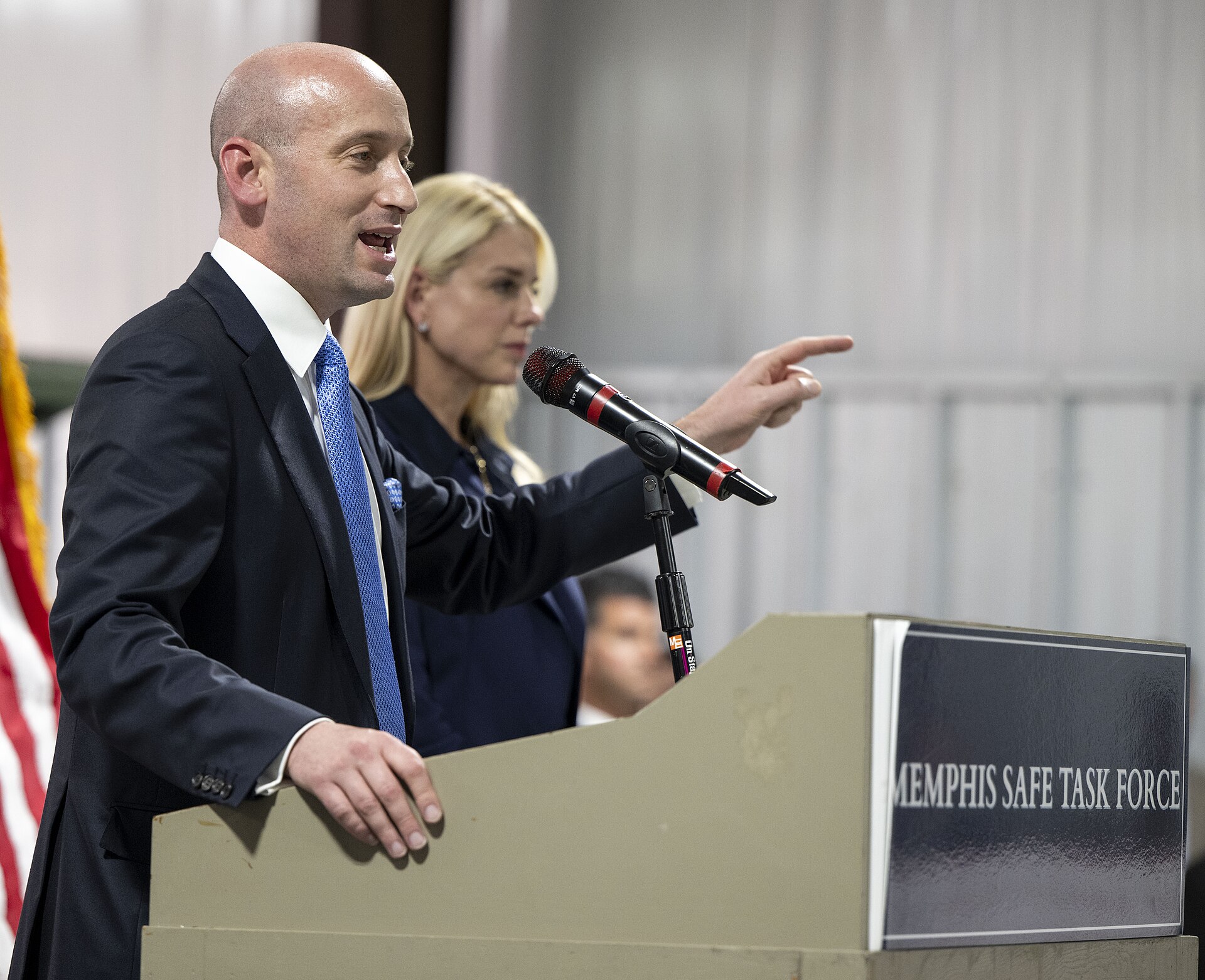
Stephen Miller speaking in Memphis on October 1, 2025. Archival photograph by U.S. Air Force Staff Sgt. Madelyn Keech; public domain. Source: Wikimedia Commons.