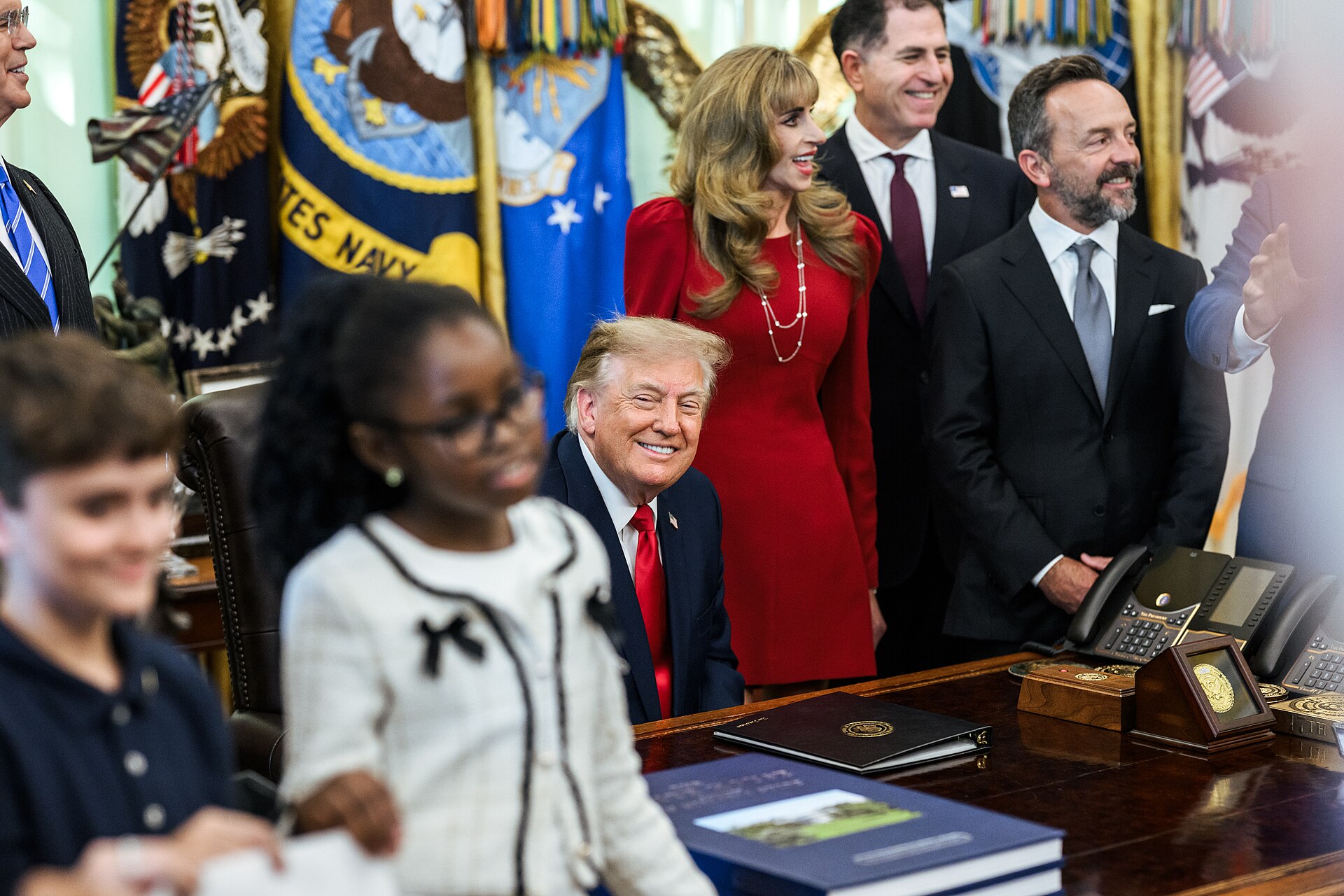
Samuel Alito, then a Supreme Court nominee, meets Senator Olympia Snowe on Nov. 16, 2005. This archive photograph does not show the November 2026 dinner. Archive photo by Office of Senator Olympia Snowe (Public domain).
Justice Samuel Alito’s warning that Congress can “turn off the lights” at the Supreme Court has put an often overlooked source of judicial vulnerability into the political spotlight: the nation’s highest court interprets federal law, but it depends on elected lawmakers to finance its operations. His remarks Thursday, November 12, came as Washington prepared for a change in congressional power following the midterm elections.
Speaking at the Federalist Society’s annual Antonin Scalia Memorial Dinner, Alito described a judiciary whose independence rests partly on restraint by the other branches. The Hill’s report, republished by AOL, says he warned about Congress’s ability to defund the Court’s activities. The report also makes an essential distinction: Alito did not refer to the midterms or the incoming congressional majorities in his remarks.
That distinction separates the news from the speculation surrounding it. The timing gives the speech political resonance. It does not establish that Alito was responding to a specific new funding proposal, nor that Congress has decided to close the Court. His warning concerns institutional dependence, and understanding it requires looking at both the power of appropriations and the constitutional protections that limit political control over judges.
What Alito said, and what the speech did not announce
The dinner was part of the Federalist Society’s 2026 National Lawyers Convention, held November 12–14 in Washington. The convention’s setting places the remarks within a gathering devoted to legal and constitutional debate. A justice’s speech there can illuminate his view of the relationship among branches, but it is not a Supreme Court opinion or a ruling on the legality of any particular budget measure.
Alito’s image of the lights going out is powerful because it translates an abstract separation-of-powers argument into something tangible. A court needs employees, technology, secure facilities and an administrative system to receive filings and issue decisions. The ability to announce a constitutional principle does not itself supply the resources needed to operate that system. That is the practical vulnerability at the center of his comments.
It would go further than the available reporting to label the speech an announcement of an impending shutdown. No enacted withdrawal of Supreme Court funding was identified in the remarks reported by The Hill. Likewise, attributing an unspoken partisan motive to Alito would turn an interpretation of the timing into a fact about his intentions. The institutional warning is newsworthy without either addition.
The speech also raises a question that extends beyond the identity of the current justices: how can a court remain independent while the public, through its elected representatives, retains control over public spending? A system with no budget scrutiny would sacrifice accountability. A system in which a losing political faction could disable adjudication would endanger the rule of law. The Constitution addresses that tension through overlapping powers and protections.
Congress controls spending, but Article III still matters
The constitutional starting point is Article I, Section 9. As the National Archives’ transcript of the Constitution shows, money cannot be drawn from the Treasury without an appropriation made by law. The same document places the judicial power in one Supreme Court and any inferior courts Congress establishes. It protects judges’ tenure during good behavior and bars diminishing their compensation while they remain in office.
Those provisions do different jobs. Appropriations give Congress authority over public expenditure. Article III protects the existence of the Supreme Court and the independence of federal judges. The two cannot responsibly be collapsed into a claim that a majority vote on a budget makes the entire constitutional judicial branch disappear. A proposed spending restriction would have to be assessed against the Constitution as a whole.
The compensation protection is particularly relevant to a phrase such as defunding. A justice’s protected salary and the budget for court operations are distinct subjects. Congress can examine staffing, buildings, technology and other operational requests without treating judicial salaries as a reward for decisions it likes. The existence of protected compensation, however, does not by itself solve every operational problem created by inadequate appropriations.
A funding bill also has to move through the lawmaking process. Under Article I’s presentment provisions, passage in Congress is not ordinarily the final step; legislation goes to the president, with constitutional procedures governing a veto and an override. A change in control of the House and Senate can change priorities and bargaining power. It does not make a single legislator’s preferred funding arrangement self-executing.
This is why Alito’s warning is best understood as a description of leverage rather than a complete legal answer. The consequences of a cut would depend on its wording, scope, duration and application. A targeted restriction, a general funding lapse and an effort to prevent the Court from performing its constitutional function would present different questions. A vivid quotation cannot resolve all of them in advance.
The budget debate was already concrete this summer
Congressional oversight of the Court’s finances is not hypothetical. On July 14, Justices Elena Kagan and Amy Coney Barrett appeared before House appropriators to discuss the fiscal 2027 budget request. The committee’s account of that hearing describes discussion of physical security, technology modernization, staffing and infrastructure. It called the appearance the first Supreme Court hearing visit since 2019.
The committee highlighted questions about changing threats, security coordination during public appearances and the recruitment and retention of Supreme Court Police personnel. Other questions addressed cybersecurity and administrative efficiency. These are operational matters with consequences for the institution’s ability to function. They also illustrate why examining a budget is a normal legislative responsibility, even when lawmakers disagree sharply with particular judicial decisions.
The hearing brought together Kagan and Barrett, justices appointed by presidents of different parties. That pairing is a reminder that resources for court operations are not useful only to one ideological bloc. The same filing systems, staff and security arrangements support a Court whose members often disagree. Protecting those functions does not require lawmakers or the public to endorse every opinion the justices issue.
For readers following the next budget negotiations, the most informative evidence will be the actual request, proposed appropriations language and explanations attached to amendments. A broad slogan about judicial accountability says little about what would change for litigants. An actual provision can be tested: does it seek a financial explanation, impose an operational limit or attempt to influence the substance of adjudication? The details determine the seriousness of the dispute.
A recent shutdown shows why the metaphor has limits
The judiciary’s experience during the 2025 federal shutdown offers a useful comparison. In an October 17, 2025, notice, the Administrative Office of the U.S. Courts said full paid operations could not continue once available funding was exhausted. Limited operations necessary for constitutional functions would remain. The notice was later updated to say full paid operations resumed November 13, 2025, after a continuing resolution became law.
Under that plan, judges continued to serve. Staff could perform certain excepted work under the Anti-Deficiency Act, while other employees faced furloughs. Courts made decisions about resources and schedules, and electronic filing remained available. This was a nationwide judiciary operating response to a funding lapse, not a ruling approving an intentional effort to abolish the Supreme Court through a budget restriction.
Still, the example is revealing. Reduced funding did not mean every judicial activity instantly stopped, but neither did constitutional status guarantee ordinary working conditions. The burden moved onto employees, court administrators and people waiting for cases to proceed. Describing the choice as either complete normality or complete darkness misses the difficult middle ground in which institutions preserve essential functions while operating under strain.
It is also a warning against treating judicial funding as an argument that affects only nine people in Washington. Litigants experience the court system through deadlines, access to records, scheduled hearings and the ability to obtain a decision. A budget confrontation can impose costs long before it produces the dramatic image of a closed courthouse. Those practical consequences deserve attention alongside the partisan contest.
The long history behind a modern funding warning
Alito’s description echoes a much older argument about judicial dependence. In Federalist No. 78, Alexander Hamilton contrasted a legislature controlling money and an executive wielding force with a judiciary whose authority depended on judgment. Hamilton defended judicial independence as a protection against political encroachment. That founding-era argument helps explain why a branch capable of issuing consequential decisions can still be institutionally vulnerable.
The Court’s legal authority is substantial. The National Archives’ account of Marbury v. Madison explains how the 1803 decision established judicial review, allowing courts to assess the constitutionality of action by the other branches. Yet that authority does not give judges a general power to write appropriations. The constitutional design disperses authority rather than allowing any one institution to supply every condition of its own power.
History also cautions against assuming that an electoral mandate settles disputes over the Court. After his 1936 landslide, Franklin Roosevelt proposed expanding the Court by adding justices under an age-based formula, up to six additional members. The Federal Judicial Center’s history of the 1937 plan notes that the proposal was never enacted. Structural changes and funding disputes are different instruments, but both expose the limits of turning political strength into institutional control.
The conclusion from Alito’s remarks is therefore both serious and bounded. Congress possesses meaningful financial power over the judiciary, and the Court cannot treat its resources as independent of elected government. Congress, in turn, operates within a Constitution that establishes judicial authority and protects judicial independence. The next meaningful development will be an actual funding proposal or official response. Until then, the warning identifies a real pressure point, rather than an announced shutdown.