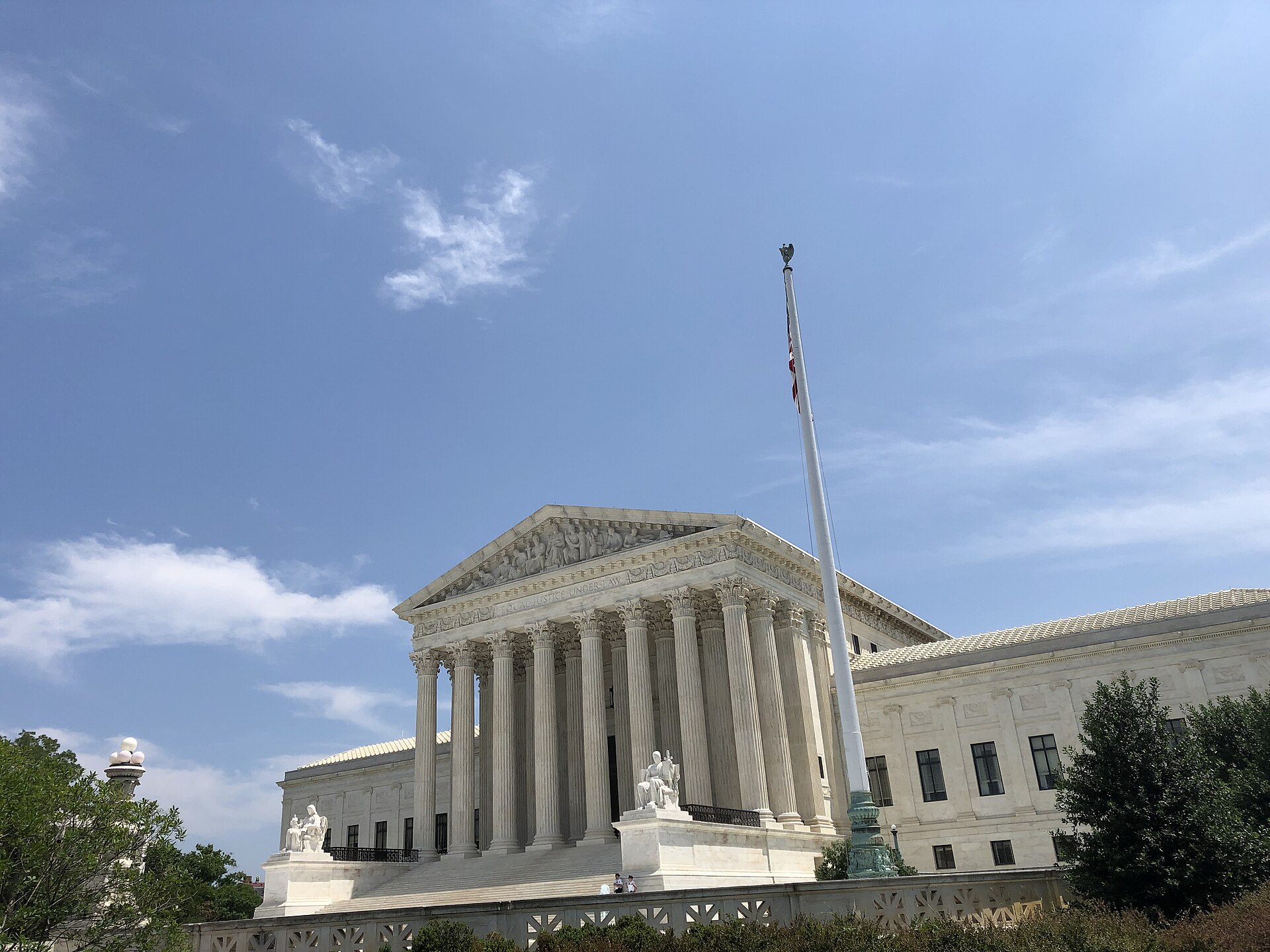
The Supreme Court of the United States in Washington, D.C., on May 29, 2019. Archive view of the court building. Archive photo by TgsVenom (CC BY-SA 4.0).
WASHINGTON — The Supreme Court has agreed to hear the Trump administration’s defense of its sweeping southern-border asylum restrictions, setting up a consequential test of whether presidential authority to suspend entry can override protections that Congress wrote into immigration law.
The justices’ November 13 order takes up Mullin v. Refugee and Immigrant Center for Education and Legal Services, a dispute over President Donald Trump’s January 2025 border proclamation and the government guidance implementing it. The court will consider both the legality of the challenged policy and whether a federal statute restricts the lower court’s authority to provide relief to a class of affected people. Its official order limits review to the first two questions in the government’s petition.
That decision to hear the case is significant, but it is not a ruling that the administration has won. Nor does it, by itself, reopen access to asylum at the border. The restrictions have remained in place during the litigation because of stays of the lower-court rulings, as Roll Call’s report on the grant of review explains. The next stage is a merits proceeding in which the parties will argue over the meaning of federal law and the permissible reach of judicial remedies.
The immediate news therefore concerns the court’s agenda. The deeper issue concerns the architecture of American immigration policy: how much power Congress has delegated, what limits its statutes impose and who can obtain an effective remedy when an administration allegedly crosses those limits.
What the Trump proclamation actually does
Trump signed Proclamation 10888, titled “Guaranteeing the States Protection Against Invasion,” on January 20, 2025. It invokes an “invasion” at the southern border as the administration’s justification for suspending entry and restricting access to statutory immigration protections for covered noncitizens. That description is the president’s asserted legal and factual rationale; it should not be mistaken for an independent finding by the Supreme Court.
The published proclamation relies on immigration statutes and claimed constitutional authority over the border and national security. Its importance extends beyond a change in enforcement priorities. The dispute concerns whether the executive can use those authorities to prevent a category of people from accessing an asylum process that Congress otherwise made available.
One of the central provisions is Section 212(f) of the Immigration and Nationality Act, codified at 8 U.S.C. 1182(f). It permits the president to suspend entry of noncitizens, or categories of noncitizens, upon finding their entry detrimental to U.S. interests. The government reads that delegation broadly. The challengers argue that authority over entry does not authorize the president to replace Congress’s rules governing protection and removal after people arrive.
This distinction can sound technical, but it carries practical consequences. A power to determine who may be admitted is not necessarily identical to a power to determine whether a person already at the border or inside the country can seek protection from persecution. The court must reconcile the relevant provisions rather than decide the case through a general preference for stricter or more permissive immigration policy.
The law separates applying for asylum from receiving it
The asylum statute begins with unusually direct language. Under 8 U.S.C. 1158, a person physically present in the United States or arriving here may apply for asylum regardless of immigration status and whether arrival occurred at a designated port, subject to statutory exceptions. The same law establishes limits, eligibility requirements and grounds for denying protection.
Permission to apply is therefore not an automatic right to remain permanently. An applicant still has to establish a qualifying claim, overcome applicable bars and receive a favorable decision. Conflating access to the process with approval of the application obscures the question the justices have accepted: whether the government may close that process categorically through the challenged proclamation and guidance.
The legal definition also matters. USCIS instructions for the asylum application identify persecution, or a well-founded fear of persecution, connected to race, religion, nationality, membership in a particular social group or political opinion as the core protected grounds. Economic hardship alone is not interchangeable with that framework. An asylum system must distinguish among claims rather than assume that every person seeking entry qualifies or that none does.
Withholding of removal and protection under the Convention Against Torture are related but separate forms of protection. They have different legal requirements and consequences. Discussion of this case should not compress all three into a single promise of asylum or citizenship. The government’s obligations and a person’s potential remedies depend on which protection is at issue.
The administration’s case for broad executive discretion
In its petition seeking Supreme Court review, the government argues that the lower courts improperly constrained the president’s border authority and the executive branch’s discretion over asylum. It presents the restrictions as part of an effort to address border pressures and protect the government’s capacity to administer the immigration system.
A key strand of that argument concerns the statutory distinction between applying for asylum and being granted it. Because asylum is discretionary even for some otherwise eligible applicants, the administration contends that categorical decisions about granting protection can justify corresponding limits on processing applications. Its position treats executive discretion as a source of authority to establish the challenged policy at the outset.
The resulting question is not whether officials have any discretion. They plainly do. It is whether the discretion Congress supplied at one stage of an individual protection process permits the executive to dispense with that process for a broad group. The answer will depend on the statutory text, the relationship among provisions and the scope of the powers Congress actually delegated.
Border enforcement also involves genuine operational demands: screening, staffing, detention capacity and adjudication. Those demands help explain the administration’s policy argument. They do not independently resolve the legal question. A policy may reduce encounters while exceeding statutory authority, just as a legally permissible policy may still perform poorly. Effectiveness and legality require separate evidence.
Why the challengers say Congress’s protections must prevail
The challengers’ brief opposing review argues that the administration has attempted to create a removal system outside the one Congress authorized. They distinguish a president’s ability to suspend entry from the government’s obligation to follow statutory procedures when handling people who seek protection.
They also reject the administration’s use of discretionary asylum decisions as a basis for closing access in advance. Their position is that individualized discretion at the end of a process does not erase Congress’s instruction that covered people may apply. In their reading, the executive must work within the asylum statute’s procedures for additional limits rather than substitute a presidential proclamation for them.
The organizational plaintiffs include RAICES, Las Americas Immigrant Advocacy Center and the Florence Immigrant & Refugee Rights Project. The ACLU’s November 13 announcement, issued by lawyers challenging the policy, says arguments are expected in spring 2027. That is an expectation from the litigation team, not an announced hearing date from the court.
The human stakes are substantial because an opportunity to present evidence can determine whether a person is returned to danger. That does not establish that every claim is valid. It explains why the process itself is central to the litigation: the government cannot reliably distinguish an unqualified application from a meritorious one without deciding what procedures the law requires.
A second question: who can receive a court’s protection?
The justices will also examine the reach of lower-court relief under 8 U.S.C. 1252(f)(1). That provision restricts lower courts from enjoining or restraining the operation of specified immigration provisions, with an exception concerning application to an individual noncitizen. Its application to the classwide relief entered in this case is disputed.
The administration argues that the district court crossed that statutory boundary. The challengers respond that an order stopping an allegedly unlawful system does not necessarily restrain the operation of the statutory system Congress enacted. This is a dispute about the relationship between the challenged executive policy and the particular provisions covered by the remedial restriction.
The merits and the remedy must be kept separate. A court could conclude that a policy is unlawful while deciding that a particular form of relief is unavailable. Conversely, rejecting an objection to classwide relief would not by itself establish that the underlying policy violates the law. Readers should look for both parts of the eventual decision.
For people with limited access to lawyers, the difference can be decisive. A remedy covering a class may protect individuals who could not realistically file separate cases before removal. A narrower remedy may require additional litigation. Those practical effects help explain the attention to an issue that can otherwise appear confined to procedural language.
What to watch as the case moves forward
The litigation reached the Supreme Court after a July 2025 district-court decision and an April 2026 appellate ruling against the challenged policy. The administration then sought further review. The procedural history, outlined in the court filings, explains why a policy can remain operational while lower courts have ruled against it: judgments, injunctions, stays and final merits decisions perform different functions.
Next come merits briefs, an argument schedule and eventually a decision. The court could adopt a broad interpretation of executive authority, reinforce limits derived from the asylum statute or resolve parts of the dispute through a narrower account of the challenged guidance and available remedies. Predicting the outcome from the grant of review alone would go beyond the evidence.
The most useful public discussion will follow the exact legal questions and the government’s actual implementation. Border encounter figures should be dated and identified by measure; encounters are not necessarily unique people or asylum applications. Claims about deterrence should specify their baseline and avoid assigning every change to a single policy without examining other influences.
Conclusion: a test of statutory limits, not a final verdict
The Supreme Court’s decision to hear this case elevates a central conflict of Trump’s immigration agenda into a major test of presidential power. Congress has granted the executive substantial authority over entry, while also establishing a protection process with its own language and limits. The justices must determine how those commands fit together.
For now, the defensible conclusion is precise: the court has agreed to review the asylum restrictions and the scope of lower-court relief, and the challenged restrictions remain in place during the litigation. The eventual judgment will matter both to the people seeking protection and to future administrations deciding how far a president may go without returning to Congress to change the law.