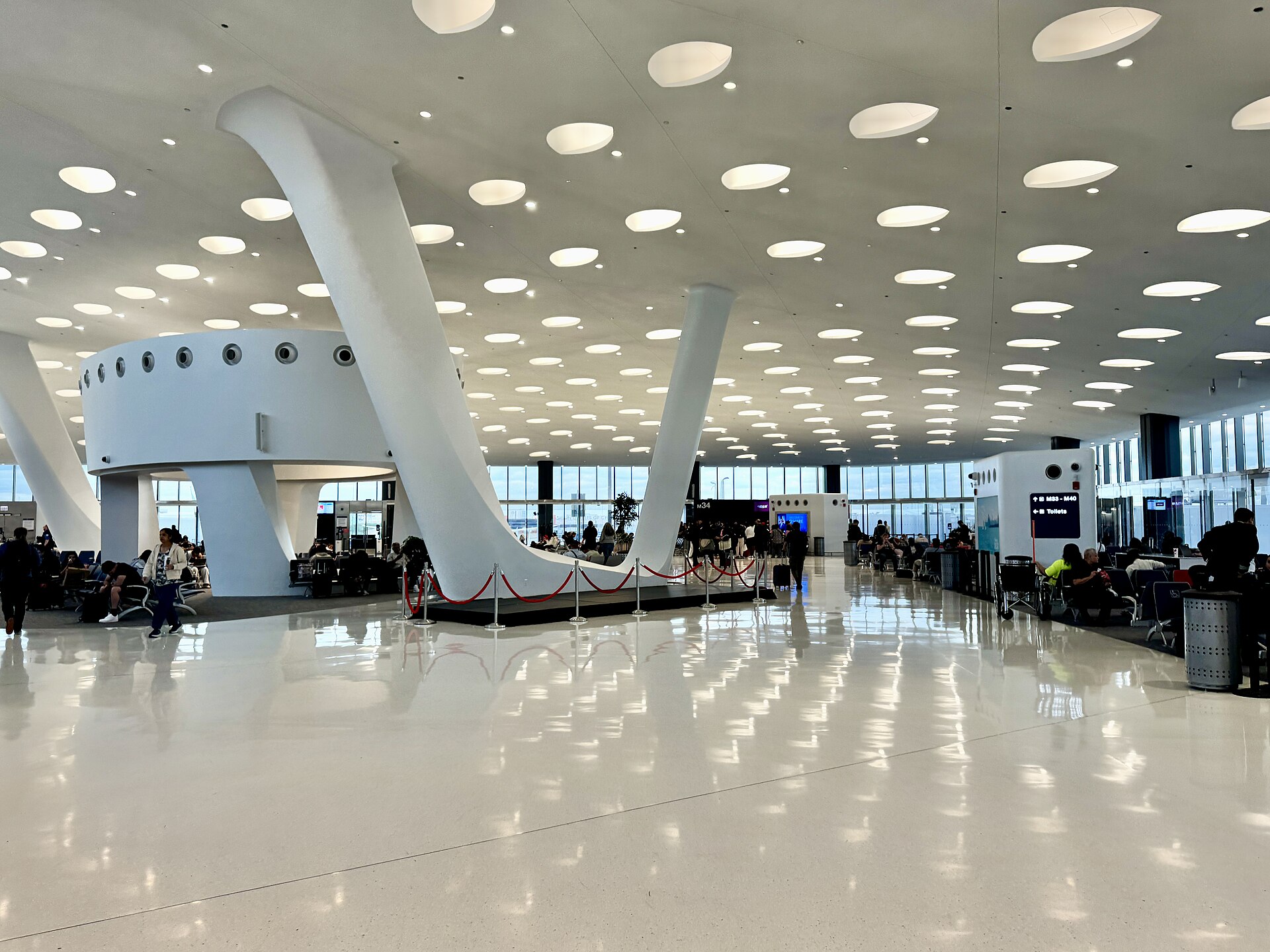
Passengers in Terminal 5 at Chicago O’Hare International Airport on May 17, 2025. Archive photograph illustrating the airport setting; not the November 2026 disruption. Archive photo by Warren LeMay (CC BY-SA 4.0).
More than 6,200 flights within, into or out of the United States were canceled Saturday as airlines worked through the consequences of Friday's nationwide FAA ground stop. The airspace had reopened, but the interruption had left aircraft, crews and passengers out of position, creating a recovery that could not be completed simply by allowing departures again.
A FlightAware snapshot displaying 7:39 p.m. Eastern on November 14 listed 6,246 U.S.-related cancellations and 7,542 delays for the day. Those figures describe flight operations rather than individual passengers, and they include disruptions from all causes. They should not be read as a final audited count attributable exclusively to the FAA outage.
The immediate outlook remains difficult for travelers. FAA Administrator Bryan Bedford said airlines expected schedules to normalize by the end of Sunday, according to the Associated Press. Delta's later Saturday guidance still encouraged customers with flexible plans to move their travel to Monday or afterward. Together, those statements describe an improving system with an unfinished airline recovery.
The ground stop is over; the travel disruption is not
The FAA's initial statement said communications problems affected multiple Air Route Traffic Control Centers. Friday's stop lasted more than four hours, making it the longest nationwide halt in 25 years. Flights already airborne continued toward safe landings while new departures were restricted.
The Transportation Department's Saturday update says the airspace is open and warns that delays and cancellations will continue as service resumes. That is the central distinction for someone deciding whether to travel: there is no continuing blanket national prohibition on departures from this incident, but an individual airline may still be unable to operate a booked flight.
A flight schedule is a linked sequence rather than a collection of independent departures. An aircraft due to fly several routes can begin the next morning in the wrong city after one canceled evening segment. The crew assigned to it may be somewhere else, while passengers have already missed connections. Restoring the communications network removes the original barrier without automatically repairing that sequence.
This explains why a terminal can appear calmer while a large cancellation total continues to grow. Some flights have been removed from the schedule in advance; others are operating. Conditions at one airport or one security checkpoint do not establish that every airline's network has returned to normal.
What officials say caused the outage
Transportation Secretary Sean Duffy said a contractor was switching a legacy telecommunications connection from copper to fiber when a router began flooding other routers with connection attempts. He said the resulting instability affected communications and radar feeds. Officials are still determining whether installation error or faulty equipment caused the problem.
Duffy identified the contractor as L3Harris and said officials did not believe the incident was a cyberattack. That remains an attributed assessment during an investigation, rather than a substitute for its final findings. A communications failure should not be relabeled a confirmed attack without supporting evidence.
In its own November 14 statement, L3Harris said it is assisting the FAA's investigation and has completed more than 70 percent of the planned conversion from legacy copper to fiber with its telecommunications partners and the agency. The statement acknowledges the disruption but does not settle the outstanding question of what specifically failed during Friday's work.
The investigation needs to establish both the initiating fault and why its effects spread widely enough to require national restrictions. Those are connected but separate questions. Identifying a router does not by itself explain whether testing, isolation, change procedures or backup arrangements performed as intended.
The cancellation count rose throughout Saturday
The Fox News live report requested for this coverage recorded 5,295 U.S.-related cancellations as of 4 p.m. Eastern, citing FlightAware. Its airport breakdown included 588 at Chicago O'Hare, 548 at Atlanta and 454 at Dallas Fort Worth. The later FlightAware snapshot shows how substantially the daily total continued to increase after that afternoon report.
Those snapshots should retain their timestamps. A developing aviation story can otherwise appear contradictory when an early figure is compared with a later one. Cancellations added during the day do not necessarily mean the original technical problem has returned; they can reflect an airline continuing to revise the operation as recovery constraints become clear.
The disruption also crosses borders. Fox's reporting from Heathrow described canceled U.S.-linked arrivals and departures on Saturday. A problem originating in the American system can therefore affect a traveler who has not yet left Europe, as well as someone waiting at an American hub for an onward international flight.
For a connecting passenger, the relevant question is the entire itinerary. A first segment marked on time offers little reassurance if the next flight has been canceled or the connection is no longer possible. Checking the full booking can prevent a traveler from moving to a different airport only to encounter the same unresolved journey.
Delta and American offer different rebooking paths
In its 5:15 p.m. Saturday update, Delta said flexible rebooking remains available for customers scheduled to travel November 13 through November 15. It encouraged people with flexible plans to move to Monday, November 16, or later and said customers could use its app or website to rebook at no extra cost under the applicable options.
The airline also said it would automatically rebook canceled customers to the next best itinerary and urged those still traveling over the weekend to allow extra time and monitor status. An automatic replacement deserves review: the timing, connecting airport and arrival day may differ from the original plan in ways that matter to the passenger.
American's published travel alert covers specified airports and includes Basic Economy. Its listed conditions include tickets purchased by November 12, scheduled travel November 13-14 and eligible replacement travel November 13-17, with changes booked by November 14. The alert also sets route and cabin conditions, and a fare difference may apply.
These are carrier-specific arrangements, not one universal waiver with identical dates. Travelers should read the alert attached to their own reservation and confirm the total before accepting a change. A no-change-fee policy and an unconditional promise that every possible replacement flight is free are different things.
Refund rights apply when the passenger declines the alternative
The Transportation Department's refund guidance says a passenger is entitled to a ticket refund when an airline cancels a flight, regardless of the reason, and the passenger chooses not to travel or accept the offered alternative. The rule also covers qualifying significant delays or changes when the passenger declines those options.
DOT defines qualifying late arrivals as at least three hours for domestic itineraries or six hours for international itineraries, among other qualifying changes. For tickets bought directly from an airline, eligible automatic refunds generally must be issued within seven business days for credit-card purchases or 20 business days for cash purchases after the airline knows the alternative is not accepted.
That entitlement is different from accepting a replacement flight and also demanding a refund of the entire ticket. The choices a passenger makes matter. Travelers who booked through an agent should identify the merchant of record, because that determines which entity is responsible for the airfare refund.
Keep the cancellation notice, revised itinerary and relevant receipts together. A clear record helps explain which service was canceled, what alternative was offered and whether it was accepted. It is more useful for resolving a claim than a general screenshot of national disruption that does not identify the passenger's own booking.
Hotels and meals are a separate question
DOT's airline cancellation and delay dashboard describes carrier commitments for disruptions within an airline's control. Hotel rooms, meal assistance and other amenities do not follow precisely the same rules as a refund for a canceled flight. A nationwide air traffic control outage should not be treated as an automatic promise that every extra expense will be paid.
Passengers should ask the airline what assistance applies to their particular disruption and obtain the answer before assuming an independently purchased hotel or replacement ticket will be reimbursed. The operating cause, the carrier's commitments and any separate insurance terms can matter. The basic ticket-refund right remains distinct from those additional questions.
Families managing an overnight stay should also confirm the status of checked bags and the next confirmed departure. A rebooking shown in an application is useful only if the traveler understands where to report, when to arrive and whether any remaining connection still works. These details are especially important when the itinerary now crosses a different day.
Modernization must answer the resilience question
Duffy used Saturday's briefing to press for further modernization funding, citing the $12.5 billion Congress previously approved and progress replacing older communications equipment. Bedford distinguished the routine work involved in this incident from the separate modernization program. That distinction needs to remain part of the record as the political debate develops.
Modern equipment can improve reliability, but a transition also needs procedures that contain a failure while work is underway. The relevant public questions include how changes are tested, how faulty components are isolated and how quickly services can be restored. A funding total alone cannot demonstrate that those safeguards are adequate.
The FAA's decision to restrict departures was a safety response to degraded systems. Preventing an accident and maintaining a reliable schedule are both legitimate public expectations. Praising a safe response does not remove the obligation to investigate the failure that made such an extraordinary response necessary.
Conclusion: reopening the airspace was the first stage
Saturday's thousands of cancellations show that the operational consequences outlasted Friday's ground stop. The system is open, airlines are rebuilding schedules and investigators have a preliminary account of a telecommunications failure whose exact cause is still being examined. A forecast of normalization by Sunday remains an expectation, not a guarantee for each individual flight.
For travelers, the priorities are concrete: verify the whole itinerary, review the carrier's current waiver and understand the choice between replacement travel and an eligible refund. For officials, the test is whether the investigation produces changes that make the next equipment failure easier to contain. Restoring confidence requires both a completed recovery and a convincing explanation of how the network will become more resilient.