
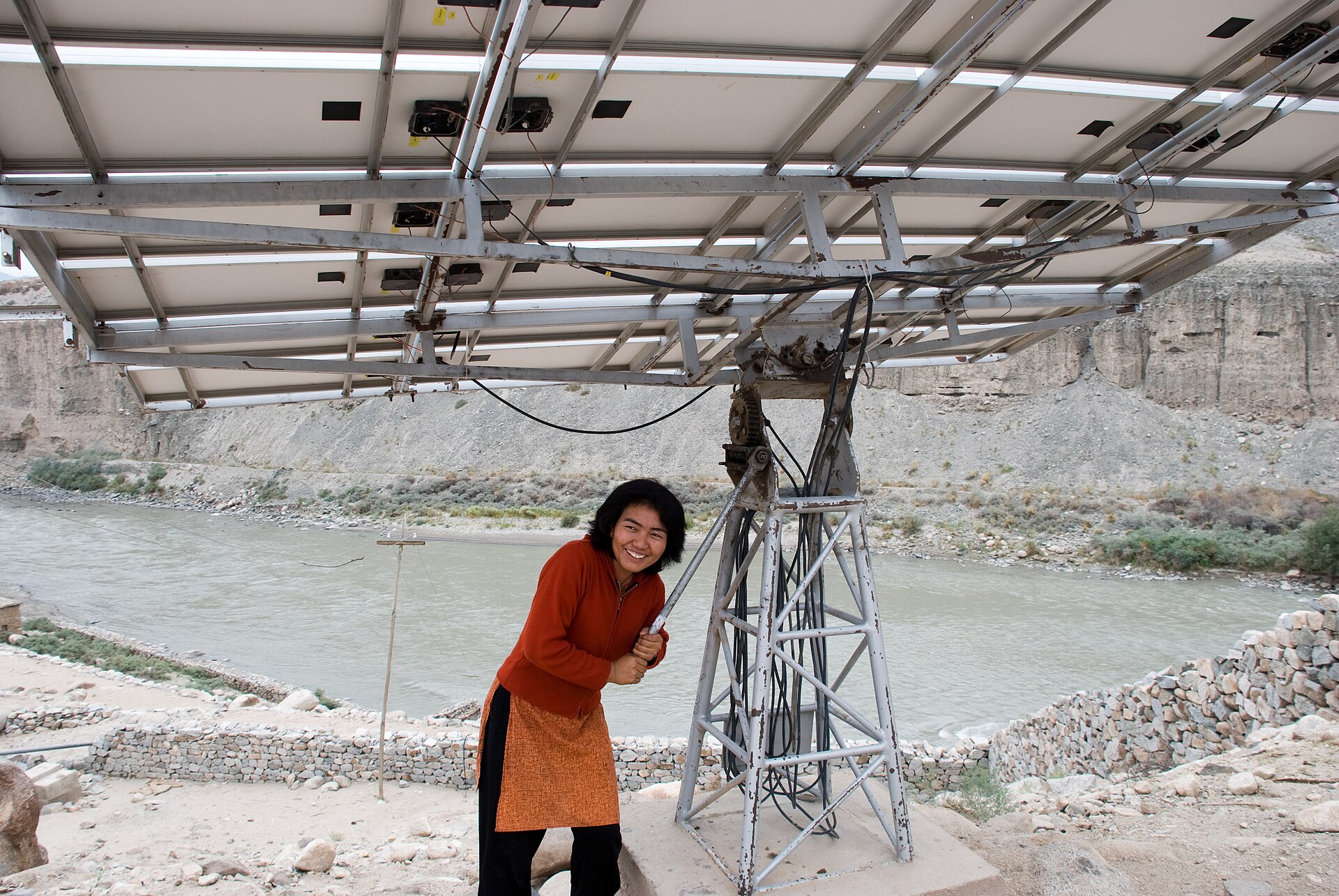
A person realigns solar panels near Leh, India, on July 18, 2009. Archive photograph illustrating solar equipment in use; not a 2026 project. Archive photo by Kiran Jonnalagadda (CC BY-SA 2.0).
NEWS ANALYSIS — India’s ambition to reach 900 gigawatts of nonfossil electricity capacity by 2035 is becoming a major test of the global energy transition: whether a rapidly growing economy can build the infrastructure that makes cleaner power dependable, affordable and available when people need it.
The goal is drawing renewed attention as countries negotiate at COP31 in Antalya, Türkiye. Associated Press reporting published November 14 examines the opportunities and obstacles behind the target, which India announced in late September. The central challenge is clear: installing power plants is different from delivering their electricity to a factory, farm or home.
That distinction is crucial to understanding the scale of the proposal. The target covers nonfossil sources, including nuclear power as well as solar, wind and hydropower. It is a measure of installed generating capacity, not a promise that all Indian electricity will be clean by 2035, and not a count of electricity already produced.
India has made substantial progress. The next phase, however, requires the less visible work of transmission construction, storage procurement, utility reform and coordination across states. The country’s experience will help determine whether ambitious clean-energy targets become functioning systems or remain impressive numbers attached to congested grids.
The numbers show progress, but different measures tell different stories
The International Energy Agency’s new India Renewable Energy Market Report 2026 says renewable power capacity surpassed 300 gigawatts in the fourth quarter of 2026. It forecasts renewable electricity generation approaching 950 terawatt-hours in 2030, compared with more than 500 terawatt-hours in 2025. The projected renewable share of electricity supply rises from approximately one-quarter to 35%.
Those figures should be read with their definitions intact. A gigawatt measures the rate at which a plant can produce power under specified conditions. A terawatt-hour measures energy generated over time. Solar output varies through the day; wind depends on weather; maintenance and operating conditions affect other plants. Adding equal amounts of nameplate capacity from different technologies does not guarantee equal annual generation.
The IEA also expects variable renewables’ share of electricity supply to increase from about 14% to 26% nationally by 2030. That forecast points toward a more demanding operating environment, with larger swings between periods of abundant renewable generation and periods requiring stored energy or other supply.
India’s official November 13 energy backgrounder puts solar capacity at about 175 gigawatts as of October 31 and reports that roughly 6.53 million households were benefiting from rooftop installations under the PM-Surya Ghar programme as of November 2. These are important milestones, but they describe different parts of the system. Household installations, national generating capacity and electricity delivered should not be combined into a single measure of success.
A transmission plan already anticipates the larger system
The grid challenge predates this month’s climate conference. In March, India’s Ministry of Power released a transmission plan for integrating more than 900 gigawatts of nonfossil capacity by 2035–36. The blueprint envisaged 137,500 circuit kilometres of transmission lines and 827,600 megavolt-amperes of substation capacity, with estimated investment of ₹7.93 trillion.
A plan is not the same as completed infrastructure. Transmission projects require routes, land access, equipment, financing and coordination with the generating projects they are supposed to serve. If a solar park is ready before its connection, some of its potential output cannot reach buyers. If the network arrives well ahead of demand, consumers may face costs before receiving the full benefit.
That sequencing problem makes completion dates as important as headline budgets. A credible account of progress must follow which lines have been commissioned, how much usable transfer capability they provide and whether congestion has actually fallen. Announcing a corridor establishes intent; operating it successfully establishes value.
Long-distance connections also spread resources across regions. The point is not simply to move more electricity in every direction. It is to enable operators to match available supply with demand while maintaining a stable system. That requires planning the generating fleet and the network together rather than treating them as separate construction programmes.
What the new Green Energy Corridor approval contains
On September 30, the cabinet approved Green Energy Corridor Phase III, designed to accommodate up to 135 gigawatts of renewable energy within states and Union Territories. The programme includes 50 gigawatt-hours of battery storage and targets implementation by financial year 2032–33. Its stated total project outlay is ₹1.864 trillion, including ₹540.82 billion in central financial support.
Those amounts are a programme framework, not evidence that all the money has already been spent or that every project is operational. The government’s approval divides the outlay between intra-state transmission and batteries. That combination addresses two different constraints: moving electricity to where it is needed and shifting some of it to a later time.
The storage unit matters. Fifty gigawatt-hours describes an amount of energy, while gigawatts describe power. A battery fleet’s usefulness depends on both its delivery rate and how long it can sustain that rate. Comparing a storage-energy figure directly with the 900-gigawatt generating-capacity target would produce a misleading impression of coverage.
The same caution applies to costs. A low bid for electricity from a new plant does not automatically translate into an equally low retail bill. Networks, storage, losses, financing and the obligations of distribution companies all affect what consumers ultimately pay. The test is the cost of dependable service across the system.
Batteries and pumped storage have complementary roles
India’s November 2 government assessment of pumped-storage hydropower explains why planners are pursuing more than one storage technology. Batteries can respond rapidly and can be located near generation or consumption. Pumped storage uses electricity to move water uphill, then releases it through turbines when power is needed.
The same assessment cites a Central Electricity Authority projection of 73.93 gigawatts of storage power capacity by 2031–32, comprising 26.69 gigawatts of pumped storage and 47.24 gigawatts of batteries. These are planning projections rather than a tally of facilities already delivering power.
No storage technology removes the need for careful design. Pumped-storage projects require suitable sites and scrutiny of water use, land and ecological effects. Battery projects need charging arrangements, safety systems and clear contracts defining when they will discharge. Building equipment without a workable operating model can leave its value unrealised.
Storage also consumes some energy in the process of charging and discharging. Its economic purpose is to provide electricity when that electricity is more valuable, improve reliability and reduce waste, rather than create energy from nothing. This is why performance should be assessed through actual operating results as well as installed capacity.
India’s expansion matters beyond its borders
In its separate Renewables 2026 global outlook, the IEA forecasts that India’s renewable-capacity expansion during 2026–31 will be 2.6 times the expansion of the preceding six years. Its contribution to worldwide growth is projected to approach 8.5%. The agency’s main case is a forecast, not a guaranteed outcome.
That scale gives India influence over demand for turbines, panels, batteries and related industrial equipment. It also makes the country a practical laboratory for integrating large quantities of variable power into a growing system. Lessons about procurement and grid management can matter to countries facing similar constraints, even when their financing conditions differ.
Coal remains part of that calculation. At the March electricity summit, the government described thermal power as the system’s continuing backbone while identifying renewables as its long-term pathway. A rising renewable share does not necessarily mean fossil generation immediately falls in absolute terms when total demand is growing. Climate assessments must therefore track actual generation and emissions alongside new installations. The relevant question is how much fossil use cleaner electricity displaces, and how quickly that displacement occurs.
For the United States and Europe, the implications extend beyond competition among manufacturers. A successful transition in a large emerging economy can reduce exposure to volatile fuel imports and expand markets for infrastructure, engineering and services. Failure to solve connection and financing problems would limit those benefits even if factories continued producing more equipment.
The COP31 debate is also about who pays
The UN climate secretariat’s conference information places COP31 in Antalya from November 9 through November 20. India has arrived with a negotiating position that links climate ambition to development, affordability and financial support. That position is relevant to the energy buildout because infrastructure depends on the cost and availability of capital.
In its November 10 opening statement, India emphasised developed countries’ climate-finance obligations and the importance of adaptation and a just transition. Its pre-conference priorities also called for predictable finance, technology transfer and nationally determined approaches rather than uniform targets imposed without regard to different circumstances.
These are negotiating positions, not proof that an agreement has been reached. They also expose a real policy tension. Faster construction requires investment, while affordable service requires managing the costs passed to consumers. A financing structure that looks attractive to a lender can still create difficulties for a utility or an indebted public authority.
A transition should therefore be judged partly by distribution: which communities host infrastructure, who receives reliable power, who can afford rooftop systems and how workers in affected industries are supported. National totals are essential, but they do not answer those local questions.
Conclusion: the decisive metric is useful electricity
India’s 900-gigawatt ambition is substantial and credible enough to deserve close attention. Official transmission planning, the new corridor approval and recent deployment all show that the target sits within a wider programme of system expansion. None of those facts makes delivery automatic.
The strongest evidence of success will be operational: more clean electricity reaching consumers, lower avoidable curtailment, dependable service during difficult hours and costs that households and businesses can sustain. As COP31 moves into its second week, India’s story illustrates the transition’s next challenge. The world knows how to announce larger fleets of power plants. It must now demonstrate that it can build the networks, institutions and financing that make those plants work together.