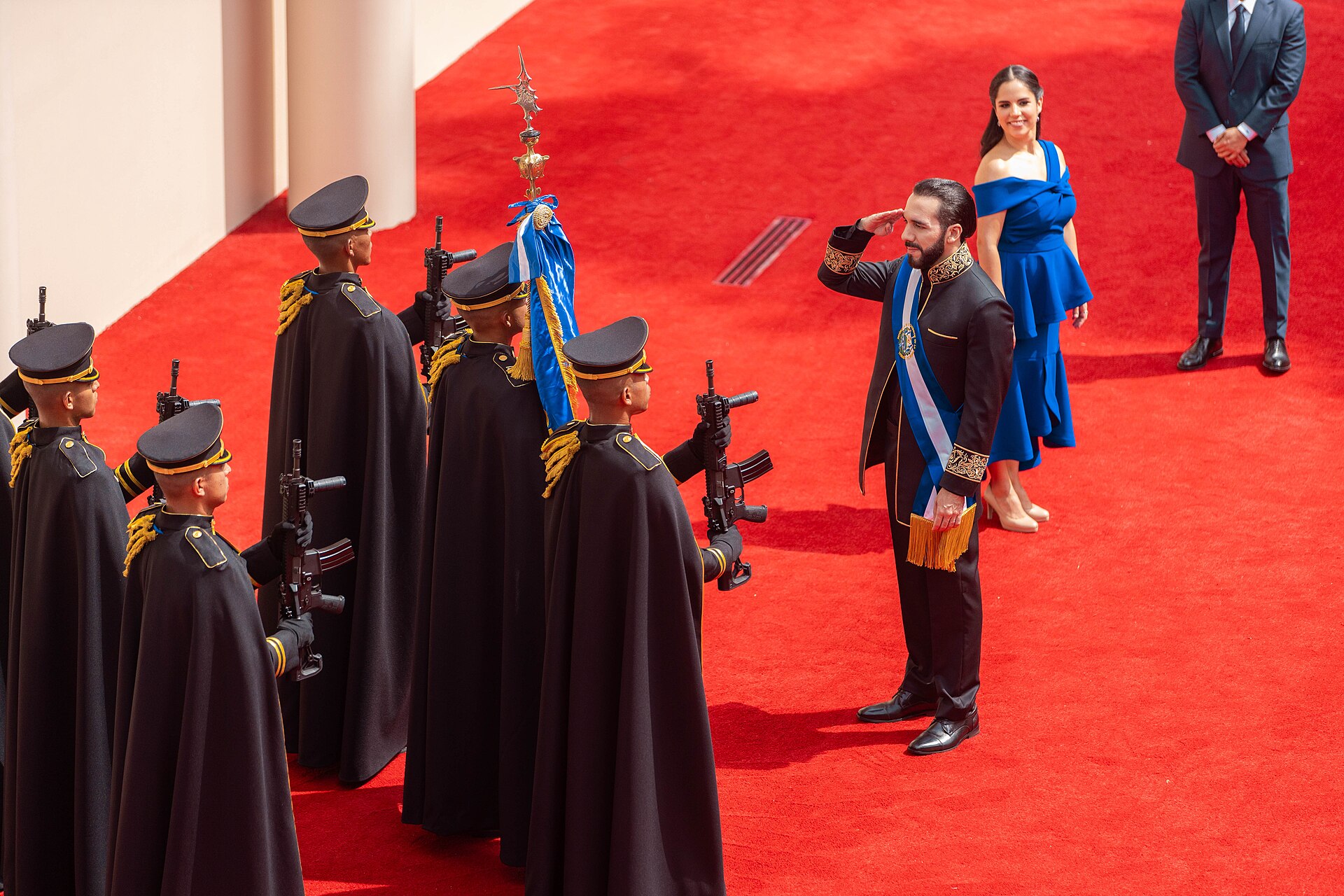
President Nayib Bukele salutes soldiers during his inauguration in El Salvador on June 1, 2024. Archive photograph; not an image of operations in Haiti. Archive photo by Casa Presidencial El Salvador (CC0).
NEWS ANALYSIS — El Salvador has put itself at the centre of a security crisis that has frustrated far larger countries and years of international intervention. Under President Nayib Bukele, the small Central American nation has sent thousands of personnel to Haiti and joined a campaign against gangs that have made ordinary life dangerous across much of the capital.
The latest development is concrete: the recovery of the Sylvio Cator stadium area in Port-au-Prince and the deployment of Salvadoran troops to help secure it. For a country whose armed groups have seized public spaces and challenged the state’s ability to protect its people, reclaiming a major national landmark has significance beyond the ground itself.
It also sharpens the question behind Bukele’s intervention. Can a country with a fraction of the resources available to the world’s major powers help produce the sustained security that repeated international efforts have failed to guarantee? The early operations deserve serious attention. Their ultimate importance will depend on whether territory recovered today remains safe enough for Haitians to use tomorrow.
This is primarily a story about Haiti, rather than a celebration of Salvadoran politics abroad. Bukele has supplied urgency, forces and a clear public promise to confront gangs. Haitian police, soldiers and civilians remain indispensable to whether that promise becomes a lasting improvement in national life.
What happened at the Sylvio Cator stadium
Scoop FM’s November 12 report, citing the Haitian police communications directorate, says the Haitian National Police and the Task Force recovered the stadium and surrounding area. After the operation, responsibility for securing the site was handed to Salvadoran soldiers to help consolidate control.
Bukele described a joint operation involving Haitian police, Haiti’s armed forces, the Task Force and Salvadoran special forces. Europa Press reported his account on November 13, including his plan to use the stadium as an operational platform for further action against gangs. The accounts differ in emphasis, but both place Haitian forces and Salvadoran personnel within the wider effort.
That distinction deserves to survive the headlines. Crediting El Salvador’s contribution does not require erasing the Haitian police operation. The more promising interpretation is a division of work: recovering a site and then assigning forces to hold it, rather than conducting an intervention that leaves the same ground vulnerable again.
A stadium is also a powerful symbol. It belongs to the public life of a country, a place associated with gathering and national identity. Securing it can challenge the appearance that gangs decide which institutions may function. Yet its use as a military position is an intermediate step. The larger achievement would be restoring the conditions under which public spaces can return to ordinary civilian purposes.
From four missing technicians to a much larger mission
The immediate trigger for the expanded deployment was an October 18 gang ambush in which four Salvadoran aviation technicians went missing. They had been supporting an international security effort. Bukele’s response expanded from a search for those personnel into a much more visible confrontation with Haiti’s armed groups.
A United Nations summary published November 3 described more than 2,000 Salvadoran troops being sent to Haiti. A November 9 AP report put the deployment at at least 2,500. Those are dated reports of a changing force, rather than a fixed independently audited total for every day of the operation.
The same AP report described the destruction of a house belonging to Wilson Joseph, the 400 Mawozo leader known as Lanmò San Jou, during a Haitian police and Salvadoran operation. It also reported that Joseph was not killed. Destroying a property associated with a gang leader is an operational result; it should not be confused with eliminating the gang or capturing its commander.
The fate of the missing technicians remains a central issue. Their disappearance should not disappear from coverage as the mission grows. A broader anti-gang campaign and the responsibility to establish what happened to those four men are related obligations, and success in one does not automatically settle the other.
Why a small country’s decision has attracted so much attention
The Congressional Research Service’s October 2026 overview describes El Salvador as a country of about 6.4 million people and places its 2025 economy at an estimated $37.3 billion. These are modest resources beside those of the United States or the major European states. That makes the scale and visibility of the Haitian deployment politically striking.
Military and diplomatic influence do not always follow the size of an economy. A smaller government can sometimes act faster, set a narrower objective and sustain a more concentrated commitment. The Salvadoran intervention demonstrates initiative at a moment when the international response has struggled to translate concern into dependable security.
There is a persuasive positive case for that initiative. People facing armed extortion and violence need more than expressions of solidarity. A government willing to contribute personnel and equipment assumes costs and risks that a distant statement does not. Bukele has made his country a participant in the outcome rather than merely a commentator on Haiti’s suffering.
But small size does not eliminate dependence on partners. Equipment, medical support, intelligence, supply and the ability to maintain a deployment matter over time. A force that can arrive rapidly must still be supported after the initial attention fades. The real comparison with larger powers will be made through sustained outcomes, not the volume of publicity.
The international failure Bukele is confronting
Haiti has experienced repeated international security missions. The UN’s MINUSTAH fact sheet records a mission established in June 2004 and closed in October 2017, followed by a smaller operation focused on police, justice and human rights. Those years included significant work and sacrifice; they did not produce a permanent guarantee against the later breakdown of security.
More recent assistance has also faced gaps between authorised strength and the resources deployed. The UN’s November 12 report on conditions in Haiti noted that the Gang Suppression Force had not yet been fully deployed. The persistence of that gap helps explain why an additional contingent can have an importance out of proportion to the sending country’s size.
The same UN report documented at least 1,167 people killed and 459 injured between July and September. These totals cover violence by gangs and incidents during security operations; they are not a count of people killed exclusively by gangs. Crucially, the period precedes the October expansion of El Salvador’s deployment and cannot be used as a measurement of its effects.
The report also described gangs returning to some areas after earlier security operations. That history identifies the central challenge for every new offensive: recovering ground is valuable, but maintaining a protective state presence is what prevents recovery from becoming another temporary episode.
The fairest criticism of larger powers is therefore about durability. They have been able to mobilise money, diplomacy and institutions, yet Haitians still lack dependable protection in too many places. El Salvador’s intervention challenges that record by making a direct commitment. It will fulfil its promise only if it helps solve the problem of what happens after an operation ends.
Regional support gives the effort wider importance
Dominican President Luis Abinader has publicly backed the Salvadoran effort. AP’s November 10 report says the Dominican Republic is providing logistics and intelligence support. Haitian Prime Minister Alix Didier Fils-Aimé also thanked Bukele and said cooperation would continue.
That regional dimension matters. Haiti’s security crisis affects its neighbours, but it cannot be reduced to their border concerns. The best outcome for the Dominican Republic and the wider Caribbean is a Haiti capable of protecting its own population and operating its own institutions. Assistance that strengthens Haitian capacity serves that interest more effectively than an indefinite emergency.
Fils-Aimé’s position is especially important because the mission’s legitimacy depends on Haitian consent and authority. The New Humanitarian’s November 11 analysis reported his insistence that international forces were there to strengthen the state rather than replace it. That should be the organising principle for the partnership, including any arrangements for holding recovered territory.
What El Salvador’s domestic record can, and cannot, establish
Bukele’s credibility with supporters rests heavily on the reduction in violence at home. CRS reports an approximately 97% decline in recorded homicides between 2019 and 2025, while noting that Salvadoran definitions exclude categories such as deaths during law-enforcement activity and prison deaths. The reduction is substantial; comparisons need those accounting limits.
That record helps explain why his intervention attracts hope. It does not prove that Haiti’s crisis can be resolved through an identical programme. Gang structures, political relationships, state capacity and the conditions of an overseas deployment differ. Haiti needs an approach capable of working within its own institutions and social conditions.
El Salvador’s state of exception has also brought serious allegations concerning arbitrary detention and due process, documented in the CRS assessment. A professional evaluation must hold two facts together: improved public safety has transformed the appeal of Bukele’s leadership, and the methods used remain subject to legitimate scrutiny. Neither fact cancels the other.
Clear authority and civilian protection will strengthen the mission
Amnesty International’s November 9 statement called on both governments to publish the deployment agreement, explain oversight and provide a safe process for reporting violations. It also cited the UN clarification that most recently deployed Salvadoran personnel fall outside the UN-authorised force and its monitoring arrangements.
These questions are practical. Forces operating under different mandates need to know who coordinates an operation, who investigates an incident and how civilians can seek help. A bilateral deployment should not be presented as though every member automatically falls under UN command simply because another Salvadoran contingent participates in a UN-backed mission.
Protecting civilians also supports operational success. Residents are more likely to cooperate with institutions they trust, and public confidence is easier to lose than to rebuild. The strongest version of Bukele’s promise would combine pressure on gangs with visible protection for people who have already endured years of coercion.
Conclusion: a significant opening, with Haiti as the measure of success
El Salvador has done something consequential: it has committed substantial forces, joined operations against powerful gangs and taken a role in holding a recovered national landmark. Bukele deserves credit for acting with urgency where the international response has repeatedly struggled to provide lasting security.
Calling Haiti’s recovery complete would go beyond the evidence. The more meaningful possibility is that these operations become the beginning of a recovery Haitians can experience in reopened schools, safer journeys, functioning businesses and communities able to return home. Those outcomes would make the language of a security miracle more than a political slogan.
A small country has placed a large question before the world: why has it been so difficult to turn international resources into dependable protection for Haiti? Bukele’s mission has made that question harder to ignore. Its greatest achievement would be helping Haitians build the durable safety that no outside power can simply declare on their behalf.