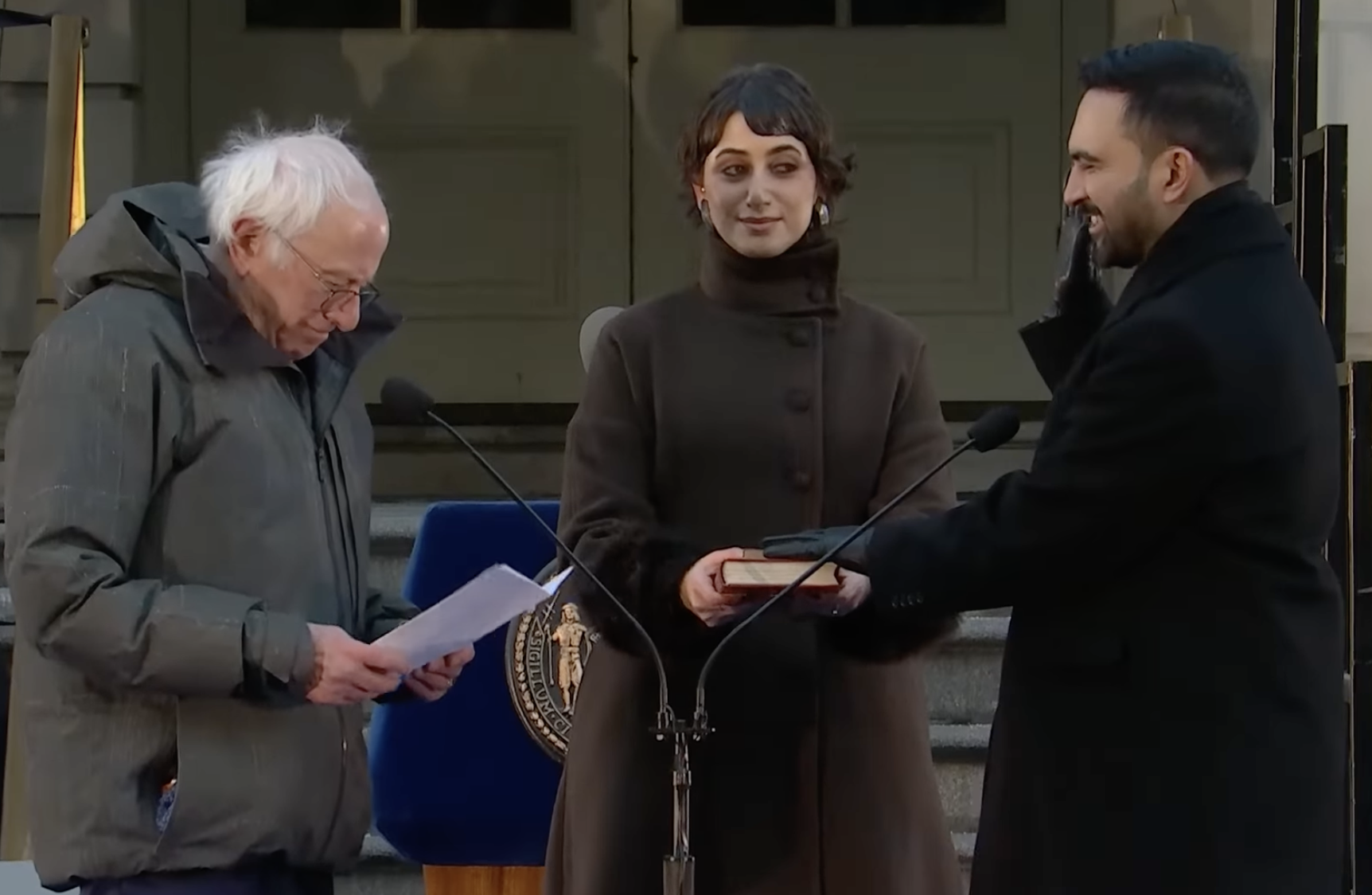
Zohran Mamdani is sworn in as New York City mayor on January 1, 2026, with Bernie Sanders administering the oath. Archive photograph, not the November SRG announcement. Archive photo by NYC Mayor’s Office (CC BY 4.0).
New York City is dismantling the NYPD's Strategic Response Group and separating the policing of demonstrations from counterterrorism, a significant change in how the nation's largest city plans to manage public protest. Mayor Zohran Mamdani and Police Commissioner Jessica Tisch announced the decision on Monday, November 16, presenting it as both a civil-rights reform and an operational reorganisation.
The plan does not eliminate the NYPD's counterterrorism responsibilities. Those functions, including heavy-weapons deployments at critical infrastructure, move into the Intelligence and Counterterrorism Bureau. Protest response will instead involve civilian dialogue staff, a specialist police communication team and a new patrol-support unit, according to City Hall's announcement.
The distinction is the organising idea behind the change. A peaceful demonstration and a terrorism threat require different starting assumptions, equipment and chains of responsibility. Separating them is intended to make those differences more than a matter of discretion at the scene.
The announcement fulfils one of Mamdani's campaign promises, but implementation will determine its significance. The city's own history shows that a new policy on paper can be only the beginning of reform. Civil-rights advocates who welcomed the decision also said they would scrutinise the successor patrol unit, while Tisch defended the plan as consistent with the department's ability to confront serious threats.
What replaces the Strategic Response Group
The civilian component is the Community Dialogue and De-escalation Division, housed within the Mayor's Office of Community Safety. It will have neither weapons nor arrest powers. NBC New York reports that the civilian restructuring begins in the new year, with the police dialogue team leading those efforts while the civilian division is established. Its purpose is to help the city prepare for demonstrations and communicate with the people involved, working alongside the NYPD rather than becoming a civilian substitute for every police responsibility.
Within the department, the First Amendment Support Team will consist of 30 uniformed officers trained in communication and de-escalation. The new Patrol Support Division will contain vetted officers with specialised crowd-management training and will spend most of its time supporting ordinary patrol work. The city says the reorganisation will not increase or reduce NYPD headcount and will be implemented without additional cost.
The job descriptions matter as much as the new names. A team whose principal task is dialogue should be judged on whether it establishes reliable communication before tensions rise, explains police decisions clearly and helps prevent avoidable confrontation. A patrol unit should be judged on the conduct of its officers and the circumstances of deployment. Neither assessment can be made merely by looking at an organisation chart.
In an interview with WABC, Mamdani and Tisch described the agreement after months of discussions. The joint presentation gives the plan a different character from an order delivered over the public objections of the police commissioner. It places the mayor and the department's leadership behind the same operational undertaking, even if they approach it from different political and professional perspectives.
Tisch's position is consequential because the promise has two parts: protecting constitutional activity and maintaining the capacity to respond to actual danger. A successful change has to do both. The civilian division cannot make an arrest, and its creation does not remove the police obligation to respond when a specific crime or immediate threat requires intervention.
The unresolved test is how the divisions cooperate when a demonstration changes rapidly. People on the ground need a clear understanding of who is communicating, who is making command decisions and which officers are authorised to act. Confusion at those points can undermine even a carefully drafted policy. Training, supervision and clear responsibility will therefore be central to the transition.
The decision builds on years of litigation over protest policing
The SRG controversy did not begin with this administration. The policing of the 2020 racial-justice demonstrations generated lawsuits, investigations and demands for restrictions on how officers could respond to crowds. Those disputes concerned wrongful arrests and excessive force, but also the broader strategy of deploying heavily equipped officers to events involving constitutional expression.
In September 2023, the New York attorney general, the Legal Aid Society, the NYCLU and private plaintiffs announced an agreement to reform the NYPD's protest response. Its central mechanism was a four-tier system requiring efforts at de-escalation before an increased response. It also addressed kettling, treatment of journalists and oversight of the department's conduct.
The tiers were intended to tie intervention more closely to conditions and individual conduct. The default was not supposed to be an overwhelming deployment. Escalation could occur when circumstances justified it, including threats to critical infrastructure or specific unlawful activity. That distinction sought to preserve public safety without treating every person at a demonstration as responsible for the actions of a few.
The earlier administration's explanation of the 2023 settlement described community-affairs officers as liaisons and retained the possibility of deploying specialised units, including the SRG, when necessary. Monday's decision goes further organisationally: the specialised group itself is being disbanded, and its two broad functions are being placed on separate tracks.
The history also cautions against announcing success too early. In May 2024, AP reported that civil-rights lawyers were questioning the city's commitment to the settlement after the policing of a pro-Palestinian demonstration in Brooklyn. The account illustrated how quickly a promise of de-escalation could be tested by an event and by disagreements about what officers had done.
For a city that hosts demonstrations across a wide spectrum of causes, consistency is an essential part of the standard. The legitimacy of a protest-policing policy cannot depend on whether an administration agrees with a crowd's message. Its value lies in rules that apply to allies and opponents alike and can be examined after a disputed incident.
Restrictions on tactics need transparent enforcement
The new approach includes formal restrictions on kettling, tear gas and long guns during First Amendment activity. Pepper spray is not to be used as a general crowd-management device. The announcement also limits long-range acoustic devices to 90 decibels and restricts the use of bicycles as weapons. These measures address the physical experience of a demonstration, not simply the paperwork attached to it.
Kettling is especially significant because enclosing a crowd can leave people unable to comply with an instruction to leave. The 2023 agreement distinguished targeted action against individuals for whom police have probable cause from enclosing people generally for enforcement. That distinction can be lost in a compressed confrontation, which is precisely why operational planning has to address exits, announcements and the positioning of officers in advance.
A sound restriction is also easier to enforce when it is specific enough to be reviewed. A general instruction to avoid unnecessary force invites argument about what was necessary. A documented rule about a particular tactic, the authority required for deployment and the information available to a commander gives investigators something more concrete to assess.
The NYCLU welcomed Monday's decision while warning that the work was unfinished. Executive Director Donna Lieberman called for passage of the CURB Act, which would put protest-policing reforms and oversight into law. The organisation also expressed concern about the new patrol unit's protest role and said it would monitor compliance with the settlement.
That response is more nuanced than unconditional approval. Executive action can change current policy, while legislation can affect how easily a later administration reverses it. The mayor's endorsement of a bill is not the same as its enactment. The NYCLU's call for a hearing and vote shows that the legal and political process remains open.
Oversight should focus on conduct rather than vocabulary. If a successor unit inherits the same habits, incentives and patterns of deployment, changing the name will have accomplished little. If different training and command rules produce fewer avoidable confrontations while preserving the ability to respond to violence, the separation will have a measurable purpose.
The measure of reform will be what happens at the next demonstration
New York's challenge is unusually demanding because its streets serve many purposes at once. Demonstrations coexist with residents trying to reach home, businesses receiving deliveries, emergency vehicles needing access and workers moving through transit hubs. Recognising the right to protest does not make those other interests disappear. It requires a response proportionate to the actual problem.
A dialogue team can help identify a workable route or communicate a genuine emergency-access concern before a confrontation develops. It cannot guarantee agreement with every organiser or participant. The relevant question is whether communication gives people a fair opportunity to understand and respond, rather than becoming a formality before decisions already made.
The same care is needed when assessing arrests. A low arrest count alone does not prove that rights were protected, just as a high count alone cannot explain the circumstances. After-action reviews should establish the reasons for interventions, the clarity of warnings, the availability of exits, the use of force and the treatment of journalists and bystanders.
Public reporting would make those comparisons more meaningful. Injuries, complaints, substantiated misconduct and the outcomes of cases can help show whether the new structure is changing behaviour. Numbers need context, including the size and nature of events, but a reform whose results cannot be examined will struggle to sustain trust.
Monday's decision is therefore a substantial institutional change with a clear governing principle: protest response should begin from the protection of constitutional activity, while counterterrorism should retain its distinct mission. Mamdani and Tisch have committed the city to that separation. Its credibility will depend on the training, supervision and public accountability that follow—and on whether New Yorkers experience a different response when they next gather to be heard.