Published November 6, 2026 · Taken Social Editorial
A school bus carrying 35 students was struck from behind Friday morning in Fond du Lac County, Wisconsin, after a teenage driver failed to stop, according to the sheriff's office. No injuries were reported, although several students were evaluated by emergency medical personnel at the scene.
The crash occurred around 7:35 a.m. on Lakeshore Drive near Subway Road in the town of Friendship. Deputies said the bus was stopped in the southbound lane with its red warning lights activated and stop arm extended when a southbound passenger car hit it.
The seventeen-year-old driver was cited for failing to stop for a stopped school bus and following too closely. The account identifies the citations issued; it does not establish a court disposition. The driver, a juvenile passenger and the students aboard the bus were reported uninjured.
The incident has renewed attention to a routine but critical part of school transportation: the space and time other motorists must give a bus when children are being collected or dropped off. The absence of reported injuries is welcome, but the collision still illustrates why the stopping requirement extends beyond simply avoiding an illegal pass.
What responders found in Friendship
A statement attributed to Lieutenant Nick Kahnke, published by Washington County Insider, describes deputies responding alongside North Fond du Lac fire and ambulance personnel and the Van Dyne Fire Department.
The initial emergency call reported a collision involving an occupied school bus without establishing the extent of injuries. Responders then assessed the people at the scene. The later statement reported that several students were evaluated and released.
WBAY's report says Johnson Bus Services sent another bus and transported the students to Bessie Allen Middle School, where they were reunited with parents and faculty. Lakeshore Drive reopened after approximately an hour.
That sequence matters to families following an early alert. An initial report that injuries are unknown is different from a later assessment reporting none. The updated account provides the more useful picture of what responders found and how the students completed the immediate reunification process.
The reviewed statements do not identify a mechanical failure or provide a reconstruction establishing the passenger car's speed. They also do not establish why the driver failed to stop. Those details should not be supplied through assumptions about a person's age or the time of day.
Wisconsin requires a full stop at flashing red lights
The Wisconsin Department of Transportation's explanation of school-bus law says an approaching vehicle must stop at least twenty feet from a stopped bus displaying flashing red warning lights. The driver must remain stopped until the bus moves again or the red warning lights are extinguished.
The department identifies an exception for vehicles traveling in the opposite direction on a divided highway. A multilane road without a separating barrier does not, by itself, create that exception.
That is an important distinction for drivers accustomed to treating additional lanes as permission to continue. The relevant feature is the divided roadway and the direction of travel, rather than simply the number of painted lanes.
In Friday's incident, the sheriff's account places both vehicles in the southbound lane. The reported collision therefore concerned a car approaching the stopped bus from behind, rather than a vehicle on the far side of a divided highway.
Stopping distance should also be understood as a minimum separation at the stop, not a suggestion to begin braking only when twenty feet away. A driver has to recognize the situation and slow sufficiently early to reach a controlled stop before that boundary.
The lights provide warning before the stop
WisDOT's guidance for motorists distinguishes amber warning lights from flashing red lights. Amber signals that the bus is preparing to stop; red signals require traffic subject to the rule to stop.
The same guidance notes that an unextended stop arm is not permission to pass a bus whose red lights are flashing. Drivers must observe the warning lights themselves rather than rely on one piece of equipment as the sole signal.
This creates a sequence motorists can anticipate. A bus slows, its warning system alerts surrounding traffic and children may be preparing to move near the roadway. The safest response begins during that sequence, before the driver reaches the final stopping point.
A simple distance calculation illustrates the importance of that early response. At thirty miles per hour, a vehicle travels forty-four feet each second. Two seconds of travel therefore covers eighty-eight feet before accounting for the distance needed to brake. This is an illustration, not an estimate of the speed in Friday’s crash or a recommended following interval. It shows why recognizing the warning early matters.
Attention also has to extend beyond the rear of the vehicle. Children may be waiting beside the road or crossing in front of the bus. The bus is large and visible, while a child near it can be much harder to see.
A following driver who watches only the vehicle directly ahead may miss that wider situation. Looking for the stop, the lights and the surrounding area gives more time to respond. The task is to recognize a school-bus stop as a place where the road environment is changing.
A recent enforcement campaign shows the scale of the problem
In a September 21 announcement, Wisconsin State Patrol and the Wisconsin School Bus Association described their annual Operation Safe Stop effort. The campaign directed attention to locations where illegal passing had been reported and included officers following bus routes.
The department said more than 1,300 citations were issued in Wisconsin during 2025 for failing to stop for a school bus. It also described a $767.50 citation cost and four demerit points following an increase in penalties under a 2024 law.
Those statewide figures provide context, but they are not a count of crashes or injuries. A citation records an enforcement event. It cannot be treated as a measure of every violation, and a violation does not necessarily result in a collision.
The distinction helps explain why enforcement and prevention both matter. A system can act on observed or reported violations while still trying to change the behavior that creates the risk. The aim is to prevent the dangerous approach or pass before a collision occurs.
The campaign's timing also makes the issue current beyond this individual crash. Wisconsin agencies were publicly emphasizing these rules during the same school term, rather than responding only after Friday's incident drew attention.
School-bus protection has several layers
The National Highway Traffic Safety Administration describes school buses as among the safest vehicles on the road, with high visibility, specialized seating, mirrors and protective structural standards. It also notes that children face particular risks while approaching or leaving a bus.
For large buses, the agency explains a protection concept called compartmentalization: strong, closely spaced seats with energy-absorbing backs create a protective space for seated passengers. Smaller buses are subject to different belt requirements because their size and weight are closer to passenger vehicles.
That explanation is general design context. It does not establish the make, restraint equipment or crash performance of the particular bus involved Friday. The fact that no injuries were reported is not enough to identify which design feature contributed to that outcome.
The broader point is that pupil transportation uses more than one safety layer. Vehicle design helps protect occupants, warning systems communicate with motorists and road rules protect children outside the bus. A failure at one point can still place demands on the others.
That is why a school bus's strong overall safety record should encourage careful use of the system, rather than complacency around it. Protection inside the vehicle and safe behavior around it serve related but different purposes.
What parents and students can take from the guidance
NHTSA recommends arriving at a stop before the bus, waiting back from the curb and using the handrail when boarding. Children should not walk behind the bus, and they should alert the driver rather than retrieve a dropped item from a place where they may be difficult to see.
The agency's regulatory explanation also distinguishes federal vehicle manufacturing and sales standards from state rules governing use. A school-transportation system operates through both sets of responsibilities, rather than through a single universal rule for every vehicle and route.
Its seating guidance emphasizes that passengers should remain fully within their seats while the bus is moving. The protective arrangement depends on how the seating space is used, not merely on the presence of a yellow vehicle.
For a family involved in an incident, the first need is specific information from responders and the school transportation provider: where students are, what assessments have taken place and how reunification will occur. Friday's update supplied those details through the replacement bus and school meeting point.
The confirmed result in Friendship remains that no injuries were reported after the rear-end collision involving 35 students. The road reopened and the children were taken to reunite with adults at school. The continuing lesson is a practical one for every motorist approaching the next stop: recognize the warning early, leave enough space and stop when the lights require it.
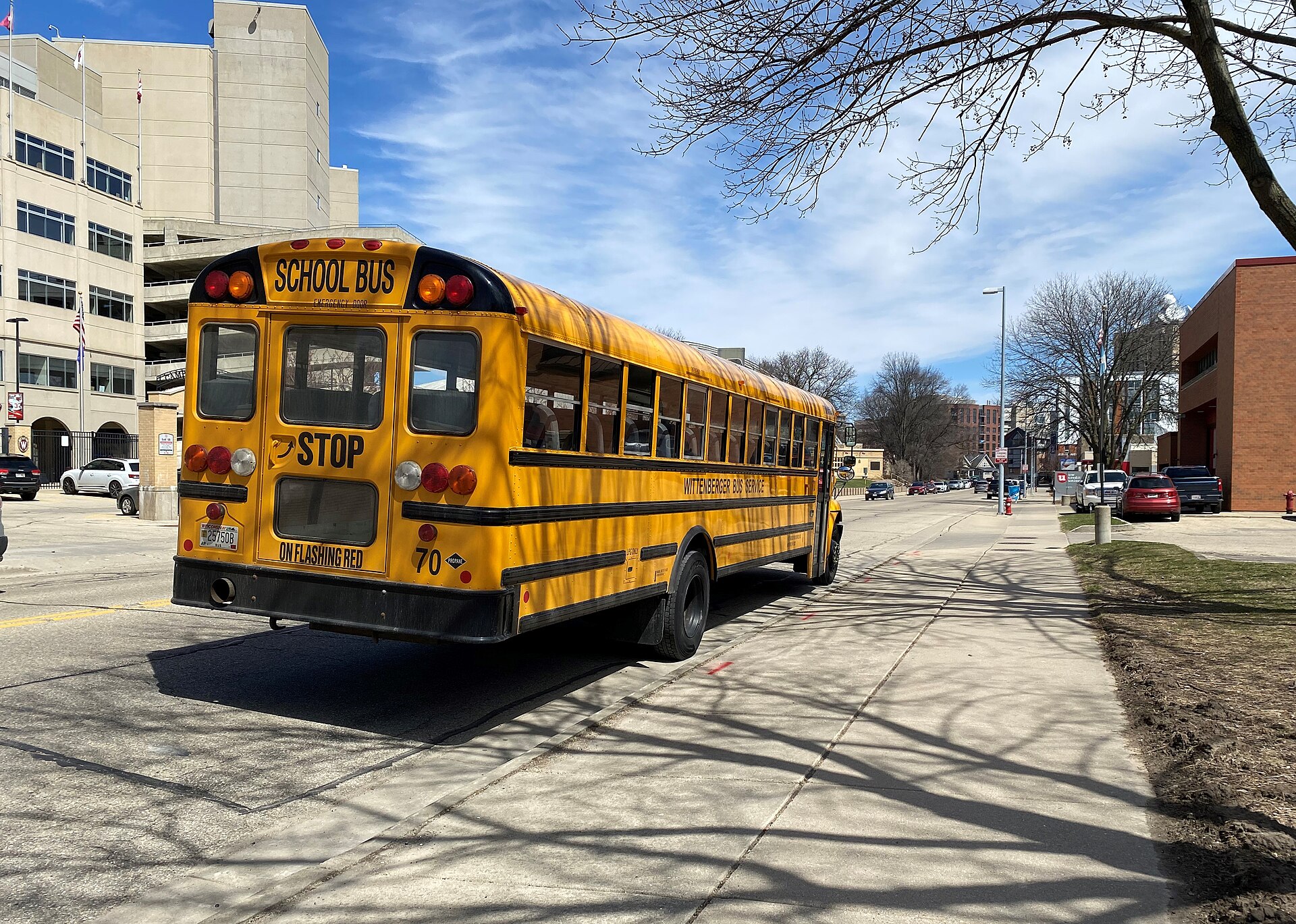
A school bus in Wisconsin, photographed April 11, 2022. Archival photograph by WORT News Dept; CC BY 2.0. This is a different bus and is not a photograph of the November 6, 2026 Friendship crash. Source: Wikimedia Commons. Image license.