Published November 6, 2026 · Taken Social Editorial
Iran's Revolutionary Guard navy said Friday that two oil tankers struck mines and caught fire in and near the Strait of Hormuz, adding a new claim to a week of dangerous uncertainty for merchant shipping. The statement did not provide the independent vessel records needed to establish the full circumstances of those two incidents.
There is, however, a separately documented human toll. The International Maritime Organization reported the death of another seafarer following an attack this week on the tanker Velos Sapphire. Its latest Council statement says at least 130 attacks against commercial vessels in the region have been verified since the conflict began, with twenty-five seafarers killed.
The distinction is essential: the Iranian account is a claim about particular tankers, while the IMO figures concern a wider body of confirmed incidents. The latter cannot automatically be used to validate the former. Together, they show why the waterway remains a serious concern for crews, energy buyers and governments trying to negotiate an end to the crisis.
Hormuz is a short geographical passage with an unusually long economic reach. What happens there can affect the availability of oil and gas, the cost of moving cargo and the confidence required for ships to make the next transit.
What Iran says happened, and what remains unverified
The Revolutionary Guard navy's public relations office said one tanker was east of the strait and the other elsewhere in the waterway, according to Iran International's November 6 report. It alleged that the vessels had used routes Iran considered unauthorized, had disabled identification and navigation systems, and had been supported by the United States.
Those allegations require attribution. The account reviewed for this article does not establish the vessels' identities, their owners' accounts, the condition of their crews or an independently verified cause of damage. Nor does Iran's description of a route determine its legal status under international law.
For a specific shipping incident, several forms of evidence can answer different questions. A master's report can establish what was experienced on board. An owner can describe a vessel's status. A coastal authority may confirm an emergency response. An investigation can address the cause of an explosion or damage. One report does not necessarily settle all four matters.
The UK Maritime Trade Operations warning issued November 3, concerning a separate November 2 incident, illustrates that discipline. It records an Indian government report about an attack on an Indian-crewed dhow leaving the strait and says UKMTO did not know the vessel's status. It does not identify that incident as either of the tankers in Friday's Iranian claim.
Keeping those records separate prevents a common error in fast-moving maritime coverage: attaching a photograph, vessel name or casualty report from one event to another merely because both occurred near the same chokepoint. Confirmation requires matching the ship, location and time, rather than accumulating unrelated reports of danger.
The confirmed cost is being borne by civilian crews
The IMO Council's account of its November 2–6 session places seafarers at the center of the crisis. Secretary-General Arsenio Dominguez reported another fatality after the attack on Velos Sapphire and described thousands of people at risk, including crews aboard ships unable to leave the Persian Gulf.
The Council called for protection regardless of nationality and for vital shipping lanes to remain safe and open. Its statement also describes the broader consequences of conflict for people at sea: serious injuries, difficulty obtaining basic necessities and barriers to returning home.
Those concerns reach beyond the moment of an attack. A vessel that survives an incident still has to maintain safe operations, communicate with authorities and arrange whatever assistance is required. A crew waiting for permission or a safe opportunity to sail faces a different problem from a cargo owner watching a price chart, even though both depend on the same route.
The organization's dedicated seafarer information page brings together regional emergency contacts and guidance for people affected by the situation. It includes material on training and certification, reflecting how prolonged disruption can interfere with ordinary professional requirements as well as immediate safety.
The practical test of a diplomatic breakthrough will therefore extend beyond a political announcement. Crews need conditions in which ships can move safely, ports can receive them and people can obtain assistance or return home. The restoration of a route has to work aboard a vessel, not only in a communiqué.
Why Hormuz matters to oil and gas markets
The International Energy Agency's February 2026 factsheet provides a baseline from before the latest disruption. It estimates that approximately twenty million barrels of crude oil and petroleum products passed through Hormuz each day in 2025, representing about a quarter of global seaborne oil trade.
The passage is only twenty-one nautical miles wide at its narrowest point. Its navigable channels are much narrower: two miles for each direction of travel, separated by a buffer. That concentration helps explain why a local security threat can become a global supply concern.
The IEA also identifies the limits of diversion. Saudi Arabia and the United Arab Emirates have pipelines that can bypass the strait, but the available alternative capacity described in that pre-conflict factsheet was substantially smaller than normal Hormuz flows. Other Gulf exporters depend heavily on the passage. Gas is part of the exposure as well, because large volumes of Qatari and Emirati liquefied natural gas normally transit it.
Later data show how sharply the route's use changed. In its August 2026 energy security tables, the U.S. Energy Information Administration estimated Hormuz flows of crude oil and petroleum liquids at 4.9 million barrels per day in the second quarter, compared with 21.6 million in the fourth quarter of 2025.
That is a decline of roughly seventy-seven percent between those two quarterly estimates. The calculation describes the periods in that table, not the number of barrels moving through the strait on November 6. It is evidence of the scale of the earlier disruption, rather than a live traffic counter.
The EIA also explains a measurement difficulty relevant to the latest claims: some cargo movements can be obscured in tracking data. Its analysis supplements vessel-tracking information with origin, destination and other route evidence. That is another reason to distinguish an estimate constructed from several inputs from a single ship position appearing on a public map.
For the market, a threatened cargo matters through both volume and timing. A shipment arriving late can create a short-term requirement for replacement supply even if the original oil is eventually delivered. When uncertainty affects many voyages at once, buyers have to consider the reliability of the entire delivery schedule.
Diplomacy is continuing alongside that uncertainty. The Associated Press reported Friday, citing two Middle Eastern government officials, that Iran was reviewing Qatari proposals addressing differences with Washington over its nuclear program. The report describes an effort to move toward indirect talks, rather than an agreement already reached. That is a potentially important opening, but its immediate significance is the existence of a negotiating process, not a confirmed restoration of shipping.
A recovery also has a sequence of its own. Political agreement can create the conditions for safer movement; shipping decisions then depend on whether those conditions are credible and sustained. Owners need to know that a voyage can be completed, while buyers need to know that a delivery schedule can be trusted. A reduction in one kind of threat would be welcome, but dependable passage requires the overall operating environment to improve. That is why actual vessel movements and verified safety reports remain useful alongside diplomatic statements.
Identification systems and passage rights need careful treatment
Iran's allegation that the tankers disabled systems should not be treated as a complete explanation of what happened. The IMO describes automatic identification systems as equipment that shares ship information with other vessels and coastal authorities. Their role includes navigational awareness, but an AIS signal is not the entirety of a ship's navigation capability.
The organization's operational guidelines recognize circumstances in which a master may switch AIS off because continued operation would compromise safety or security. That general provision does not establish why any particular vessel stopped transmitting, or whether the Iranian claim about these ships is accurate.
Similarly, a government's description of an unauthorized route is not a substitute for examining passage rights. Part III of the United Nations Convention on the Law of the Sea sets out the regime of transit passage through straits used for international navigation, including obligations applying to ships and states bordering them.
The legal framework and the operational danger are connected but distinct. A right of passage does not physically remove an explosive hazard. A warning about danger does not, by itself, settle every state's claim to regulate a route. Both dimensions have to be addressed if commercial shipping is to recover dependable access.
That is the central issue behind Friday's tanker headlines. The immediate Iranian claims still require independent detail, while the verified casualty record already establishes the seriousness of the threat. A durable improvement will be measured in safer voyages, documented incidents declining and crews able to work without becoming participants in a conflict they did not choose.
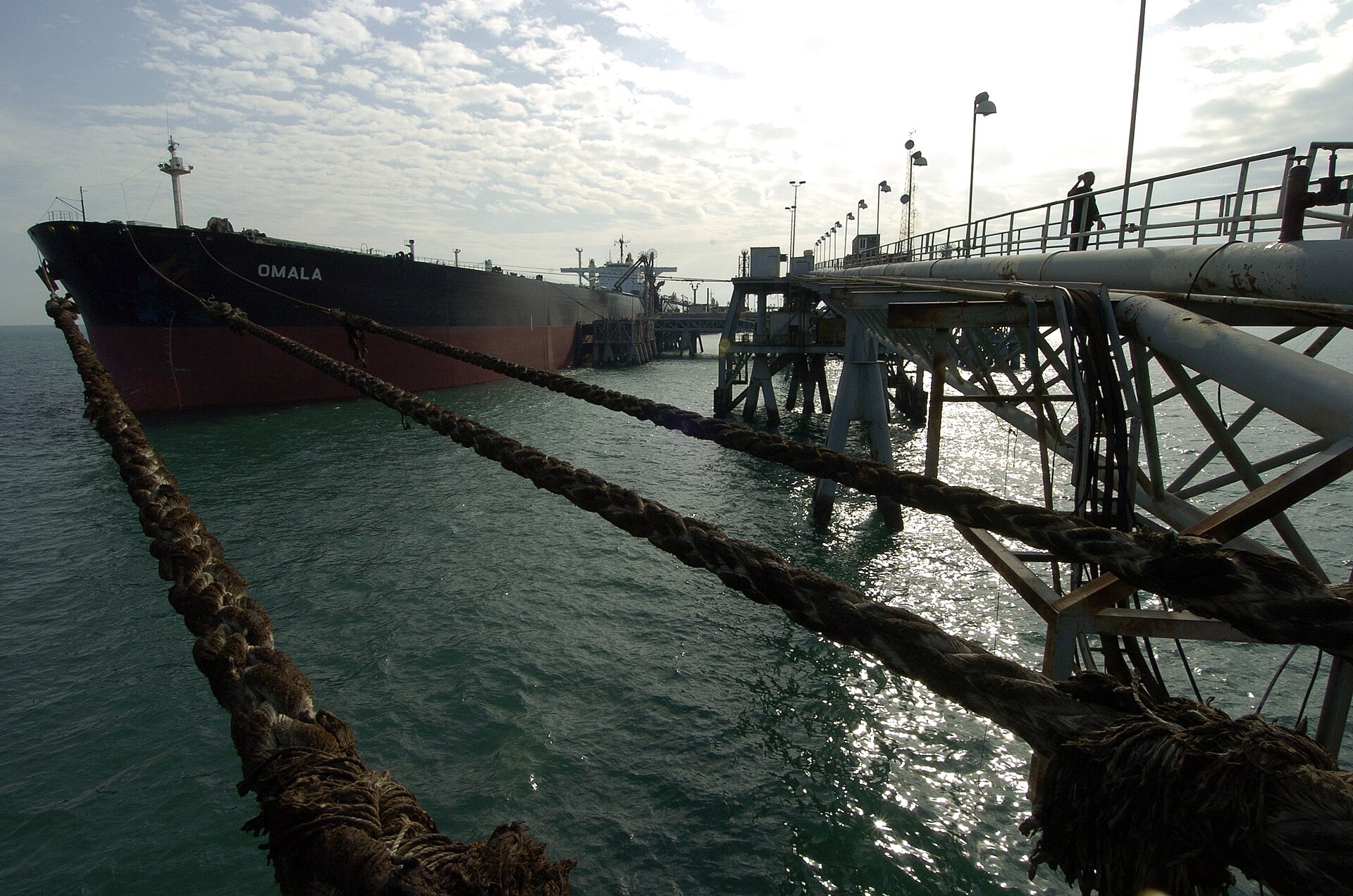
The oil tanker Omala at Iraq’s Al Basrah Oil Terminal in the Persian Gulf on December 7, 2004. Archival U.S. Navy photograph by Photographer’s Mate 1st Class Richard J. Brunson; public domain. This is not a vessel or incident identified in the November 2026 mine claims. Source: Wikimedia Commons.