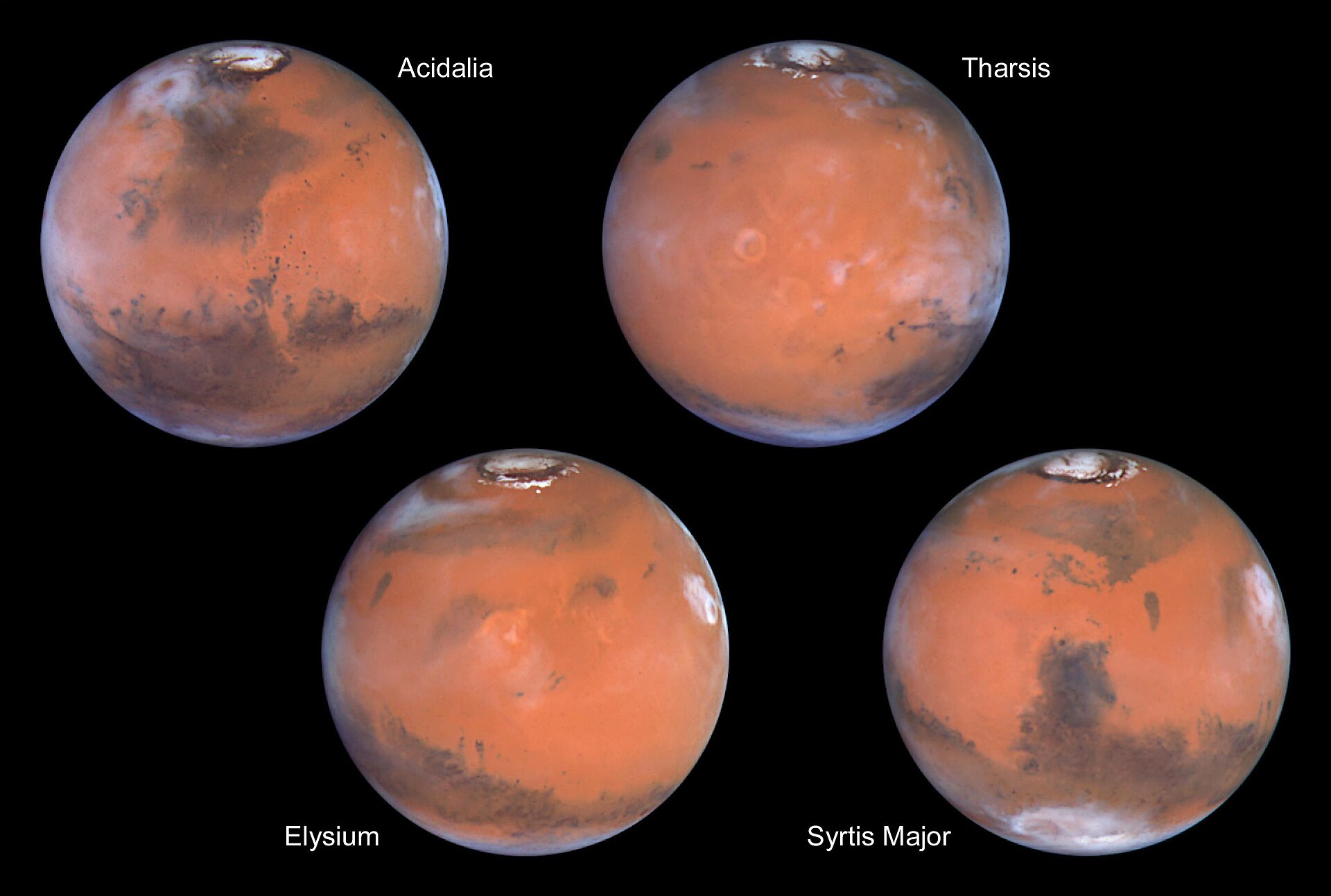
Four color-composite Hubble Space Telescope views of Mars from observations in April and May 1999. Archive photo by Steve Lee, Jim Bell, Mike Wolff and NASA (Public domain).
NASA has moved a new Mars mission from an unusual holding pattern into an interplanetary journey. The agency’s two ESCAPADE spacecraft completed powered flybys of Earth on November 7 and November 9, using our planet’s gravity together with engine burns to set their course for the Red Planet. Their next destination is Mars orbit in September 2027.
The maneuver is a milestone in navigation, but the mission’s larger purpose is scientific. ESCAPADE will investigate how the solar wind interacts with Mars and helps remove material from its atmosphere. Instead of relying on a single spacecraft to sample a changing environment, the mission will place two coordinated observers around the planet. That pairing is designed to answer a deceptively difficult question: when an instrument detects a change, did the environment change over time, or did the spacecraft simply move somewhere different?
According to NASA’s November 9 mission update, the first spacecraft made its closest Earth approach around 5 a.m. Eastern Time on November 7 and the second around 6 a.m. on November 9. Both performed approximately nine-minute engine burns. The successful departures are an important step, although arrival, orbit insertion and the start of the main science campaign remain ahead.
A different route to the Red Planet
Most accounts of Mars travel begin with a launch window, the period when Earth and Mars line up favorably for a direct transfer. Those opportunities recur roughly every 26 months. ESCAPADE tested a different approach. The spacecraft launched in November 2025 and spent time on a carefully designed path near Earth before returning for the flybys that sent them outward this month.
The mission used an orbit associated with the Earth-Sun L2 region, on the side of Earth away from the Sun. The route allowed the spacecraft to wait for a more useful planetary geometry rather than make an immediate direct departure. NASA describes this as the first time it has used a powered Earth flyby to propel a spacecraft toward Mars. The achievement is the successful execution of a planned route, not a claim that the usual physical constraints of interplanetary travel have disappeared.
A gravity assist changes a spacecraft’s trajectory through an encounter with a moving planet. Adding an engine burn at the appropriate point makes the maneuver powered. The useful image is a precisely timed exchange involving position, velocity and gravity, rather than a spacecraft merely falling toward a destination. An error can affect the later approach, which is why navigation teams continue measuring the trajectory and planning corrections after departure.
The broader attraction is launch flexibility. If missions can depart Earth on a wider range of dates and arrange their eventual Mars transfer later, launch planning gains options. That does not make every launch date equally convenient or every alternative route cheaper. Additional time in space, spacecraft operations and navigation requirements all enter the calculation. ESCAPADE provides an actual flight demonstration against which future mission designers can evaluate those tradeoffs.
The immediate schedule still includes a cruise lasting about ten months. NASA’s published plan calls for Mars orbit insertion burns on September 7 and September 9, 2027. A successful Earth flyby does not guarantee those burns or the subsequent formation changes will succeed. It does establish that the mission has passed a demanding navigation milestone and is now traveling toward the planet it was built to investigate.

Why Mars is losing atmosphere
The ESCAPADE mission overview places the project at the intersection of planetary science and heliophysics, the study of the Sun and its influence through space. Mars has a thin atmosphere and a magnetic environment unlike Earth’s. The mission will study how incoming solar material interacts with that environment, how energy travels through it and how particles can escape.
The solar wind is a continuous outflow of charged particles from the Sun. Its conditions vary. When that moving plasma encounters a planet, the response depends on the planet’s magnetic fields and atmosphere. Earth’s global magnetic field shapes the interaction in one way; Mars, which retains magnetized regions in its crust but lacks an Earth-like global field, presents a different natural experiment.
Mars is often discussed through the question of ancient water. Orbital observations, landers and rovers have supplied extensive evidence that water shaped its surface. Atmospheric research addresses a related part of that history: what happened to the surrounding environment over long periods, and which processes helped transform the planet? Measuring present-day escape does not provide a video of ancient Mars. It gives researchers physical processes and rates to test within models of its evolution.
It is tempting to reduce that history to one cause. The scientific task is more demanding. An observation made during one solar event must be compared with other conditions, and a present-day measurement must be interpreted in the context of a different ancient Sun and a different planet. The value of a mission is therefore partly in constraining explanations: narrowing what models can plausibly assume and identifying where important uncertainties remain.
ESCAPADE is not a life-detection mission, and the flybys have not produced evidence that life exists on Mars. Its subject is the planet’s space environment. That work can inform the wider question of habitability without claiming to answer it alone. A planet’s ability to retain an atmosphere affects its surface conditions, but atmospheric measurements and the discovery of organisms are separate scientific achievements requiring different evidence.
What two spacecraft can reveal that one cannot
A spacecraft in orbit is always moving through a system that is also changing. Imagine a probe measuring stronger particle activity after it crosses from one region to another. With only that record, researchers must determine how much of the difference reflects its location and how much reflects a change occurring throughout the environment. This is a measurement problem, rather than a shortage of dramatic photographs.
ESCAPADE’s first planned science formation places the two spacecraft along the same orbital path at different positions. Passing through similar regions at different times should help separate spatial structure from temporal change. The mission’s later formation places the observers in different orbits so one can sample the incoming solar wind while the other measures the response closer to Mars. The observations become a coordinated comparison rather than two unrelated snapshots.
The spacecraft carry instruments to measure particles, magnetic fields and plasma conditions. The published mission design identifies an electrostatic analyzer, a magnetometer and a Langmuir probe among the scientific instruments. Those measurements complement one another: particles reveal what is moving, magnetic readings help describe the environment guiding that motion, and plasma measurements help characterize the surrounding charged material.
The logic resembles a well-designed terrestrial experiment, although there is no laboratory switch that lets scientists turn the Sun on and off. Observing the incoming conditions and the response together strengthens the ability to associate the two. Repeated observations across changing circumstances are still necessary. A correlation during one encounter is a starting point for analysis, not sufficient proof of every proposed mechanism.
NASA expects science operations to begin in June 2028 after arrival and orbital adjustments. The first formation is scheduled for six months, followed by a five-month campaign in the complementary configuration. These dates describe the current plan. Readers following the mission should distinguish spacecraft arrival from science readiness: entering orbit is a major achievement, but establishing the geometry required for the experiment takes additional work.
The significance goes beyond a successful slingshot
ESCAPADE belongs to NASA’s SIMPLEx program, which supports smaller, innovative planetary missions. The University of California, Berkeley’s Space Sciences Laboratory leads the project with a network of partners. Its design places a focused scientific question at the center: what can coordinated observations establish about the way Mars responds to the Sun? It is not intended to duplicate every capability of a larger planetary observatory.
The approach offers a useful way to assess mission value. Smaller spacecraft can be scientifically powerful when their configuration addresses an ambiguity that a single larger instrument cannot resolve by itself. Conversely, having two spacecraft does not automatically double the quality of every measurement. The benefit depends on synchronization, calibration, location, communications and the ability to compare equivalent observations. The mission’s choreography is part of the instrument in a practical sense.
Future exploration provides another reason to care about the results. Robotic systems and eventual human missions will operate in a space environment affected by solar activity. Understanding that environment supports planning, although ESCAPADE is not a personal radiation forecast service for future astronauts. Its contribution is a better physical description of the system that later missions and models will need to account for.
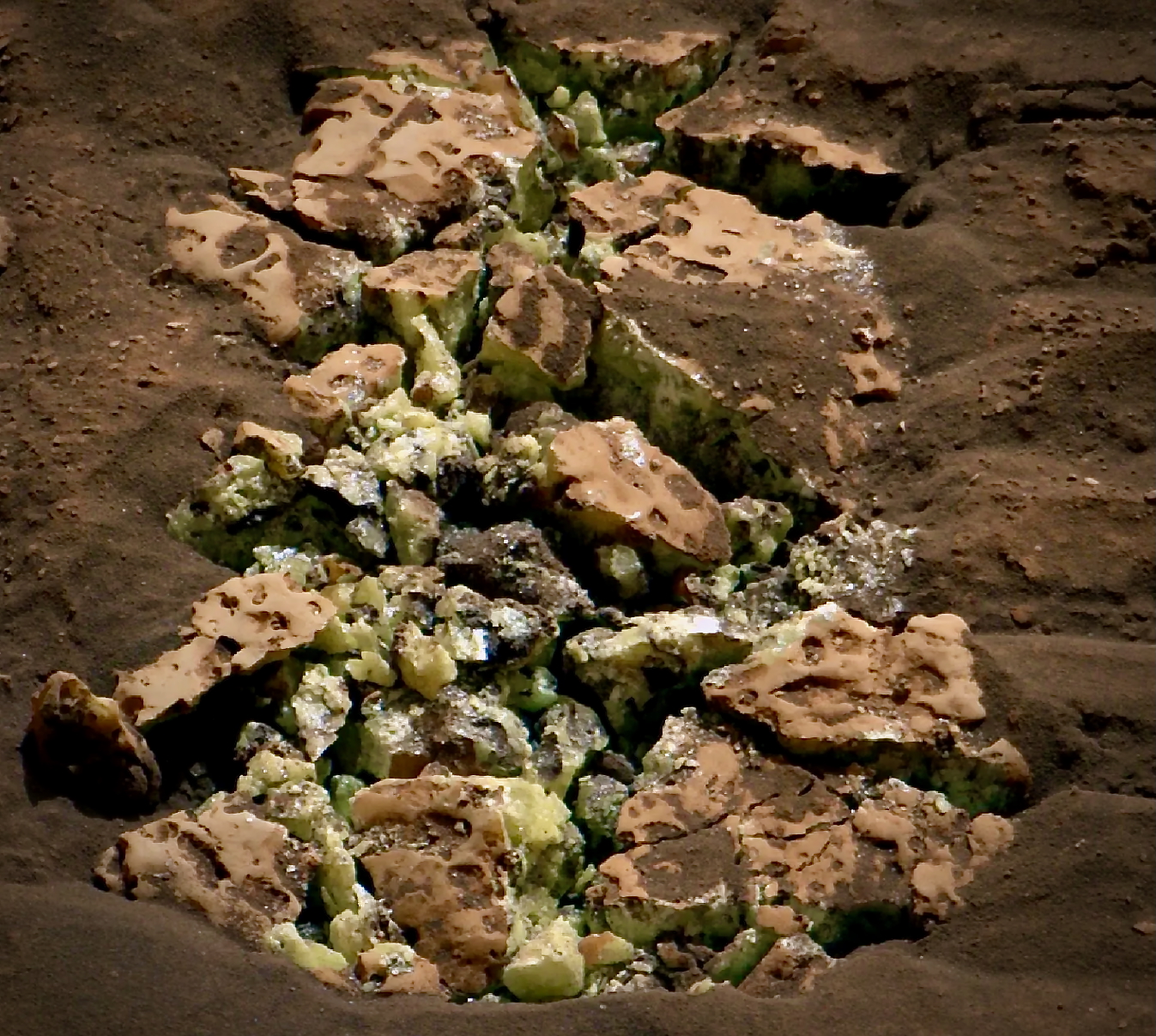
This is also a distinct story from Curiosity’s discovery of pure sulfur in Gediz Vallis. A rover examines rocks and local geological evidence at the surface. ESCAPADE will examine particles and fields around the planet. Both contribute to understanding Mars, but their observations answer different questions. Treating every Mars development as another claim about ancient life obscures the variety of work required to reconstruct a planet’s history.
The next decisive tests will be successful cruise corrections, safe orbit insertions and the coordinated measurements themselves. For now, the conclusion is substantial enough: two spacecraft have completed a new route out of Earth’s neighborhood and are on course to study Mars together. Their promise lies in making the invisible interaction between a planet and the Sun more measurable—and in giving scientists a stronger basis for explaining how a world can change over time.