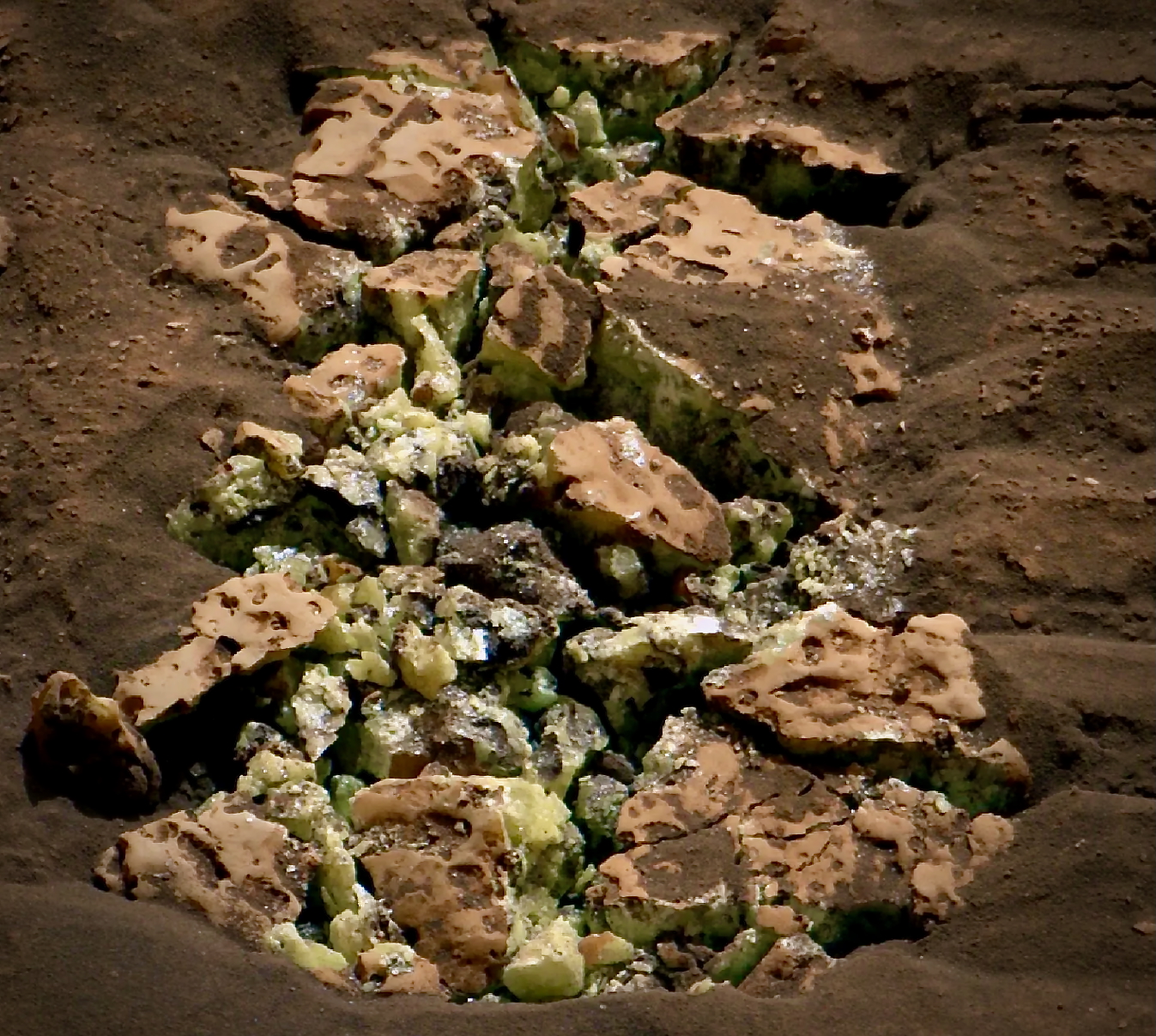
Actual Curiosity rover imagery shows sulfur crystals exposed inside a broken Martian rock in 2024. The discovery was announced that year; new research followed in 2026. Press image courtesy of NASA/JPL-Caltech/MSSS (Public domain).
A brittle rock beneath a rover wheel has become one of the most revealing puzzles in the exploration of Mars. When NASA's Curiosity crossed a pale outcrop in Gediz Vallis on May 30, 2024, the rock broke open and exposed yellow crystals. They were elemental sulfur: the chemical element in its native form, rather than sulfur bound into the sulfate minerals already familiar to Mars scientists.
The discovery is attracting renewed attention, but its date deserves to remain attached to the story. NASA announced it in July 2024. The significant development in 2026 is the scientific work that followed, including an August paper in Science and laboratory experiments published in Geophysical Research Letters. Together, those studies make the deposit more interesting without turning it into evidence that life has been found.
At issue is a deceptively simple question: how did a field of such pure sulfur form in this particular place, and then survive for an immense span of time? The answer could connect deep sources of gas, water near the surface, erosion and the changing chemistry of an ancient planet. It also tests how confidently scientists can read a familiar-looking mineral in an unfamiliar environment.
“It shouldn't be there, so now we have to explain it,” Curiosity project scientist Ashwin Vasavada said in NASA's original announcement. Two years of subsequent research have supplied possible explanations. The remaining differences among them are part of the discovery's value.
What the rover found, and how scientists identified it
Sulfur itself was not new to Mars. Sulfates and sulfides had already recorded different parts of the planet's chemical history. Native sulfur is different because the sulfur atoms are not incorporated into those compounds. That distinction concerns chemical state, not simply colour, and it changes the conditions scientists must reconstruct.
The yellow material was an immediate visual clue, but a photograph cannot establish composition by itself. The rover's Alpha Particle X-Ray Spectrometer, or APXS, provided measurements used to identify the stones. The University of New Brunswick's account of its researchers' contribution describes how Lucy Thompson and Catherine O'Connell-Cooper help select targets, operate the Canadian instrument and interpret the returned data. The finding rests on that analytical work as well as on the striking images.
NASA's instrument descriptions explain the complementary tools Curiosity carries. APXS measures chemical elements at close range. ChemCam uses a laser and spectrometers to examine targets, while cameras document textures and the relationship of a target to the surrounding terrain. These observations answer different questions: what a rock contains, what its surface looks like and where it sits within the geological setting.
The distinction between those questions becomes especially important when dust conceals a rock's interior. A pale outer surface does not necessarily reveal the composition beneath it. Breaking a stone exposed material that had been hidden from view. The accident therefore created a useful opportunity, but the interpretation still required measurements, comparison with other stones and an assessment of the deposit as a whole.
The 2026 paper led by Scott VanBommel and Jeff Berger describes light-toned stones in a winding canyon within Gale crater and concludes that the deposit appears to have formed in place. Its authors propose a source involving buoyant fluids from beneath the surface. That is a geological interpretation built on the observations, rather than something the rover directly photographed happening.
The distinction is crucial. The presence of sulfur can be established with considerable confidence even when the complete sequence that produced it remains debated. Discovery and explanation do not have to arrive at the same moment. Often the strongest finding is the one that leaves the best-defined new question.
Gediz Vallis preserves more than one episode of Martian history
Gediz Vallis cuts into the terrain around Mount Sharp, the layered mountain inside Gale crater. Curiosity's mission overview describes an investigation of whether ancient environments could have supported microbial life. Reading the mountain's layers and later features helps scientists distinguish conditions that existed at different times, rather than treating Mars as a landscape shaped by one event.
A channel can record erosion, transport and deposition, while the rocks within it may also preserve chemical changes that occurred after they were deposited. Rounded stones can point toward transport by water; angular debris can support a different history. Pale halos and altered material can provide clues to later interaction with fluids. In its 2024 account, NASA discussed evidence that both energetic flows and more local landslides helped shape the area.
That complexity is why the sulfur cannot be interpreted in isolation. An explanation must account for where the stones are found, their purity, their fragility and their relationship to neighbouring deposits. A process capable of making sulfur somewhere on Mars is not automatically a successful explanation for this particular field.
NASA's 360-degree panorama of Gediz Vallis offers a useful view of that setting. The mosaic was assembled from 336 images captured on June 19, 2024, and its colour was adjusted to approximate how the scene would appear under Earth-like lighting. The agency's linked video lets viewers examine the rover's arm, the surrounding terrain and the pale stones within the broader landscape. It is a reconstruction from actual rover photographs, rather than a computer-generated visit to Mars.
In its explanation of the 2026 research, Washington University in St. Louis places formation of the sulfur stones roughly three billion years ago. VanBommel argues that their pristine condition supports formation near where they were found: extensive transport would be difficult to reconcile with the survival of such delicate material. The researchers also interpret preservation as evidence against prolonged later exposure to liquid water at the deposit.
That last point adds an intriguing tension. Water can participate in a mineral's formation, yet extended later contact with water may alter or remove evidence of the original process. A deposit can therefore speak about an active period and the long interval that followed. The sulfur may be valuable both for the conditions that created it and for the conditions that allowed it to remain recognisable.
The competing explanations are testable, rather than interchangeable
The Science team's proposed history begins with sulfur-bearing gases associated with magma. In the published abstract, the researchers suggest that magmatic vapour cooled in the near-surface frozen environment, with sulfur later released as erosion changed the pressure. Their model links a deep source to a shallow deposit without requiring the visible stones to have travelled a great distance.
A separate July 21 study in Geophysical Research Letters, led by Cornell University's J. Wang, examines a chemical mechanism. The team tested whether chlorate could oxidise dissolved sulfide and produce native sulfur without biology. Experiments ran for 54 days at about 22 degrees Celsius, under oxygen-free, acidic conditions with a pH of roughly 1.7. Analyses of the resulting solids identified elemental sulfur and sulfate.
Those numbers matter because they describe what was actually demonstrated. The experiment establishes that a particular reaction can make sulfur under the conditions tested. It does not establish that a Martian water body had exactly those conditions, or that this reaction alone produced the entire Gediz Vallis deposit. It expands the set of plausible nonbiological pathways that field interpretations must consider.
Another proposal, presented by W. Rapin and colleagues in a 2026 Lunar and Planetary Science Conference abstract, considers an impact-related sulfur melt. Their scenario starts with sulfur-rich material upstream, heated by a meteorite impact, then flowing down the channel before cooling and crystallising among avalanche deposits. The authors discuss geological features and modelling that could support or test that account.
A conference hypothesis is not equivalent to a settled finding, and the impact scenario should not be merged casually with the fluid-release model as though they were one established sequence. They make different claims about the origin, movement and deposition of sulfur. Comparing them means asking which observations each explains, which assumptions each requires and what additional evidence could distinguish them.
The same discipline applies to the laboratory work. A chemical experiment can show that a mechanism is possible; a field interpretation must show that it is appropriate to the location. The strongest eventual explanation will have to satisfy both chemistry and geography. That demand makes the puzzle harder, but it also makes the competing proposals scientifically useful.
Why the sulfur is significant without being proof of life
On Earth, native sulfur can be associated with several kinds of processes, including volcanic systems and microbial activity. That does not turn every sulfur deposit into a biological signature. Similar materials can arise by different routes, and the geological setting must help distinguish those routes.
The Washington University account explicitly says the researchers do not see evidence that ancient microbes formed these stones. The chlorate experiments provide another reason to resist an automatic biological interpretation: a nonliving chemical system can produce elemental sulfur. A rigorous search for life requires understanding such alternatives, not overlooking them because a biological explanation would make a more dramatic headline.
Habitability is also a separate question from habitation. A setting with water and chemical energy may offer conditions of interest to astrobiologists. Demonstrating that organisms actually occupied it would require additional evidence capable of surviving competing explanations. Curiosity's mineral measurements help reconstruct environments; they do not substitute for a direct demonstration of life.
What makes Gediz Vallis remarkable is the amount of history concentrated in a small, fragile material. Its chemical state points to particular reactions. Its location constrains how it arrived or formed. Its survival limits what could have happened afterward. The deposit can therefore sharpen a reconstruction of Mars even if every step in its formation eventually proves to be nonbiological.
The clearest conclusion from the research available in November 2026 is that the sulfur discovery is real, its initial observation dates to 2024, and its origin remains an active scientific problem. New papers are replacing a moment of surprise with hypotheses that can be tested against measurements. That is a substantial advance: an accidentally broken rock is helping turn the broad story of a once-wetter Mars into a more precise account of its chemistry, its changing surface and the long preservation of its past.