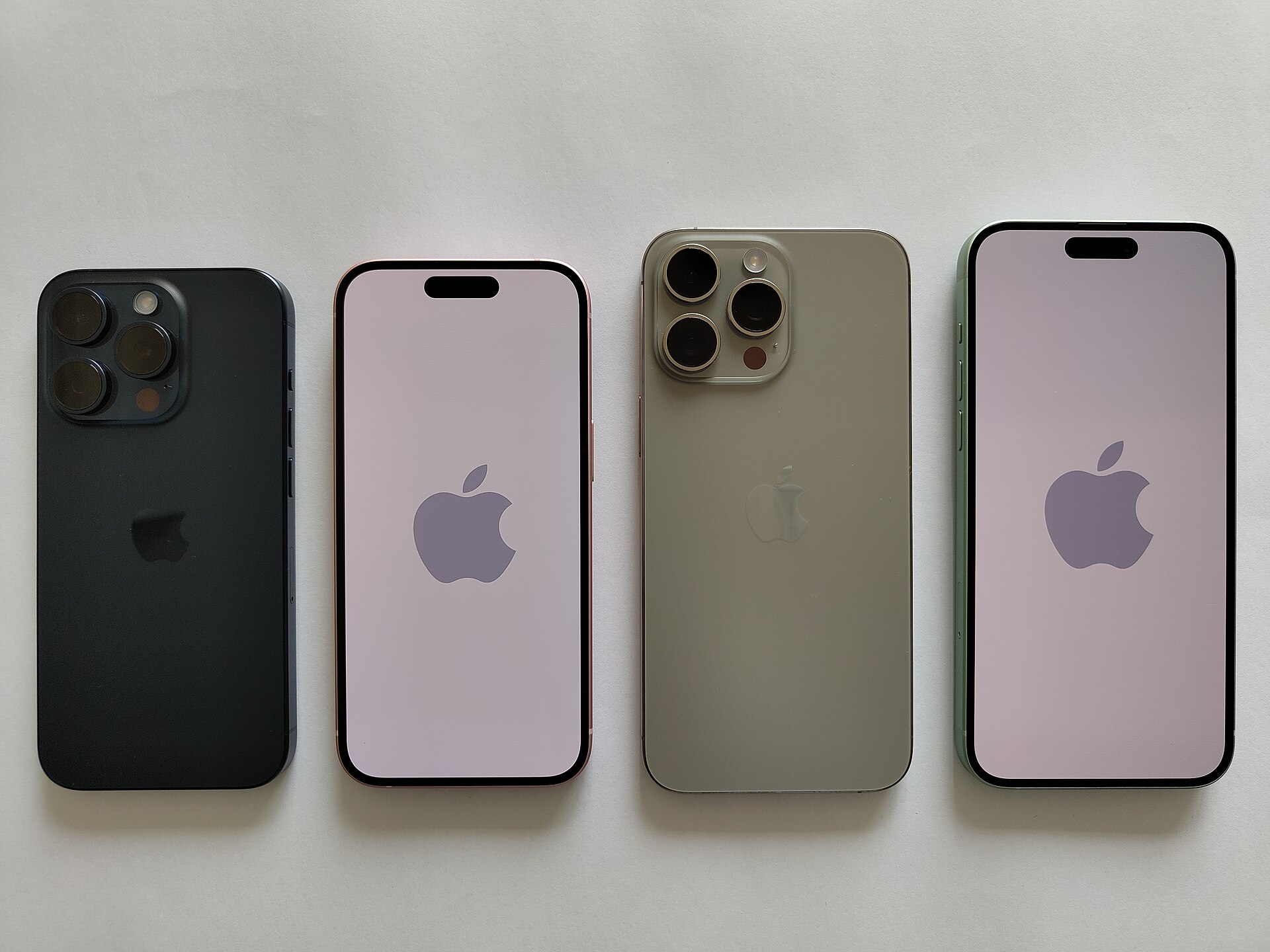
iPhone 15 Pro models in a December 12, 2023 product photograph, used to illustrate iPhone security. Archive photo by IPHONE 15 (CC BY-SA 4.0).
A public iPhone security warning has put a relatively obscure term, “sandbox escape,” in front of people who normally have little reason to think about operating-system boundaries. The concern is specific: a malicious application may be able to read files belonging to other apps, potentially exposing sensitive information that those apps store locally.
Binance raised the alarm in a November 10 statement, naming the vulnerability worse_query and warning about recovery phrases, private keys and login credentials. The exchange described an iOS-level issue affecting more than its own products. Its warning named iOS 26.7.1, 27.0.1 and 27.2.
For readers searching “iPhone hacked,” the essential distinction is between a demonstrated weakness and evidence that a particular person's device has been compromised. The published material supports taking the flaw seriously. It does not establish that every iPhone has been remotely taken over or that reading a news story about it means a phone has been infected.
What the worse_query researcher actually published
The original research repository describes worse_query as a developer proof of concept for a sandbox escape on iOS 26.0 through 26.7.2 and iOS 27.2. It lists several application and shared-container locations that the technique can access. The author explicitly says it is not a jailbreak.
That description is narrower than some of the language circulating around an “iPhone hack.” It concerns access across a boundary that normally separates applications. A complete takeover of a device, an attack delivered through an unsolicited message and an application reading another application's files are different security events, even though all can produce worrying headlines.
The version ranges in the repository and the individual versions named by Binance should also be reported separately. One is the researcher's stated scope for the proof of concept; the other is the exchange's public warning. Combining them into an unverified claim that every possible version has been independently tested would overstate the evidence.
For a general reader, the useful information is the nature of the boundary at risk and the conditions under which malicious software might exploit it. Running a demonstration on a personal device would not be a sensible way to find out whether ordinary use is safe. The research is evidence for developers and platform security teams to evaluate.
Why the app sandbox matters
Apple's platform security documentation explains that third-party apps are sandboxed and receive their own home directories. The design is intended to stop one app from gathering or changing another app's information. Access beyond that space normally goes through operating-system services designed to mediate it.
That separation is a foundation of the smartphone model. A person can install a game without intending to give it the contents of a financial app. An app's presence on the same physical device does not ordinarily entitle it to every file the owner has stored there. A sandbox escape challenges that assumption.
The sensitivity of a particular exposure depends on the data that is reachable and how it has been protected. A cached picture, a temporary document and a credential that permits access to money do not carry the same consequences. Describing the vulnerability accurately requires attention to both the boundary failure and the information on the other side.
It is also important to separate normal sharing from unintended access. Apple's documentation on app groups describes a legitimate mechanism through which a developer's apps and extensions can share a configured container. The existence of authorized sharing does not mean arbitrary applications should be able to browse unrelated containers.
Why cryptocurrency wallets are part of the warning
Binance's advice centers on malicious software from untrusted sources, including manually signed or sideloaded application packages. It urges users to remove such apps and keep iOS and applications current. Where a breach is suspected, the exchange recommends creating a new wallet on a clean device and resetting active login sessions.
The financial concern follows from what a secret can do. A recovery phrase or private key is not merely a label attached to an account; exposure can undermine the owner's control of a wallet. That makes the way a wallet stores and handles secrets a consequential part of the security picture.
Apple provides a separate mechanism for credentials through the Keychain. Its security guide describes encrypted storage for passwords, keys and tokens, with different protection classes and Secure Enclave involvement. A report about access to application files should not automatically be expanded into a claim that every Keychain secret has been extracted.
Nor should the existence of a warning be treated as proof of a particular theft. Establishing an incident requires evidence connecting unauthorized activity to a device, application and mechanism. A market loss, a forgotten password or an alarming post is not enough to establish that chain. Readers dealing with actual account activity should use verified support channels for the affected service.
Has the latest iOS update fixed it?
As of the November 14 check for this report, Apple's security release index lists iOS 27.2.1 as the latest iOS version. It records a November 9 release and also lists iOS 26.7.3 for that date. Those entries establish what Apple has released; they do not, by themselves, establish a fix for worse_query.
In a November 10 clarification, the researcher said the flaw was not patched in iOS 27.2.1 or iOS 27.3 beta 1 and said the repository would be updated when it was patched. That is the researcher's assessment. Taken Social has not independently reproduced the vulnerability or tested those builds.
Apple's iOS 27.2.1 security advisory lists fixes involving components including AirPlay, App Intents, Bluetooth and Messages. It does not identify worse_query by name. The absence of that name alone would not prove the state of every possible implementation, but the advisory offers no basis for telling readers that this particular flaw has been conclusively repaired.
Updating still addresses other documented problems. The useful distinction is between keeping a device current and claiming that one update resolves every newly discussed vulnerability. A responsible security report can recommend current software while being precise about what the available evidence says about a specific issue.
What an ordinary iPhone owner can review
A practical starting point is the software actually installed on the phone. Apple's device and account access checklist recommends reviewing unfamiliar apps, trusted devices, unexpected biometric access and configuration profiles. A profile may have a legitimate employer or school purpose, so its origin and role should be understood before making changes.
The same approach applies to a suspicious application. Record its name and where it came from, then use official support guidance to assess it. An app that arrived through a link in an unsolicited message deserves a different level of scrutiny from software a person knowingly installed from a recognized source.
A broad warning does not justify indiscriminately deleting essential work tools or resetting every device in a household. Protective action should follow the evidence available in the individual case. For routine prevention, reviewing installation choices and keeping software current are more useful than repeatedly searching for signs that cannot reliably diagnose a compromise.
People responsible for several devices can also use the moment to check whether everyone understands the source of installed software. A convincing icon or a familiar brand name is not the same as a verified publisher. Clear installation habits help reduce exposure to many threats beyond the one making headlines this week.
Account compromise has its own warning signs
Apple's account recovery guidance identifies signs including unfamiliar sign-ins, unexpected authentication codes, changed account information and activity the owner did not authorize. Its recovery steps include changing the account password, reviewing trusted devices and confirming control of associated email addresses and phone numbers.
These are useful signals for an account investigation, but they do not identify worse_query as the cause. Someone can lose account access through phishing or credential reuse without any app sandbox failure. Conversely, a device-level issue and an account-level problem may require different responses. A precise description helps a support team investigate the right problem.
It is worth preserving a clear record of unusual activity and using a trusted path to the provider's support site. The goal is to establish what happened and regain control, rather than accept a stranger's explanation simply because it uses the same technical term as a current news story.
A real warning can attract fake solutions
Apple's anti-scam guidance warns about misleading security pop-ups, impersonated support calls and requests for credentials or verification codes. A widely discussed vulnerability can give those tactics a plausible opening: the scammer presents an urgent problem and then offers a supposed fix that requires handing over access.
A claim that a stranger can “check” a wallet by receiving its recovery phrase should therefore be treated with particular suspicion. The existence of worse_query does not make an unsolicited support message trustworthy. Verification should begin with a known provider's official channel, reached independently of the message.
The same principle applies to downloads advertised as emergency protection. Installing an unknown package in response to a story about malicious packages defeats the purpose of the warning. The useful response is deliberate verification of software and accounts, supported by the platform's published guidance.
Conclusion: take the boundary failure seriously and keep the evidence precise
Worse_query matters because the separation between apps protects information people reasonably expect to remain private. The original research and Binance's warning justify careful attention to untrusted applications, sensitive local storage and current software. They also require precision about affected versions and the status of a patch.
The clearest conclusion is that a specific security weakness deserves a specific response. Review unfamiliar software, follow official recovery guidance when there is evidence of compromise and do not confuse a software update with a verified fix for this flaw. That approach protects readers more effectively than treating every iPhone as already hacked.