Published November 5, 2026 · Taken Social Editorial
NASA’s next step toward returning astronauts to the Moon will take place much closer to home. The agency’s current Artemis plan calls for a crewed demonstration in Earth orbit in 2027, using the flight to test the spacecraft interactions that a lunar landing will require in 2028.
The distinction is central to the updated schedule. Artemis III is now an Earth-orbit test mission; Artemis IV is the planned return to the lunar surface. Readers relying on older descriptions that assigned the first landing to Artemis III can easily miss how the program’s sequence has changed.
In a November 4 summary of its acceleration plans, NASA described work on spacecraft, launch processing and spacesuits intended to support that timetable. The agency’s leadership presented the changes as a way to reduce risk and move hardware through preparation more quickly. The dates remain mission targets, dependent on readiness rather than simply the arrival of a calendar year.
A complicated rehearsal in Earth orbit
NASA’s detailed mission description sets out a planned 14-day Artemis III flight involving Orion and test vehicles from Blue Origin and SpaceX. NASA astronauts Randy Bresnik, Frank Rubio and Andre Douglas, along with European Space Agency astronaut Luca Parmitano, are assigned to fly aboard Orion.
The sequence begins with Blue Origin launching a Blue Moon test article. Orion and its crew would follow on the Space Launch System rocket, rendezvous with the waiting vehicle and dock. A SpaceX Starship test vehicle would launch later, allowing Orion to perform a second docking demonstration during the same mission.
The different spacecraft are not interchangeable. NASA plans for astronauts to enter the Blue Moon test vehicle and evaluate its environment and systems. The Starship demonstration is focused on docking and integrated operations, without the Orion crew entering Starship during that test. That difference helps define what each demonstration will—and will not—establish before a lunar expedition.
The value of the rehearsal lies in the interfaces. A spacecraft can perform well on its own while still presenting difficulties when it must communicate, maneuver or dock with another vehicle. Testing those interactions in orbit gives engineers and flight controllers evidence that ground simulations cannot fully reproduce.
Hardware is moving through Kennedy
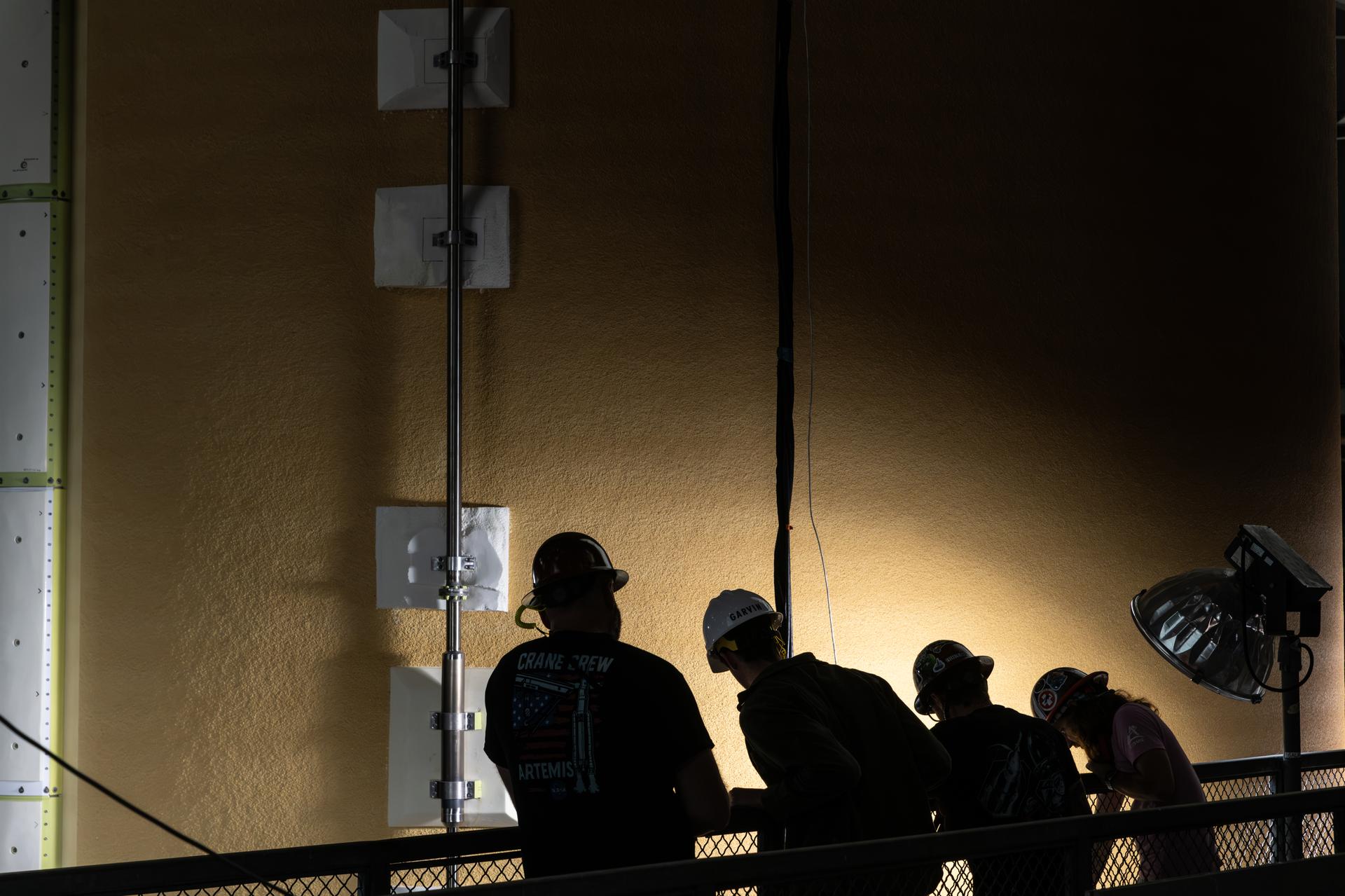
The program’s progress is visible in physical hardware as well as planning documents. NASA’s October 28 assembly update describes integration of the Artemis III SLS core stage with the solid rocket boosters inside Kennedy Space Center’s Vehicle Assembly Building.
The 212-foot core stage is a major component of the launch vehicle. NASA said the next work includes testing and checks before the stage-and-booster stack moves to Launch Pad 39B for a tanking test. That exercise is intended to load liquid hydrogen and liquid oxygen into the core stage and let teams practice countdown procedures.
Assembly, tanking tests and an eventual launch are distinct milestones. Completing one narrows the work remaining, but does not certify the entire mission as ready. For a program involving several launch vehicles and spacecraft, progress has to be assessed across the complete sequence rather than through a single photograph of a rocket component.
NASA’s November summary also says processing timelines have been reduced by about half. The agency reported that it redesigned and tested a critical fuel-line component internally in five months, at roughly one-tenth of an earlier outside estimate. Those are NASA’s assessments of particular improvements, not an independent estimate that the whole Artemis program will cost one-tenth as much.
The landing goal—and the dependencies behind it
According to NASA’s Artemis IV overview, the mission is targeting early 2028. Four astronauts would launch aboard Orion, with two descending to the lunar surface and spending approximately a week near the South Pole before returning to orbit for the journey home.
That plan requires more than a successful SLS launch. The landing system, crew equipment and the operations connecting Earth orbit, lunar transit and surface work all have to be ready. NASA is working with both SpaceX and Blue Origin, and its latest summary describes alternative approaches intended to preserve flexibility as the systems develop.
The agency is also working with Axiom Space on a lighter Sortie suit for early moonwalks. NASA says it would supplement, rather than replace, the larger suit intended for more demanding missions. The distinction reflects a broader design question in exploration: which capabilities must be available for an initial visit, and which belong to later, longer operations?
For people following Artemis, the most meaningful next evidence will be completed tests and demonstrated readiness. A target year communicates intent; a docking demonstration, a successful tanking test or a qualified component provides evidence about execution. NASA’s current roadmap now makes the sequence clear: prove critical interactions around Earth in 2027, then use that experience to support a lunar landing in 2028.
Header photograph: technicians beside the Artemis III Space Launch System core stage in the Vehicle Assembly Building at Kennedy Space Center on October 22, 2026. NASA/Sean Cannon. Real NASA photograph, not an artist’s rendering.