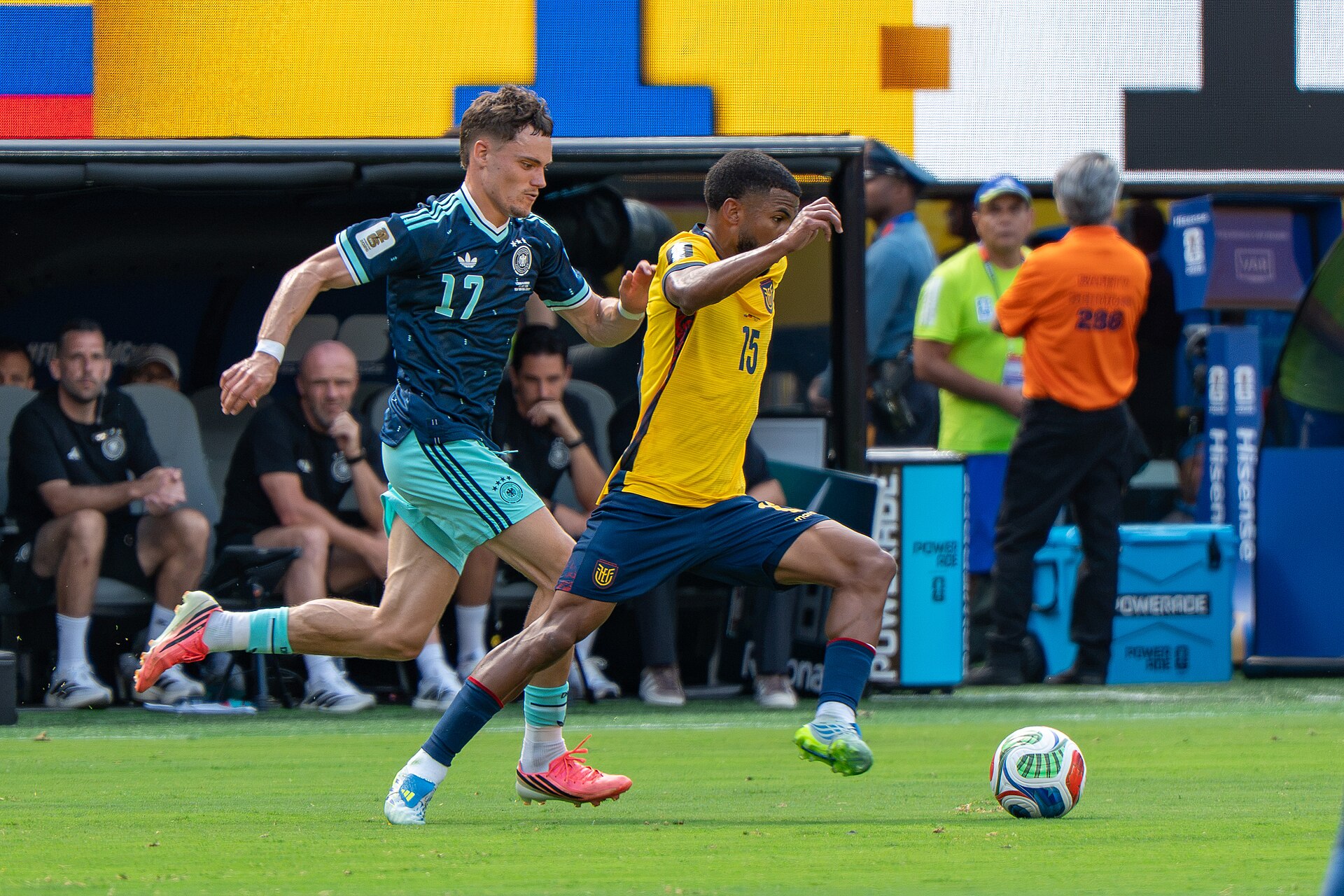
Florian Wirtz, left, competes with Ecuador’s Pedro Vite at the World Cup on June 25, 2026. Archive action photograph; it does not show the November match against the Netherlands. Archive photo by Bryan Berlin (CC BY-SA 4.0).
Germany did more than qualify for the Nations League quarterfinals on November 16. A 5–0 victory over the Netherlands in Berlin turned a tense final group match into an emphatic statement, with Derry Scherhant opening the scoring and Florian Wirtz supplying two goals as the hosts pulled away after halftime.
UEFA confirmed that Germany finished first in Group A2 and the Netherlands second, with both advancing despite a three-way tie on 11 points involving Greece. The Greeks beat Serbia 1–0 on the same evening but missed the quarterfinals on the comparison between the tied teams. The scale of Germany’s win therefore mattered to the final shape of the group, beyond the prestige attached to beating a familiar rival.
For Jürgen Klopp’s side, the performance offered an encouraging end to the international year. The German federation described it as the country’s biggest victory over the Dutch since a 7–0 result in 1959. Yet the halftime score was only 1–0. Understanding how the contest changed is more revealing than treating the final margin as evidence that Germany controlled every minute.
Scherhant gives Berlin its decisive first-half moment
The DFB’s official match record lists Scherhant’s opener in the 41st minute, followed by Wirtz in the 60th, Nico Schlotterbeck in the 65th and Wirtz again in the 71st. Brajan Gruda completed the scoring later in the second half. Four different players scored, and the four goals after the interval transformed a narrow advantage into a result neither side could mistake for an ordinary one-goal contest.
Scherhant’s contribution carried an additional personal significance. A Berlin-born attacker who had developed at Hertha, he scored in the city’s Olympiastadion in what Sportschau reported was his fourth senior international appearance. His route to this moment, through club development and a new opportunity with the national side, gave the opening goal a story beyond the scoreboard.
“It couldn’t have gone better,” Scherhant said in remarks published by the DFB, translated from German. The brief reaction conveyed the emotional weight of scoring the opener at home. The goal also arrived at an important point in the match: close enough to halftime to give Germany a lead to build on, after a period in which the Dutch had made clear chances difficult to create.
The federation’s report describes a first half shaped by caution and limited openings. Germany had possession but initially struggled to find the gaps it wanted, while the Netherlands looked for opportunities to counter. Scherhant had already struck the outside of the post before producing the shot that beat Bart Verbruggen. The opening goal was an individual intervention in a tight game, rather than the inevitable conclusion of continuous easy chances.
That distinction is important when assessing the performance. A team can deserve its victory without having solved the opponent’s defensive structure from the opening whistle. Germany had to persist through a phase in which the contest offered relatively little. Scherhant supplied the breakthrough that made the second half a different problem for both teams.
The Dutch could no longer approach the remaining time as though a level score would be enough. Even before the later goals, the change in score altered the demands on their attacking and defensive decisions. Germany, by contrast, could seek another opening from a position of advantage. A narrow lead does not decide a match, but it changes the choices available within it.
Wirtz turns the advantage into a second-half surge
Wirtz’s first goal, around the hour mark, was the point at which Germany’s advantage became much harder to manage for the visitors. He followed his initial effort, retained the opportunity and finished from outside the penalty area. Schlotterbeck then added a header from a set piece before Wirtz struck again from close range after Gruda’s work. Germany’s goals came through different routes, which made the sequence especially damaging.
The contrast between Wirtz’s two finishes captures his influence. One required finding a shot from distance; the other required arriving to complete a move closer to goal. The two actions asked different things of the defense. An opponent trying to prevent him from turning and shooting still had to account for his movement into a more crowded scoring area.
Gruda’s role also deserves attention alongside the headline scorer. UEFA’s account credits his contribution to Wirtz’s second goal and describes his own finish from a rebound. He helped create one goal and was available to finish another. That combination widened Germany’s attacking threat beyond the player who scored twice, making it more difficult for the Dutch to solve the problem through attention to one individual.
The postmatch reactions suggest that the improvement was not only about finishing. Klopp said Germany had needed to adapt during the first half, while Joshua Kimmich emphasized the team’s more assertive pressing and greater courage after the break. Wirtz pointed to the additional space available in the second half. These are the participants’ explanations, and they fit the change from a close contest to a much more open one.
There is a useful tactical connection between those accounts. Winning possession higher up the pitch can shorten the distance an attack needs to travel and reduce the time defenders have to reorganize. More space can also give a creative player an extra moment to turn, combine or shoot. That is an interpretation of why the reported changes mattered, rather than a claim that every goal followed an identical pattern.
Germany also continued looking for goals after establishing a comfortable lead. The score advanced from 2–0 to 4–0 within 11 minutes, before Gruda added the fifth. That sustained attack gave the result its exceptional scale. It was not simply a late flurry after the competitive question had been settled by a single isolated incident.
Why the three-way tiebreaker matters
The final group table requires more explanation than a glance at points alone. Germany, the Netherlands and Greece all finished with 11. UEFA’s account states that the records in the comparison among those three teams put Germany first and the Netherlands second. Greece’s victory over Serbia was therefore insufficient to take the Greeks into the quarterfinals.
A result can have two effects in such a situation: it supplies points for the overall table and changes the comparative record against a direct rival. Germany’s five-goal margin was striking on its own, but its relevance to the group was not merely cosmetic. The match completed a set of results that had to be evaluated under the competition’s tiebreaking procedure.
That is also why the Netherlands could lose heavily and still advance. Qualification reflected the group campaign and the applicable comparison, not a judgment that a team must be eliminated after a particularly poor final performance. The result leaves Dutch supporters with a difficult evening to assess, but it does not remove their team from the next round.
For Germany, finishing first adds a concrete achievement to the emotional satisfaction of the win. The federation says the team will face a group runner-up in the quarterfinal stage in March 2027. No particular opponent should be attached to this result before the relevant draw determines the pairing. Reaching that stage creates an opportunity; it does not establish how the knockout tie will unfold.
The German response to the pressure of the final evening is nevertheless significant. With qualification and the order of the group at stake, the side converted a relatively cautious start into a decisive attacking performance. That is a more meaningful basis for encouragement than a large win in a match with nothing left to determine.
An emphatic night, with a clear test still ahead
The new faces in Germany’s team were part of the story as well as the result. The federation’s prematch team announcement placed Scherhant, Gruda, Philipp Treu and Nathaniel Brown alongside established internationals such as Kimmich, Wirtz and Kai Havertz. Scherhant and Gruda subsequently scored, while the match record shows Finn Jeltsch entering in the second half for his senior international debut.
That mixture gives Klopp evidence about how less established players can contribute in a demanding fixture. It is one thing to introduce a player with a game already settled and another to start him when a place in the next round is at stake. Scherhant’s opener and Gruda’s involvement gave Germany tangible returns from that selection, rather than only experience accumulated for some later date.
For the Netherlands, the review has to address the collapse after the second goal without erasing the more competitive first half. The visitors had remained within one score until the hour mark. They then conceded three more times, turning an adverse position into a much heavier defeat. A useful review would distinguish the difficulty of conceding an exceptional strike from the collective response required after going further behind.
Germany’s next challenge is consistency against opponents who may offer fewer of the openings available in Berlin’s second half. A knockout tie asks different questions from one group match, particularly when the score and the remaining time influence how both sides approach it. The value of Monday’s performance will increase if the pressing, persistence and attacking variety can be reproduced when the circumstances are less favorable.
The conclusion from Germany–Netherlands is still emphatic. Germany won 5–0, finished top and demonstrated several ways to turn pressure into goals. Scherhant supplied the breakthrough, Wirtz led the second-half surge, and the supporting contributions made it a team performance. The March quarterfinals will provide a new test, but Berlin gave Germany a substantial result and a credible direction to carry into it.