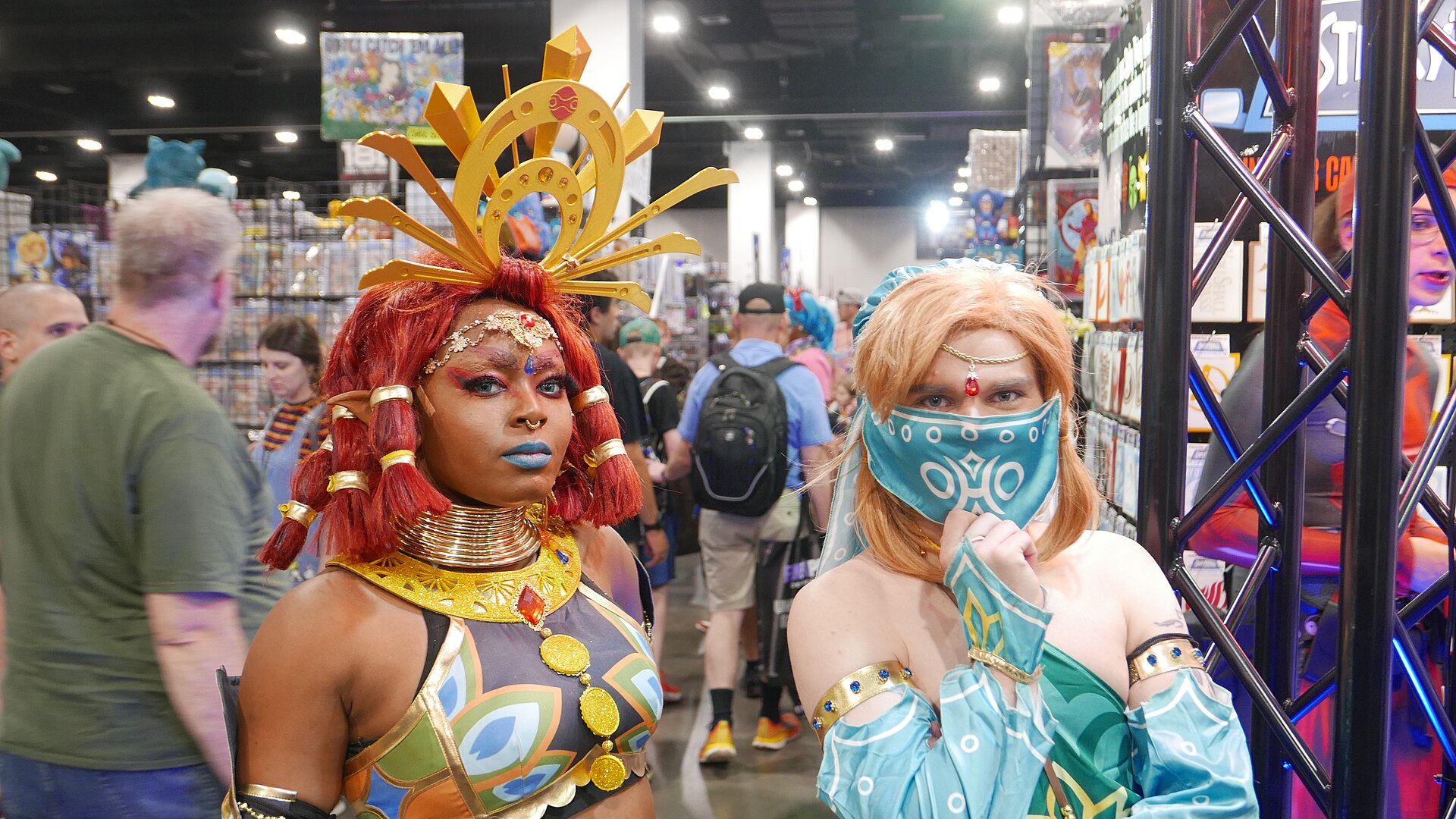
Fans dressed as Urbosa and Link at Fan Expo Denver on July 5, 2024. This photo does not depict gameplay. Archive photo by dmgice (CC BY 2.0).
Nintendo’s remake of The Legend of Zelda: Ocarina of Time is out for Nintendo Switch 2. The U.S. launch was Nov. 5 at a listed regular price of $59.99. What makes it a remake becomes apparent before Link leaves his childhood home: Nintendo has rebuilt the presentation, added voiced cutscenes and changed how the player moves the camera. The adventure still sends Link across two versions of Hyrule, years apart. For someone deciding between the remake and the original, that shared story is only the beginning of the comparison. Nintendo’s U.S. launch announcement Official Switch 2 game listing
This release also brings two practical questions left over from the previews. The first is what features require the launch update. Nintendo’s support notes say version 1.1.1 adds Zelda Notes support and fixes several issues. The second is whether the remake uses Nvidia’s DLSS. The version 1.0.0 license screen reproduced by Output Lag lists AMD’s FidelityFX Super Resolution 1.0. That is a meaningful clue about the game’s software, with limits on what it establishes about the picture a player will actually see. Nintendo’s version 1.1.1 notes Published images of the game’s license notices Taken Social’s prelaunch reporting
What the Ocarina of Time remake changes
The game preserves the broad outline of the 1998 adventure. Link leaves Kokiri Forest with Navi, meets Princess Zelda and works his way through dungeons while trying to stop Ganondorf. As young Link he uses equipment such as the Fairy Slingshot. Adult Link can wield the Master Sword and has a different set of tools. A place that seemed to have one purpose in childhood can become a different kind of problem later. That is why the adventure is still distinct even among other games set in Hyrule: traveling through time changes the places a player is learning to navigate. Nintendo’s guide to Link and the world of Hyrule
The camera is one of the more consequential changes. A puzzle in a three-dimensional room asks the player to see the same object from different positions. The camera can make that satisfying or difficult for reasons that have little to do with the design of the puzzle. Nintendo says it reworked the camera and movement for the remake. It also gives players a choice between button and motion aiming for equipment such as the Fairy Bow and Hookshot. For a player new to the game, those options can make a room easier to read before they change anything about how to solve it. Nintendo’s description of the rebuilt controls The product guide to aiming options
Producer Eiji Aonuma’s account of the original explains why changing the camera deserves care. The Nintendo 64 team was still deciding how to make a close fight readable in three dimensions. Its Z-targeting let Link and the camera stay oriented around an enemy so the player could move relative to that target. The idea helped make combat less about continually correcting the view. It survived into later Zelda games. A remake can offer finer control while preserving that original relationship between the character, the enemy and the space around them. Aonuma and Hidemaro Fujibayashi on the original game’s design
Sound has changed too. Nintendo describes voiced cutscenes, expanded dialogue and a symphonic score. Aonuma recalled that, late in production on the 1998 game, he asked composer Koji Kondo to rethink a piece of music for the final boss. Kondo returned with the replacement the next day. The anecdote helps explain why the music is such a delicate part of the remake. The original cues were written to shape what a player felt in a particular room or fight. An orchestral arrangement can give those cues a different scale while leaving the underlying melody recognizable. The developers’ account of Koji Kondo’s score Nintendo on voice and music in the remake
The remake also gives players reasons to look around after they recognize a location. Nintendo describes fairy thoughts scattered through Hyrule that provide additional bits of lore. The Hall of Fallen Foes offers a way to face powerful enemies again. Those changes serve different interests. One rewards a player who wants to see what a familiar corner has to say; the other gives someone a reason to return to the game’s combat after clearing a challenge. Neither replaces the central progression of finding a tool in one area and realizing it changes what is possible in another. Nintendo’s launch guide to additional activities
The designers kept one important boundary around those additions. In Nintendo’s interviews, the team explained that it retained separate maps for areas instead of joining all of Hyrule into a seamless world. Stepping out of Kokiri Forest into Hyrule Field still has a defined moment of arrival. The artists also varied the level of detail between accessible ground and distant scenery to help signal where Link could go. That makes the remake a different proposition from a new Zelda designed around unrestricted travel. It is using new visual tools to preserve a particular order of discovery. Nintendo developers on the remake’s separate areas
Does Zelda: Ocarina of Time on Switch 2 use DLSS?
Nintendo’s U.S. launch announcement and product page do not advertise DLSS. The game's version 1.0.0 legal notices, shown in images published by Output Lag, list FSR 1.0 and SMAA anti-aliasing. FSR 1.0 is an AMD technology, even though the Switch 2 uses a processor from Nvidia. A technology’s name in a legal notice can document that it was included. It does not identify every setting in which it runs, which parts of the image it affects or how Nintendo configured it at release. Treating the license screen as a complete performance test would go beyond the evidence. The version 1.0.0 notices Nintendo’s advertised features
AMD describes the first version of FidelityFX Super Resolution as a spatial upscaler. It works from the current frame, enlarging it and applying sharpening without needing motion information from earlier frames. The distinction is useful because a number printed next to a television resolution describes the final output. It does not tell the viewer the resolution at which the game built the picture before scaling. Nintendo’s listing says the remake supports HDR and variable refresh rate on compatible televisions. Those are separate display features, and they do not disclose the game’s internal rendering resolution or confirm a particular scaling method. AMD’s technical explanation of FSR 1 Nintendo’s display compatibility notes
The better question for a player is how the game looks during ordinary play on the display they use. Fine patterns, moving foliage or fences may reveal artifacts that are hard to see in a still image. Handheld and television play also put the same details at different viewing distances. That is why controlled footage, with the game version and display mode identified, would add more than a new round of guesses about a logo in the credits. Nintendo publishes supported play modes, but its official launch material does not put a frame rate and rendering resolution against each one. Supported television, tabletop and handheld modes
What to check before starting on Switch 2
The store lists the game at 24.9 GB, with support for TV, tabletop and handheld play and one player on a system. If you already bought it, Nintendo advises connecting the console to the internet and checking that the software is current. From the home menu, highlight the game, press plus or minus and check the version beneath the title. Choose Software Update and then Over the Internet to request an update manually. The Nov. 4 update enables Zelda Notes and preserves existing save data, according to Nintendo. Official storage and play information Nintendo’s instructions for checking and applying the update
Zelda Notes is in the Nintendo Switch App for supported phones and tablets. It offers location challenges, a record of the player’s activity and a quiz. Nintendo’s launch material also describes an app version of the ocarina for playing or sharing music. The game has its own musical option on Switch 2: players can use the console’s microphone to play the instrument by humming or playing an instrument into it. These features reward curiosity about how the music works. The main adventure is built around learning when a song is the answer to something Link finds in the world. Nintendo’s guide to music and Zelda Notes Zelda Notes and its requirements
Which version of Ocarina of Time should you play?
The Nintendo 64 original is available through the Nintendo 64 library for Nintendo Switch Online + Expansion Pack subscribers. That is the option for seeing how the 1998 game looked and played, including the original presentation and controls. There is also the separate 2011 release Ocarina of Time 3D for Nintendo 3DS. People who remember a handheld edition or already have access to the Nintendo 64 library can reasonably think they own a version of the same adventure. The new Switch 2 edition is a distinct purchase and does not run on the original Switch. Nintendo’s guide to the Nintendo 64 release on Switch Online Nintendo’s original 3DS announcement Switch 2 exclusivity
The remake’s price makes more sense if the changes are the parts of the game you want to experience. Its new presentation can be a draw for people coming from the more recent Zelda games or returning after years away. The 1998 version has a different value: it shows how the designers communicated where to look and what to do with fewer tools. First-time players can start with either. Nintendo treats the story as a standalone adventure, so there is no need to play Breath of the Wild, Tears of the Kingdom or another release before starting. Nintendo’s explanation of the standalone story Official options for revisiting the original
After launch, the clearest case for the remake is what Nintendo chose to rebuild around the old design. The camera, performance of the dialogue and music can change how a player reads a scene or room. The central idea, returning to a place as a different version of Link and finding that what you know gives you new options, is still there. If you want that idea as players first encountered it, the Nintendo 64 edition has a clear place. If you want to see what a new team can add while keeping it recognizable, the Switch 2 game is now the version to investigate.